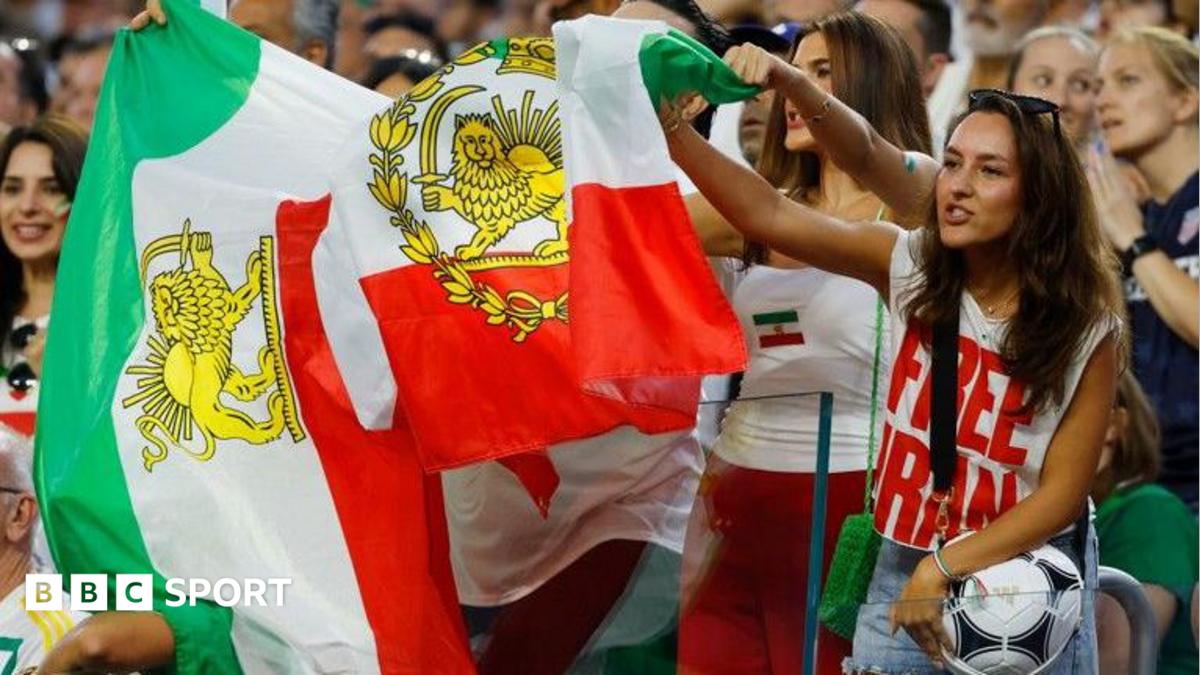
The 2026 FIFA World Cup group stage fixture between Iran and New Zealand at Los Angeles Stadium was billed as a routine international football matchup on paper, but the day was defined far more by deep political divisions among Iranian spectators than the action on the pitch. On the field, Iran fought back twice from falling behind to secure a dramatic 2-2 draw, but outside the stadium and scattered through the stands, stark splits between pro-regime and dissident Iranian fans turned the match into a public stage for long-simmering political tensions.
Outside the arena, hundreds of Iranian diaspora protesters, many of them Iranian-Americans, gathered to demonstrate against Iran’s ruling Islamic Republic and the national team they argue represents the state rather than the Iranian people. The most prominent symbol at the protest was the pre-revolutionary Lion and Sun flag, a widely recognized emblem of opposition to the current Tehran regime that FIFA has banned from stadium grounds as an explicitly political symbol. Despite the ban, the flag was still visible inside the venue, printed on clothing and waved by spectators.
Protesters chanted slogans calling for regime change in Iran and rejected the national team as a representative of the ruling government. “Mullahs’ team is not my team,” protesters chanted, before breaking into the pre-revolutionary Iranian national anthem. One young protester summed up the anthem’s meaning to the crowd simply: “It means freedom and pride.” Outside the stadium, many activists linked their protest to ongoing human rights abuses in Iran, with one protester hanging a makeshift noose around his neck to protest the execution of dissidents in the country, and others arguing that recent diplomatic talks between Washington and Tehran cannot normalize the violence carried out by the Iranian regime against its own people.
The divisions that played out outside the stadium only continued inside the stands, where spectators waved both the official Islamic Republic flag and the dissident Lion and Sun flag, all clad in Iran’s national team colors. This split between competing visions of Iranian identity created an impossible pressure for the Iranian squad, which has long maintained that football should be a unifying force rather than a political platform. Striker Mehdi Taremi clarified the team’s position ahead of the match, stating the squad plays for all Iranians both inside the country and in the diaspora, and that the team does not seek to engage in partisan politics.
The split among fans left many Iranian-Americans in attendance caught between conflicting loyalties. “It’s complicated,” explained Samaneh, an Iranian-American who has lived in the U.S. for a decade. “I’m here to support Iran, not the regime. I miss my country.” Samaneh added that she still cried when the official national anthem played, and that ongoing travel restrictions imposed by the Trump administration have left her mother stranded in Iran, leaving her constantly worried about her family and unable to return home to visit. Even when New Zealand scored to take the lead during the match, some anti-regime spectators were captured celebrating the goal, highlighting how deeply politics had infiltrated the contest.
Other fans argued for a clear separation between the national team and the ruling government, saying football should remain a space to bring people together across political divides. Mostafa, an Iranian-American living in the U.S., said that “Soccer is about friendship, cultural connections and putting politics aside.” Pourmand, a lifelong Iran fan who has attended the past two World Cups in Qatar and Russia and traveled from San Diego to the team’s training camp in Tijuana, echoed this view. “The people of Iran are represented by these players,” he said. “They’re here to show we’re worthy of being here – a message of friendship and human values.” For other fans like Elika, supporting the team is tied to personal connection rather than politics: she attended the match in honor of her late father, who shared a love of watching Iran compete at the World Cup, and said “I felt compelled to come in honour of my dad, and in honour of Iranians who just want peace and the chance to enjoy a game like this.”
Even before the match kicked off, politics had already disrupted Iran’s World Cup campaign. Visa issues forced the team to relocate its pre-tournament training base from Arizona to Tijuana, Mexico, forcing players to cross the border for matches in the U.S. while staying in Mexico. While a recent ceasefire agreement between the U.S. and Iran has lowered fears of open military escalation between the two nations, underlying tensions remain high, and those tensions spilled directly into the World Cup fixture in Los Angeles.
After the final whistle, the day’s events made one fact clear: despite the Iranian team’s stated goal of uniting all Iranians through football, deep political divisions within the global Iranian community have made that unity impossible to achieve at this 2026 World Cup. Outside the stadium, it was clear that for this community, separating football from politics was no longer an option.