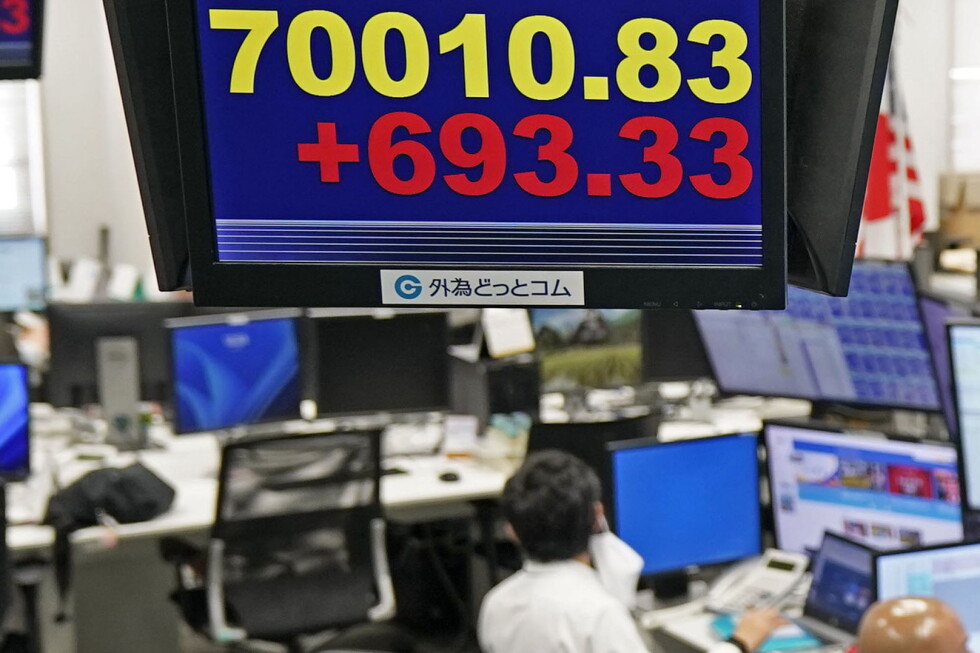
In a historic trading session on Tuesday, most Asian equity markets logged gains, with Japan’s benchmark Nikkei 225 briefly crossing the 70,000 threshold for the first time ever before paring its early advances. The milestone came moments after the Bank of Japan (BOJ) announced it would lift its key interest rate by a quarter percentage point to 1%, bringing borrowing costs in the country to their highest level in 30 years.
By mid-afternoon Tokyo trading, the Nikkei 225 held onto moderate gains, rising 0.6% to settle at 69,713.05. South Korea’s Kospi outperformed regional peers, jumping 2.1% to push further into uncharted record territory at 8,721.64. Mainland China’s Shanghai Composite inched up less than 0.1% to 4,100.53, while Taiwan’s Taiex added 0.6% and India’s Sensex gained 0.5%. The only major losses in the region were recorded in Australia and Hong Kong: Australia’s S&P/ASX 200 slipped 0.3% to 8,892.10, and Hong Kong’s Hang Seng dropped 1.3% to 24,533.35.
The positive momentum across Asian markets followed a broad global rally on Monday, triggered by news that the United States and Iran had reached a tentative agreement to restore steady global crude oil exports. The deal raised hopes that shipping through the Strait of Hormuz, a critical chokepoint that supplies much of Asia’s oil imports, will soon reopen. On Monday, Wall Street posted strong gains: the S&P 500 climbed 1.7%, the Dow Jones Industrial Average gained 0.9% to hit a new all-time high, and the Nasdaq composite surged 3.1%.
International benchmark Brent crude fell 4.8% on Monday in response to the deal, and prices continued to trend downward early Tuesday. By early Asian trading, Brent crude slipped 24 cents to $82.93 per barrel, while U.S. benchmark crude fell 9 cents to $80.66 per barrel. Oil prices have fallen sharply from triple-digit levels recorded just a few weeks ago, when geopolitical tensions pushed costs up; before the recent conflict, crude traded at roughly $70 per barrel.
While the market has reacted positively to the tentative agreement, many energy analysts have urged caution, noting that multiple core issues remain unresolved. Negotiations between the two parties are set to continue over the next 60 days. Even if the Strait of Hormuz reopens as scheduled on Friday, industry experts warn it will likely take several months for global energy supply chains to return to full operational capacity.
On Wall Street Monday, artificial intelligence (AI)-focused stocks led the market rally. Micron Technology jumped 10.8%, Advanced Micro Devices gained 7%, and Nvidia rose 3.5% — the largest single contribution to the S&P 500’s gain, as the AI chipmaker holds the title of the most valuable company on Wall Street, giving it outsized weight in the index. SpaceX, Elon Musk’s aerospace firm that also controls AI startup xAI, rose 19.6% in just its second day of public trading on U.S. exchanges.
In the bond market, U.S. Treasury yields edged lower, as investors bet that cooling oil prices will reduce pressure on central banks to implement further interest rate hikes. The yield on the 10-year Treasury slipped to 4.47%, down from 4.48% recorded late last week. In currency markets, the U.S. dollar held nearly steady against the Japanese yen early Tuesday, trading at 160.33 yen, while the euro dipped slightly to $1.1580, down from $1.1592 in previous trading.