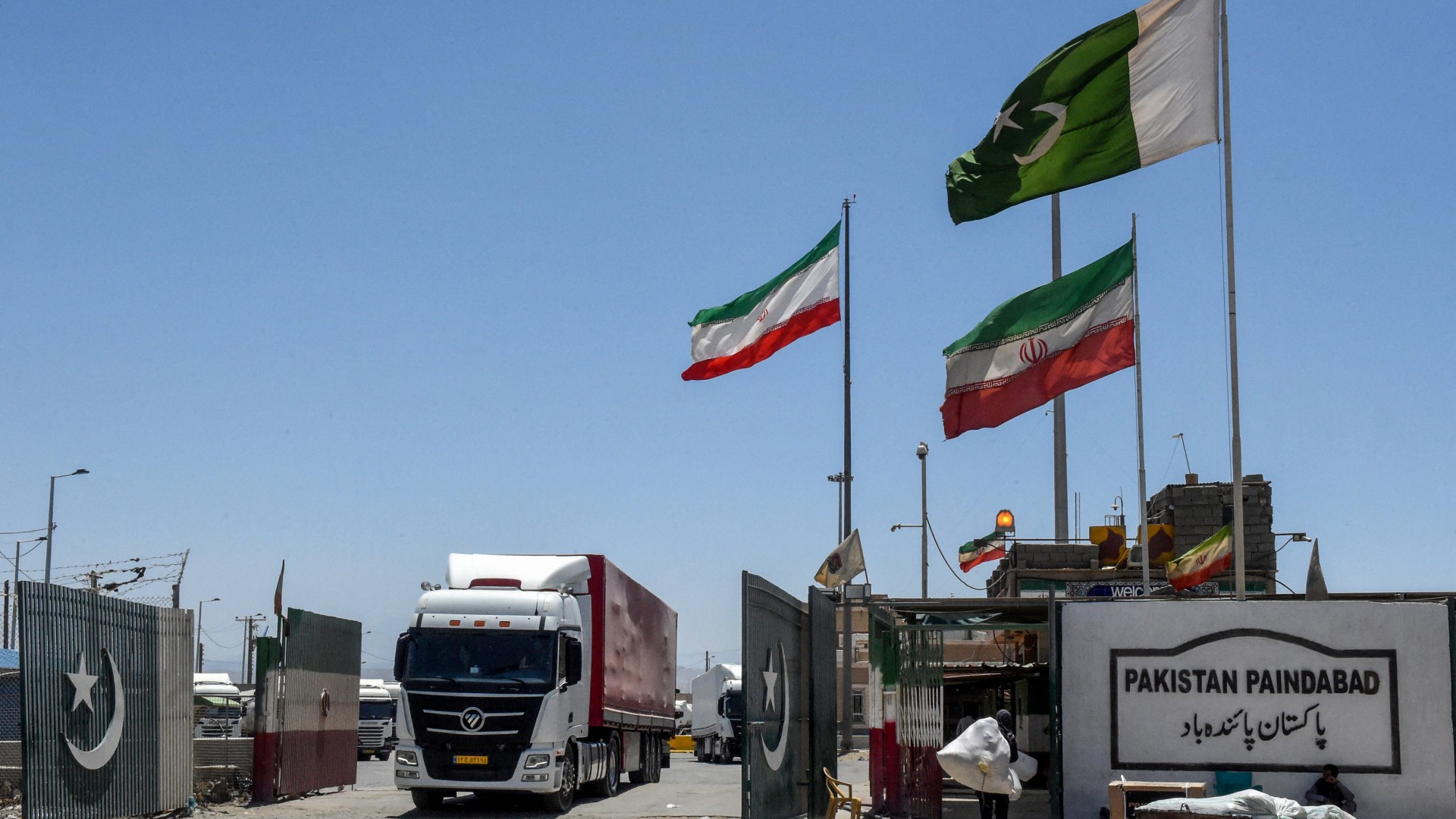
Facing escalating US naval pressure that has crippled its maritime access to the Arabian Gulf and Persian Gulf, Iran has pivoted eastward, breathing new life into a decades-dormant overland trade corridor project with Pakistan that offers a critical alternative to blockaded sea routes. Now in its fifth week, the US blockade has thrown Iran’s regional trade into disarray: thousands of containers bound for the Islamic Republic have been stranded at Pakistan’s Karachi Port, war-risk insurance premiums for shipping passing through the Strait of Hormuz have skyrocketed, and most major carriers have suspended Iran-bound voyages entirely.
In late April, just days after a second round of US-Iran negotiations collapsed, Pakistan’s Ministry of Commerce issued a little-noticed regulatory order, SRO 691, formally designating six new transit corridors that allow third-party cargo bound for Iran to travel overland across Pakistani territory from Pakistani ports. The move revives a bilateral road transport agreement first signed by the two nations in 2005 that sat idle for nearly 20 years, connecting Pakistan’s three major deep-water ports – Karachi, Port Qasim, and the China-backed Gwadar Port – to two Iranian border crossings in Balochistan: Gabd and Taftan. The shortest route, linking Gwadar to Gabd, cuts travel time to the border to just two to three hours, down from 18 hours over the route from Karachi.
For years, Tehran refused to move forward with the project out of concern that expanding activity at Gwadar would draw trade away from Chabahar, Iran’s own Indian-funded deep-water port on the Gulf of Oman. But that strategic calculation shifted dramatically after the outbreak of regional conflict and the imposition of the US naval blockade, which left Chabahar exposed to growing instability. The urgency of the project was underscored by the timing of Iranian Foreign Minister Abbas Araghchi’s high-profile visit to Islamabad, where he met with Pakistani Prime Minister Shehbaz Sharif and Army Chief Asim Munir just as the corridor order was announced.
Beyond providing immediate relief for Iran’s import crunch, the corridors open a new long-term pathway for regional trade extending all the way to Central Asia. Trial shipments, including a refrigerated cargo of meat bound for Uzbekistan, have already traversed the route, with cargo moving north from the Iranian border through Iran’s domestic road network to Central Asian markets. Analysts note that the corridor exposes a key limitation of the US maritime blockade: goods shipped from China and other major trade partners to Pakistan can be unloaded outside Iranian jurisdiction and transported overland, bypassing blockaded Iranian waters and the Strait of Hormuz entirely. Currently, Tehran is increasingly relying on a network of alternate overland and maritime routes through Pakistan, Turkey, the Caucasus, and the Caspian Sea to keep import flows moving.
The arrangement operates in a legally ambiguous space: Pakistan does not formally enforce US sanctions on Iran, and existing US sanctions frameworks allow for limited non-US trade with Iran as long as transactions avoid explicitly sanctioned entities. To date, the White House has not issued any formal public objection to the corridor; when asked about the project, US President Donald Trump only stated he “knows everything about it” without further elaboration.
Analysts emphasize that the new corridors are an adaptive response to wartime pressure, not a fundamental fix for Iran’s deep-seated economic challenges under sanctions. “These land routes are less a major economic transformation for Iran than a form of economic breathing space under pressure,” explained Mostafa Modabber, a South Asia-based analyst. Fatemeh Aman, an independent specialist on Iran-South Asia relations, echoed that assessment, noting that “land routes cannot match the scale, speed or profitability of maritime trade. They may reduce vulnerability at the margins, but they are unlikely to fundamentally change Iran’s broader economic challenges under sanctions and conflict conditions.”
The project also faces significant practical and political obstacles. Pakistan grapples with underdeveloped transport infrastructure in Balochistan, pervasive corruption within customs agencies, persistent insecurity in border regions, and widespread influence from informal smuggling networks. Islamabad also walks a delicate diplomatic tightrope, balancing its economic interests with Iran against its ties to Washington, Riyadh, and other Gulf states, and remains hesitant to openly confront the US should Washington choose to intensify pressure on Iran-related trade. Even after the corridor’s formal launch, many stranded containers in Karachi continue to move slowly, as Pakistani banks and logistics firms remain wary of potential US secondary sanctions.
Despite these challenges, the corridor carries broader strategic significance for regional trade architecture. It links Iran directly to two major integrated trade networks: the China-Pakistan Economic Corridor (CPEC) and the International North-South Transport Corridor (INSTC) that connects Iran to Russia and India. For China, Iran’s largest remaining major trading partner, the route offers a way to sustain critical supply chains without full dependence on maritime lanes vulnerable to US naval interdiction. For Pakistan, the project advances its long-held goal of positioning itself as a key transit hub connecting South Asia to Central Asia and the Middle East, while also boosting the commercial viability of Gwadar Port, the centerpiece of CPEC.
The reactivation of the Iran-Pakistan corridors reflects a larger ongoing shift in regional trade patterns as traditional maritime lifelines through the Strait of Hormuz become increasingly contested. What began as a emergency workaround for a five-week blockade has emerged as a visible signal of how quickly regional powers are reworking trade routes to adapt to rising geopolitical tension.