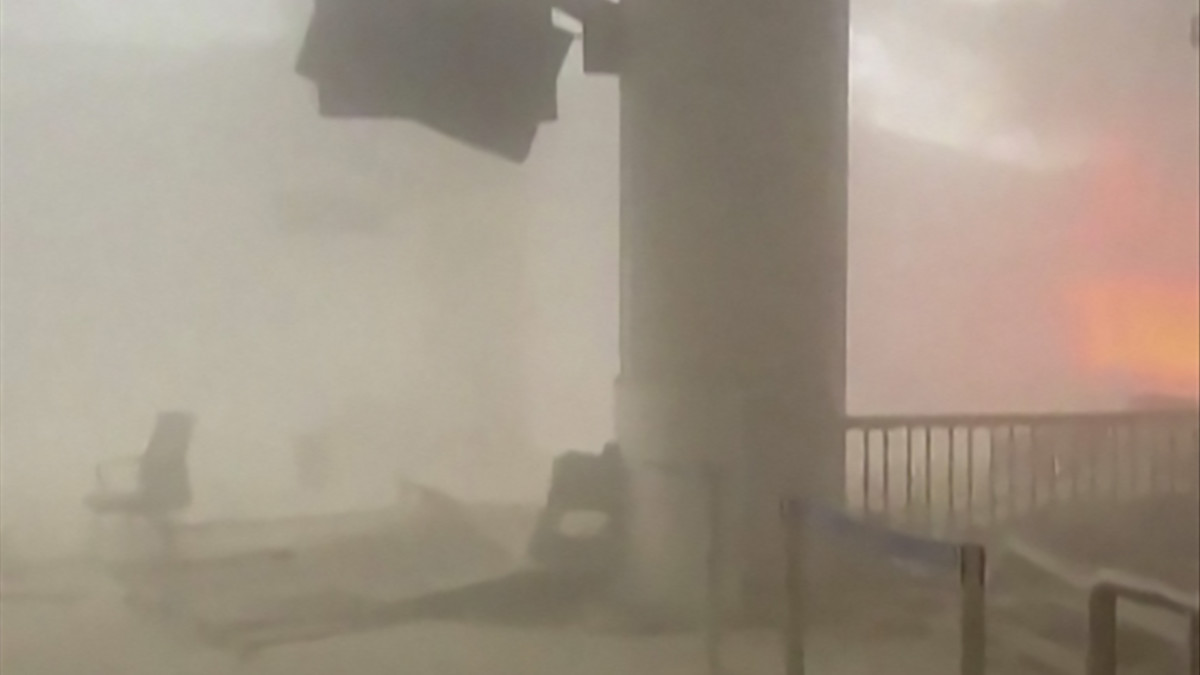
A dangerous escalation of conflict between the United States and Iran has left the small Gulf nation of Kuwait reeling from deadly missile and drone attacks, pushing an already fragile ceasefire to the breaking point. On Tuesday night, Iranian forces launched a heavy barrage of projectiles that targeted Kuwait’s main airport, leaving at least one person dead and 63 others injured. Graphic footage from the scene confirms widespread destruction: Terminal 1 is engulfed in active fire, its partial roof has collapsed, and thick plumes of dark smoke have blanketed the airport area.
Kuwaiti officials have issued a sharp denial of Iranian claims that the country allowed the U.S. to use its airspace to launch pre-emptive strikes against Iran. In an official briefing, Kuwaiti Defense Ministry spokesperson Brigadier General Saud al-Otayan publicly denounced the assault as “criminal Iranian aggression.” In a coordinated diplomatic response, Kuwait summoned Iran’s acting chargé d’affaires to formally protest the attack and ordered two Iranian embassy personnel to leave the country within a 24-hour window.
The Islamic Revolutionary Guard Corps (IRGC) confirmed its responsibility for the assault in an official statement posted to its Telegram channel, noting that the strikes targeted two key sites: Ali Al Salem Air Base, a major facility that hosts U.S. military helicopters, and the U.S. Fifth Fleet headquarters based in neighboring Bahrain. The attack followed a chain of escalating tit-for-tat strikes that began when U.S. forces targeted an empty oil tanker Tehran was reportedly attempting to bring to one of its ports. This action came amid a broader U.S. naval blockade on Iranian shipping, imposed after Iran took control of key transit areas in the Strait of Hormuz and began demanding new transit fees for commercial vessels passing through the strategic waterway. U.S. officials say Iran first opened fire on American sailors after the tanker strike, prompting the U.S. to launch its own counterstrikes on Iran’s Qeshm Island. Following the Iranian assault on Kuwait and Bahrain, U.S. military officials announced they had “successfully defeated” the wave of missile and drone attacks and reaffirmed their counterstrikes on Qeshm Island.
This latest attack marks one of the most severe strikes on Kuwait since Iran launched a series of retaliatory assaults against Gulf states earlier this year, in response to a joint U.S.-Israeli offensive that began on February 28. Kuwait currently hosts approximately 13,500 U.S. troops, one of the largest American military deployments in the entire Gulf region. Earlier this year, Kuwait and other Gulf Cooperation Council states pushed the U.S. to avoid military confrontation with Iran, but regional alliances have shifted rapidly in recent months: the United Arab Emirates has launched dozens of its own strikes against Iran, while Saudi Arabia initially granted the U.S. expanded access to its military bases before shifting its stance to back Pakistani-mediated diplomatic negotiations.
The latest flare-up has thrown already shaky ceasefire talks between Washington and Tehran into further disarray. U.S. President Donald Trump has repeatedly claimed the two sides are close to reaching a new negotiated deal, but Iranian officials have consistently denied any willingness to compromise on either their nuclear program or their demands to impose transit fees in the Strait of Hormuz. Just this week, Iran’s official Tasnim News Agency confirmed Tehran has cut off all direct contact with U.S. negotiators, though Trump insisted Tuesday that discussions remain ongoing. Talks have stalled over two core sticking points: the reopening of the Strait of Hormuz to unrestricted commercial traffic and the full sanctions relief Iran has demanded to extend the current fragile ceasefire.
Appearing before the Senate Foreign Relations Committee on Tuesday, U.S. Secretary of State Marco Rubio doubled down on Washington’s hardline stance, saying Iran will only qualify for sanctions relief if it completely abandons its nuclear enrichment program. “Iran is being sanctioned because they’ve highly enriched uranium. Iran is being sanctioned because of their nuclear activities; if they agree to give up those things, there will be sanctions relief,” Rubio told lawmakers. “They have to agree on negotiating severe and long-term limitations and/or cancellation of enrichment activity.”
Rubio claimed Iranian negotiators have recently begun discussing aspects of their nuclear program that were previously off the table, but he offered no concrete details to support the assertion. Iranian officials flatly rejected the claim Friday, stating explicitly that “no negotiations” are currently underway over the country’s nuclear program. Rubio’s comments also make clear the U.S. has no immediate plans to release the billions of dollars in frozen Iranian assets that Tehran has made a core requirement for any permanent ceasefire agreement.
Caught between competing regional and global powers, Kuwait finds itself in an increasingly vulnerable position. With a total population of around five million, the country lacks the extensive military capabilities of larger Gulf states like Saudi Arabia and the UAE, and has less diplomatic leverage than neighboring Qatar to de-escalate tensions. As fighting reignites along the Gulf, this small nation has become an unintended casualty of the escalating standoff between the U.S. and Iran.