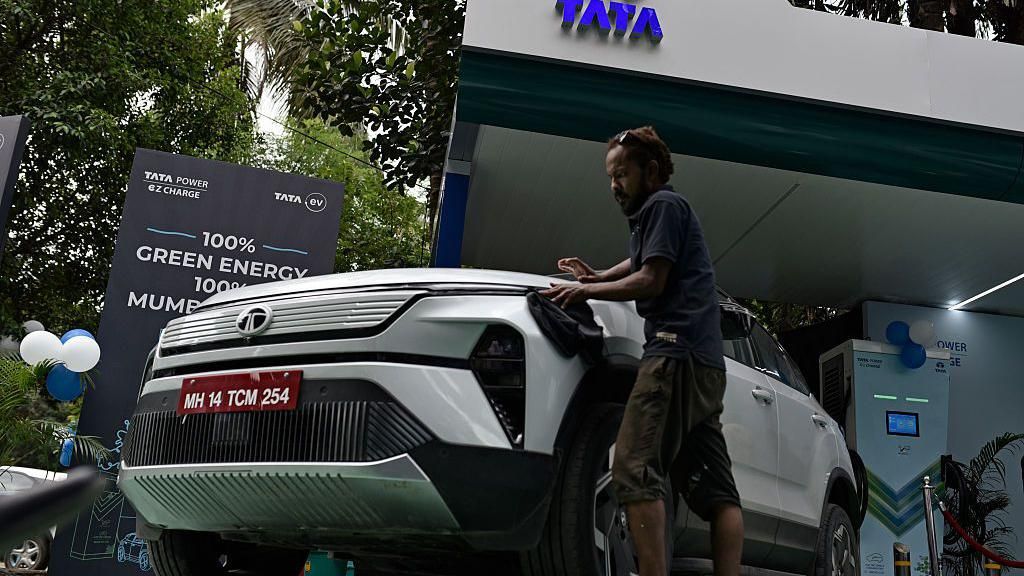
Against a backdrop of global energy volatility driven by the ongoing Middle East conflict, India’s electric vehicle (EV) market appears to have crossed a critical milestone that signals a potential shift toward mainstream adoption, according to industry analysts and new market data. For the 12-month period ending March 2026, India’s electric car market expanded by a robust 25% year-over-year, and earlier this year, EVs crossed the 5% penetration threshold in the country’s overall passenger vehicle segment — an industry benchmark widely viewed as the tipping point for mass consumer adoption.
India’s automobile dealers association described the ongoing shift as more than a preliminary directional trend, stating in a recent release that the transition has now become substantive. Growth is particularly pronounced in higher-priced passenger vehicle segments, where vehicles retailing above 1 million rupees ($10,481) now see one out of every 10 units sold as electric. The trend is even more established in smaller vehicle categories: electric three-wheelers already make up more than 30% of all segment sales, while electric two-wheelers capture a 15% market share.
The sharp recent spike in consumer interest has been accelerated by immediate external pressures, most notably the Middle East conflict that has sent global crude oil prices soaring by 50% in recent months. As a country that relies on imports for nearly 90% of its total oil demand, India has been forced to raise retail fuel prices after four years of relative price stability from state-run fuel retailers. Prime Minister Narendra Modi has even publicly urged Indian citizens to adopt carpooling, prioritize public transit, and embrace work-from-home arrangements to conserve domestic fuel supplies. Japanese financial brokerage Nomura notes that this prolonged market uncertainty, paired with persistently elevated fuel costs, has created an incremental, powerful incentive for Indian consumers to consider switching to EVs.
Beyond these short-term triggers, a set of long-term structural policy shifts are also pushing the transition forward. The most impactful upcoming change is the CAFE-3 regulatory framework, scheduled to take effect in April 2027 and remain in force through March 2032. According to analysts Venugopal Garre and Param Shah of global investment firm Bernstein, the new rules meaningfully tighten emissions standards and will likely drive a far more visible acceleration in EV adoption across the country.
Unlike India’s current regulatory regime, which pairs EV incentives with non-binding emissions targets and unenforced penalties, CAFE-3 will make compliance requirements legally binding. The draft rules mandate a 33% reduction in new passenger vehicle carbon emissions by 2032, cutting the allowable average from 113g/km to 76g/km. Bernstein also points out that unlike previous regulatory cycles, where roughly $1 billion in accumulated fines against eight major original equipment manufacturers (OEMs) were never collected, penalties under CAFE-3 are expected to be enforced — creating a strong financial incentive for automakers to ramp up their EV lineups.
Local policy action is also reinforcing national trends. Delhi, India’s capital and one of the country’s most chronically air-polluted urban centers, recently released an ambitious draft policy that proposes phasing out conventional internal combustion engine (ICE) vehicles entirely, and halting new registrations of ICE-powered two-wheelers and three-wheelers as early as 2027.
Another key tailwind for the market is a wave of upcoming new model launches, which analysts say will expand consumer choice across all price points. Nomura projects that EV penetration in India’s passenger vehicle market will reach 9% by 2030, driven by this healthy product pipeline. In the two-wheeler segment, a growing slate of new affordable models is expected to boost demand, while three-wheelers are projected to see EVs outsell ICE variants by 2030, a shift that will drastically speed up the overall national transition.
Nomura’s analysis notes that India’s EV adoption is currently concentrated in high-utilization, cost-sensitive segments such as three-wheelers, a pattern that suggests the adoption curve will be non-linear. As production scales to improve affordability, national charging networks expand, and policy support strengthens, penetration in passenger vehicles and two-wheelers will accelerate rapidly in coming years, the firm predicts.
Despite these encouraging indicators, India still lags far behind major global economies in overall EV adoption. Nomura data underscores the gap: China saw passenger EV penetration surge from just 5.7% in 2020 to 53.3% in 2026, while the European Union stands at 20% penetration and the United States at 8%.
One of the most pressing barriers to faster growth remains the severe shortage of public charging infrastructure. While the number of public charging stations has grown fivefold from 2,000 to more than 10,000 over the past three years, deployment is extremely uneven across the country: just four of India’s 28 states host more than 50% of all existing public chargers. The gap with leading markets is staggering: China has deployed more than 20 million public charging points nationwide, compared to India’s current 10,000. Nomura notes that persistent infrastructure gaps have kept range anxiety — consumer fear of running out of battery power mid-journey — one of the top deterrents for potential EV buyers.
Gaps in India’s domestic battery and component supply chain represent another major long-term challenge. India relies almost entirely on global imports for the rare earth minerals and processed battery materials required for EV production. While the Indian government has announced plans to scale up domestic production, global processing remains overwhelmingly dominated by China: KPMG data shows China controls 70-80% of global lithium and cobalt refining, and nearly 90% of all rare earth separation capacity. This dependency creates significant geopolitical risk for India’s EV transition, and could slow rollout timelines and erode cost competitiveness, the global consultancy notes.
Building a fully integrated domestic supply chain, from mineral mining to finished battery pack and magnet manufacturing, can take more than a decade to complete, meaning there are no quick fixes to this challenge. KPMG argues that India will need to pair short-term supply security measures with long-term investments to develop domestic manufacturing capabilities to address the gap.
For consumers and automakers alike, the timely finalization and implementation of the CAFE-3 standards will be the most critical near-term driver of growth, according to Amitabh Kant, former CEO of Niti Aayog, the Indian government’s leading policy think tank. Writing in the *Indian Express*, Kant noted that while the standards have been under discussion for three years, they remain tentative, though a final draft is expected to be released imminently. In the absence of clear regulatory certainty, automakers defer major investment decisions, supply chain development slows, and the broader EV ecosystem remains stuck in uncertainty, Kant explained. What will ultimately drive widespread adoption, he added, is consistent, predictable policy clarity.