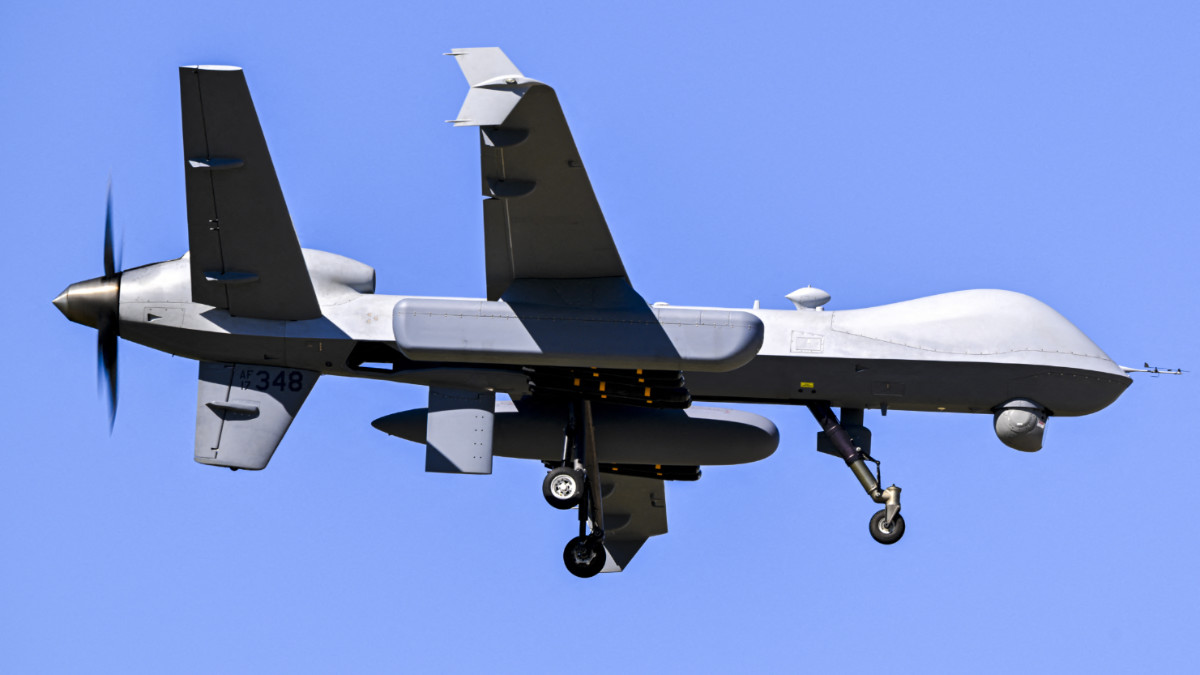
New reporting from Bloomberg has shed fresh light on the heavy material costs of the ongoing conflict between the United States and Iran, revealing that Tehran has destroyed roughly $1 billion worth of American MQ-9 Reaper drones – equal to approximately 20% of the U.S. military’s pre-war inventory of the advanced unmanned aerial vehicles.
According to Bloomberg’s Friday report, the Iranian military has taken out these high-tech assets in two primary ways: many were shot down mid-flight during surveillance or strike missions over Iranian territory, while others were destroyed on the ground at U.S. military installations across the Gulf region when Tehran launched targeted attacks on those bases.
The MQ-9 Reaper is a dual-capacity unmanned aerial system, designed to conduct long-endurance intelligence, surveillance and reconnaissance missions while also being outfitted to carry offensive ordnance – most commonly Hellfire air-to-surface missiles and Joint Direct Attack Munition precision-guided bombs. Bloomberg’s estimate of up to 30 lost Reapers exceeds the 24-drone loss figure published earlier this month by the nonpartisan Congressional Research Service, marking a higher toll than previously acknowledged by U.S. government analyses.
The $1 billion loss from destroyed Reapers adds to the already staggering cumulative cost of U.S. military operations against Iran. Back in May, a senior Pentagon official told Reuters that total war-related spending had already reached $29 billion, a figure that will grow with this latest accounting of lost equipment. While the U.S. military is currently phasing the MQ-9 out of its own active fleet as it develops next-generation unmanned systems, original equipment manufacturer General Atomics still continues production of the Reaper for export to foreign allied militaries.
Iran’s proven track record of downing the sophisticated Reaper drones also undermines previous claims from former U.S. President Donald Trump, who asserted that Iran’s air defense capabilities had been completely “obliterated” by U.S. military strikes. Instead, the repeated successes against U.S. drones demonstrates that Tehran has maintained and expanded functional air defense networks that can threaten high-value American aircraft.
This week, an unnamed U.S. official speaking to The New York Times raised additional security concerns: the report claims Iranian military commanders have likely mapped out consistent flight patterns used by U.S. fighter jets and bombers operating near Iranian airspace, a development that increases the operational risks to U.S. aircrews if any future U.S. administration chooses to resume large-scale offensive operations against Iran.
Tensions peaked in the weeks before the fragile April ceasefire between the two nations: just days before the truce took effect, Iranian air defenses shot down a U.S. F-15E Strike Eagle fighter jet, triggering a large-scale urgent search and recovery operation to extract the downed pilots. Military analysts note that if Iranian forces had captured one or more of these pilots alive, Tehran would have held enormous leverage to pressure Washington in subsequent negotiations.
The New York Times further reported that Russia may have provided critical intelligence support to Iran to help map U.S. flight patterns, allowing Iran to better position its military and air defense assets to intercept American aircraft. This collaboration aligns with the long-standing security partnership between Moscow and Tehran that has been widely documented for years. Multiple U.S. media outlets have previously confirmed that Russia has aided Iran by sharing satellite imagery of U.S. warship movements and positions of American military personnel across the Middle East.
Today, Iran’s integrated air defense network combines domestically produced interception systems with advanced hardware sourced from both Russia and China. Middle East Eye, which first reported that China supplied complete air defense battery systems to Iran after the June 2025 U.S. bombing of three Iranian nuclear sites that brought the conflict to a peak, was the first outlet to break details of Beijing’s military support for Tehran’s air capabilities.