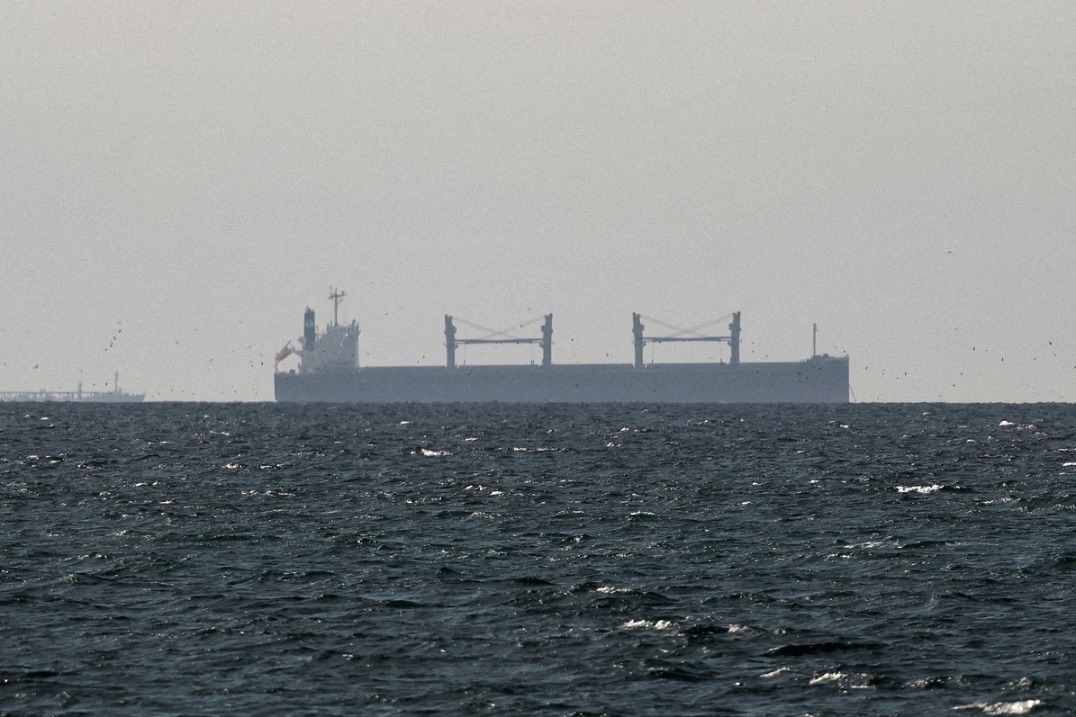
Following the collapse of US-Iran diplomatic negotiations and the implementation of a sweeping US military blockade on all vessels entering or exiting Iranian coastal areas and ports, global maritime shipping faces unprecedented new disruptions at the strategically critical Strait of Hormuz, according to industry experts and global officials.
The blockade officially entered into force on Monday, closing off the narrow waterway that connects the Persian Gulf to the Gulf of Oman and the wider Arabian Sea. US Central Command confirmed that no commercial vessels have successfully passed through the US naval cordon in the first 48 hours of the operation. Despite the escalating tensions, the White House claimed in a televised interview Wednesday that the ongoing conflict in Iran is “very close to over.”
Iran has issued a sharp retaliatory warning in response. The commander of Iran’s joint military command stated Wednesday that the country will shut down all commercial trade activity across the entire Gulf region if the US does not reverse the blockade immediately. Data from the United Kingdom Maritime Trade Operations, a division of the UK Royal Navy, confirms the blockade is enforced by a fleet of at least 15 US warships deployed in the area.
By Monday, the disruption had already stranded an estimated 20,000 seafarers and roughly 1,600 commercial vessels in the Persian Gulf, said Arsenio Dominguez, secretary-general of the International Maritime Organization. The crisis has sparked urgent alarm across global shipping firms, international businesses, and commodity traders, with immediate ripple effects already visible in global energy markets. On Thursday, Brent crude, the global benchmark for oil prices, climbed to $96.32 per barrel, a sharp jump from its pre-conflict average of roughly $70 per barrel.
Mohammad Elahee, a professor of international business at Connecticut’s Quinnipiac University, noted the strait’s outsized role in global energy supplies: “Approximately 20 million barrels of oil, 20 percent of the world’s daily oil supply and one-third of all seaborne oil traded globally, pass through this narrow waterway that is effectively controlled by Iran.” Data from maritime analytics firm Kpler shows Iran exported an average of 1.84 million barrels of crude per day in March 2026, and has hit 1.71 million barrels per day so far in April, up from a 2025 average of 1.68 million barrels per day.
The concept of US-escorted commercial shipping through the strait was previously floated by former US president Donald Trump, but experts warn the plan carries major practical and economic barriers. “The US Navy could, in theory, escort ships through there, but that would be expensive and slow,” explained Robert Kaufmann, an affiliate faculty member of the Boston University Global Development Policy Center.
The United Nations has called on all parties to uphold the longstanding principle of freedom of navigation through the strait. “The secretary-general’s position has been consistent: No one should do anything that harms the freedom of navigation in the Strait of Hormuz,” said Stephane Dujarric, spokesman for the UN secretary-general. “That freedom of navigation is based on international law and years and years of custom.”
Beyond energy markets, the crisis also threatens to upend global food systems, as the strait is a key transit route for global fertilizer trade. Delays and supply uncertainty have already pushed fertilizer prices higher, according to Luis Ribera, an extension economist in the Department of Agricultural Economics at Texas A&M University. “Slower shipments through the Strait of Hormuz make fertilizer prices increase more, both because of the slower shipments and the uncertainty,” Ribera said.
The UN Food and Agriculture Organization has issued a formal warning that the ongoing crisis could drive up global food prices worldwide. William Wilson, a professor of agribusiness and applied economics at North Dakota State University, summarized the widespread risk: “Everything going on in Hormuz is very negative to agriculture — negative for the world economy and for the world food economy in particular.”