For decades, the Eurovision Song Contest’s governing body has insisted that the annual cultural event is strictly apolitical, aiming to unite European artists and audiences through music rather than global conflict. Yet scratch beneath the surface of the glitzy performances and catchy melodies, and politics has been a persistent, defining presence, shaping the event’s history again and again through high-profile controversies rooted in global tensions. One of the most dramatic examples dates back to 1974, when Portugal’s entry *E depois do adeus* was broadcast across the country just as the Carnation Revolution — the uprising that toppled Portugal’s authoritarian dictatorship and cleared the way for independence for its African colonies — was getting underway, turning the song into an accidental revolutionary signal. More recent decades have brought repeated disputes: in 2009, Azerbaijani authorities interrogated 43 citizens who cast votes for neighboring rival Armenia’s entry, while Ukraine and Russia traded barbs for years over Russia’s invasion of Ukrainian territory before Moscow was expelled from the competition entirely in 2022. Today, however, no controversy looms larger than the fierce debate over Israel’s eligibility to compete in the 2026 contest, hosted this year in Vienna, which erupted after the start of Israel’s military campaign in Gaza in October 2023 that has sparked widespread accusations of genocide.
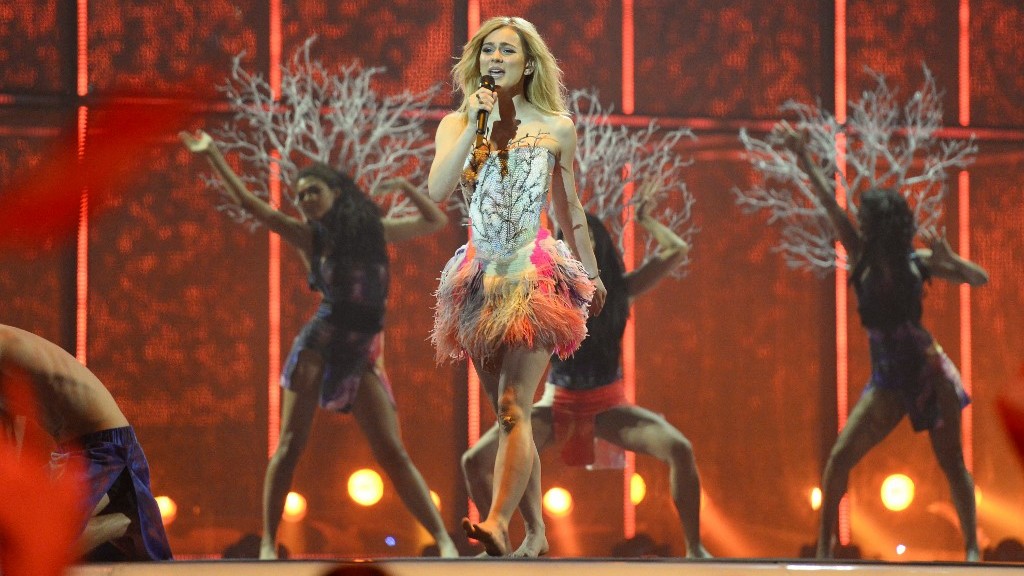
Emmelie de Forest, the Danish singer who won Eurovision in 2013 with her hit *Only Teardrops*, is among the most prominent past winners speaking out against Israel’s inclusion. In an interview with Middle East Eye, de Forest framed her opposition as rooted first and foremost in the devastating humanitarian crisis unfolding in Gaza, where tens of thousands of civilian lives have been lost. “It’s also about what it means when cultural institutions try to completely separate themselves from political reality. I don’t think music exists outside the world around us,” she explained. De Forest is one of more than 1,000 global artists who have signed the *No Music For Genocide* petition, which calls for a widespread boycott of the 2026 contest. The list of signatories includes other high-profile names: 1994 Irish Eurovision winner Charlie McGettigan, as well as global music stars Peter Gabriel, Bjork, Massive Attack, Macklemore, Brian Eno and Mogwai, among others.
While Ireland’s national broadcaster RTE has heeded calls to withdraw from the competition, de Forest’s home country of Denmark remains a participant — a decision she called disappointing, but not unexpected. The singer acknowledged that speaking out has cost her personally: she has cut ties with some friends and put her professional income at risk, but argues that standing by one’s principles requires sacrifice. “sometimes integrity costs something,” she said. “What I find most difficult is the idea that Eurovision can somehow be separated entirely from political reality. I simply don’t believe that is possible anymore. Keeping Israel in the competition is also a political decision.”
The European Broadcasting Union (EBU), which oversees the Eurovision Song Contest, rejected widespread pressure to bar Israel from competing when it ruled in December 2024 that the country would remain eligible for the 2026 event. In response to that decision, Nemo — the non-binary Swiss artist who won the 2024 contest — announced they would return their winner’s trophy, arguing that Israel’s inclusion directly contradicts the core values Eurovision claims to uphold: unity, inclusion and dignity for all people.
McGettigan, the 1994 Irish winner, quickly announced he would follow Nemo’s lead — until he realized he had never received a physical trophy to return. “So let’s say I returned a virtual trophy!” he joked to Middle East Eye. For McGettigan, the campaign to withdraw from Eurovision has been deeply personal: an avid lifelong fan of the contest, he joined pro-Palestinian campaigners in lobbying RTE to pull out of 2026, and his advocacy helped convince the broadcaster to vote to withdraw. “I’m a not a member of any organisation…it’s just me personally, and thankfully, the management at RTE decided after a vote that they weren’t going to take part and that’s admirable, I think,” he said.
McGettigan said he could no longer stay silent after seeing relentless footage of the humanitarian catastrophe in Gaza, where official counts put the Palestinian death toll at more than 72,000, with thousands more still missing and presumed dead under rubble, and the vast majority of the enclave’s infrastructure reduced to ruin. Even after a US-brokered ceasefire took effect in mid-January 2025, hundreds more Palestinians have been killed, just one week before Israel was formally confirmed as a 2026 contestant. McGettigan added that his awareness of the link between Eurovision and Israeli policy dates back to 2018, when Israel won the contest just days after Israeli forces killed 62 Palestinian civilians, including six children, during the peaceful Great March of Return protests in Gaza. “Now if that had happened in our country, and if 62 people had been murdered like that, we certainly wouldn’t be celebrating winning Eurovision,” he noted.
Like de Forest, McGettigan rejects the long-held claim that Eurovision should remain strictly apolitical, pointing to the centuries-long tradition of musicians using their platforms to advance social change and call out injustice. “When you look back at people like Pete Seeger from the 1960s, Woody Guthrie, Bob Dylan, Joan Baez, all these artists have used their music to promote peace, to draw attention to injustice,” he said. “There are two strains of thought there, some countries just see this as entertainment, and they don’t see entertainment as having any place for politics – but I do.”
So far, Spain is the only member of Eurovision’s “Big Five” (the group of largest funding countries that automatically qualify for the final, including the UK, France, Germany and Italy) to announce its withdrawal. After Spain confirmed its exit, Middle East Eye requested comment from the UK’s Department for Culture, Media and Sport, which declined to comment and deferred to the BBC, the UK’s national Eurovision broadcaster. The BBC also declined to comment, and requests for comment from the representing artists for the UK, France and Germany had not been answered by the time of publication.
As the 70th Eurovision Song Contest prepares to kick off in Vienna next Tuesday, protests are already planned to mobilize outside the competition venue. Austrian police confirmed at a recent press conference that they expect roughly 3,000 demonstrators, with both pro-Palestinian and pro-Israel groups planning gatherings, and anticipate attempts to blockade sites and disrupt the event. To maintain security, drones will be banned within a 1.5-kilometer radius of all contest-related sites, and the US FBI has established a dedicated cyber security task force that Austrian authorities can contact around the clock to address potential threats. Adding extra symbolic weight to the protests, the 15 May, the eve of the Eurovision grand final, also marks Nakba Day — the annual commemoration of the 1948 displacement and massacre of hundreds of thousands of Palestinians that accompanied the founding of the State of Israel.
For her part, de Forest emphasized that her criticism is directed at the EBU and its institutional decision to allow Israel to compete, not at individual participating artists or ordinary Eurovision fans. She says she would not feel comfortable attending the 2026 event, but still values the sense of cross-cultural connection and community that the contest has long fostered for fans around the world. Still, she argues that audiences cannot ignore the ongoing crisis in Gaza: “At the same time, I think people should continue speaking openly, asking difficult questions and refusing to simply move on as if nothing is happening. Fans have more influence than they sometimes realise, especially collectively.”