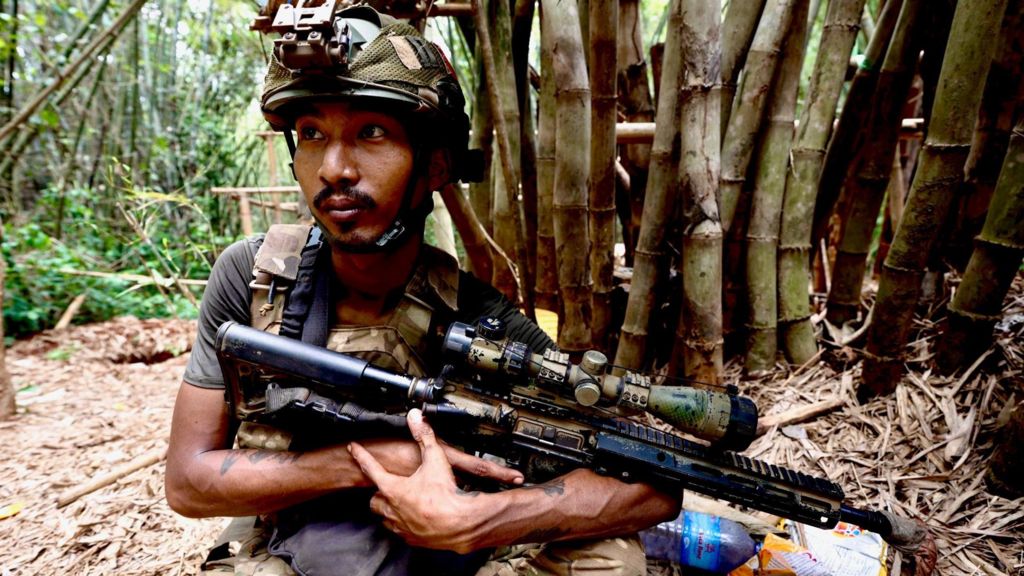
Deep in the jungle-covered mountains of Myanmar, hidden in a rebel encampment, four young men between 19 and 25 years old share a harrowing story none ever imagined they would live. None of them wanted any part of the country’s brutal civil war – and none ever volunteered to fight for the ruling military junta. Each was snatched from ordinary life in a campaign of state-sponsored forced conscription that has upended the trajectory of the conflict.
One, a chef by trade, was abducted from a city street just as he headed home after a shift. He carried no official identification, and that minor oversight was all the junta forces needed to detain him and coerce him into enlistment. A second was seized on his way back from a late-night karaoke outing with friends. A third was arrested while carrying out his routine duties for the state forestry department. The fourth describes being framed: plainclothes junta agents slipped illegal drugs into his shoe during his arrest, leaving him no choice but to enlist to avoid harsher punishment.
“Before we even understood what was happening to us, we were shipped straight to the front lines,” one of the men told a BBC reporting team that entered Myanmar without junta permission to document conditions in rebel-held territory. The BBC has agreed to keep the men’s identities secret to protect their families from retaliation back in territory controlled by the military.
The young men describe relentless exploitation during their time in junta ranks. “They made us do all kinds of things we didn’t want to do,” another added. “We never got any real rest – not in the morning, not during the day, not even at night. All the hard, dangerous work fell to us conscripts, while regular soldiers barely had to lift a finger.”
After four months of brutal basic training, the four were deployed to the front lines in Myanmar’s Karen State. One night, as they walked to a nearby stream to wash, they seized their chance: they slipped away into the jungle, running for their lives. Their escape led them straight into a patrol of the People’s Defence Force (PDF), the main armed wing of Myanmar’s anti-junta resistance, who detained them. But unlike their experience with the junta, the four say they have been welcomed with open arms.
“We are treated like brothers here, not strangers,” one explained. They plan to remain with the PDF for the time being, before eventually being moved to safety across the border with Thailand. “If we tried to go home now, the military would still hunt us down,” one said.
The accounts of these four unwilling deserters underscore a stark shift in Myanmar’s civil war, which erupted after the junta seized power from the country’s democratically elected government in 2021, arresting civilian leader Aung San Suu Kyi. After the coup, widespread opposition coalesced into an armed resistance movement that made sweeping territorial gains across the country over the first two years of conflict. Today, that tide has turned, largely thanks to the junta’s 2024 enforcement of a mandatory conscription law requiring all eligible men to serve a minimum of two years in the military.
That policy has flooded junta ranks with new manpower, reversing the resistance’s earlier momentum and pushing anti-junta forces onto the defensive across most of the country. While the junta still maintains full control over less than half of Myanmar’s territory, it has notched key gains in recent months, retaking critical population centers and reopening a vital strategic highway connecting the central city of Mandalay to Myitkyina in the northern state of Kachin. Thousands of junta troops are currently advancing to reassert control over contested border regions in Kachin, Chin, and Karen States.
Ko Kaung, a PDF battalion commander operating in Karen State, says forced conscription has become the single biggest challenge resistance fighters face on the battlefield. “Military forced conscription became the main challenging factor for us on the battlefield as it enabled the military with limitless manpower,” he explained during a patrol through the sweltering jungle. Two years ago, Ko Kaung’s fighters seized the town of Hpapun and a large junta base outside the town. Today, the area bears deep scars of war: the welcome sign at the town entrance has been destroyed by bombing, along with the local school, a Buddhist monastery, and most of the homes in now-abandoned neighborhoods. Now, Ko Kaung says he is bracing for an all-out attack: as many as 2,000 junta soldiers are advancing on Hpapun, with junta drones already circling overhead.
Unlike the junta, which draws on an endless stream of conscripted manpower, the resistance faces crippling resource constraints. “For us, despite having technology and intellectual advantages, our resources are very constrained,” Ko Kaung said. “With limited funds, we cannot source required components as much as we want and cannot recruit new soldiers as easily as the military.”
Da Wa, a PDF commander and former political activist who spent four and a half years in junta prisons, echoes that assessment. Deep in his mountain-based command, he agrees that while most of the junta’s new conscripts are unwilling recruits, their addition to the force has still improved the junta’s battlefield performance. “They are getting better at following orders,” he noted.
During a patrol along narrow jungle trails, Da Wa’s group was forced to take cover when a junta drone passed overhead. Reaching a hilltop outpost, his fighters speak in hushed tones: a junta sniper is dug in on the adjacent hill. The outpost itself was captured by the resistance in April, but overwhelming junta artillery and airstrikes forced fighters to abandon it after just two days. “We’ll take it back,” Da Wa says firmly. Like Ko Kaung, he faces overwhelming odds: some 400 junta soldiers are advancing on his position.
Beyond the flood of conscripts, Da Wa says the junta has benefited from a major shift in military support since signing a security pact with Russia. The agreement has boosted the junta’s air power: “We see pairs of aircraft now, before it would be a single fixed wing,” he explained. The junta also now holds the edge in both quantity and quality of drone technology, a disadvantage the resistance struggles to counter. “The drone danger is definitely increasing. It would be easier for us if we also had jammers… It depends on how effectively we can counter their drone attacks and how well we can defend ourselves against them.”
Compounding these challenges is the role of China, which has poured billions of dollars of investment into Myanmar and operates large rare earth mineral mining projects in Karen and Kachin States. China has brokered multiple ceasefire agreements between the junta and several ethnic rebel groups, while simultaneously cutting off the flow of weapons and ammunition to the broader anti-junta resistance.
That ammunition shortage is a daily crisis for frontline fighters, says Kyar Soe, a rebel platoon commander recovering from a landmine injury at a hidden jungle field hospital. Showing a video of a recent battle, Kyar Soe can be heard shouting to an overeager fighter firing into junta positions: “save your bullets, easy, easy!”
“Everyone is willing to fight so far,” Kyar Soe says from his hospital bed, his right leg heavily bandaged after a second reconstructive surgery. He stepped on a landmine in contested territory, and most of his right heel had to be removed. Myanmar is one of the most heavily mined countries on Earth, with 745 people killed or injured by landmines in 2025 alone, a quarter of them children. Even with his leg throbbing, Kyar Soe says he has no intention of abandoning the fight. “I’ll return to the fight,” he says. “One way or another I’ll fight until the very end as turning back home is no longer an option for me any more.”
The field hospital where Kyar Soe recovers is a makeshift facility, built from bamboo and wood huts tucked deep into the jungle. Its operating room runs on solar power, with a backup generator for outages, and operates on a tiny shoestring budget. The facility lacks sufficient funding, critical medical supplies, and even an ambulance to evacuate severely wounded patients. Yet its director, Dr Saung, a 19-year veteran of the former military who graduated from a junta military academy, remains committed to supporting the resistance.
He tells every wounded fighter who passes through his doors why the fight matters: “First, we are fighting this revolution now because the generations before us failed to fulfil that responsibility. Second, if young people choose not to oppose the dictatorship now, then one day, when they grow older like us and can no longer tolerate the oppression, they may also find themselves having to take up arms or join another resistance movement.”
During an interview, cries from a recovery ward interrupted the conversation, and Dr Saung rushed off to attend: the wife of a rebel fighter was in labor. In a sweltering hut, 29-year-old May Kyut Mon braced through increasingly intense contractions, while her 24-year-old husband Yine Chit stood beside her, fanning her in the oppressive heat and playing Buddhist mantras on his phone – he could not remember the words to chant them himself. After hours of labor, Dr Saung lifted a healthy baby girl into the air, smiling. The new parents named her Sue Paye, which translates roughly to “fulfilled wish.”
When asked what he hopes for his daughter’s future, Yine Chit did not hesitate: “A free and democratic Myanmar.” The couple cannot visit Yine Chit’s parents, who live in junta-held territory – neighbors in his village know he joined the resistance, and many support the military. “Once the revolution is over and peaceful times come, we’ll take the baby and visit both sides of the family,” Yine Chit says, his smile holding fast to that hope.