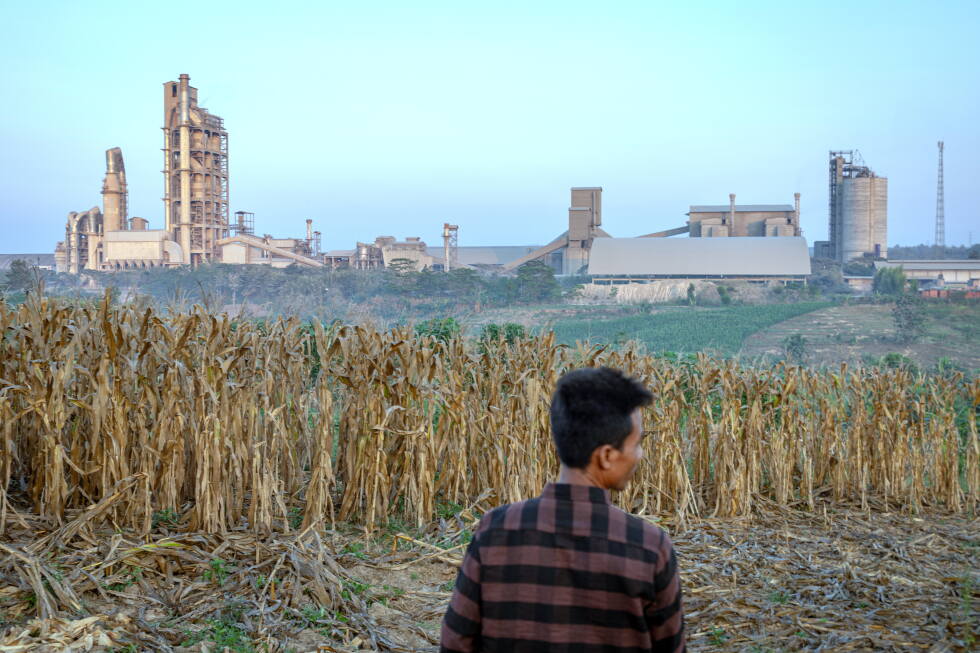
A landmark legal complaint brought by Indigenous communities and activists in Indonesia against one of the world’s largest cement manufacturers is paving the way for a new era of corporate accountability, as global South communities leverage European regulations to hold multinational firms liable for environmental and human rights harm.
The case, filed against Germany’s Heidelberg Materials, marks the first time Indonesia’s communities have invoked Germany’s groundbreaking Supply Chain Due Diligence Act, a regulation that requires large European companies to audit and address human rights and environmental risks across their entire global supply chains. At the center of the dispute is a proposed limestone mine and integrated cement factory that the firm’s local Indonesian subsidiary PT Indocement Tunggal Prakarsa plans to develop in Central Java’s ecologically sensitive Kendeng Mountains.
For Indigenous Samin communities that have called the Kendeng range home for generations, the project represents an existential threat. The mountains are a rare karst ecosystem that functions as a critical natural carbon sink and supplies regional groundwater reserves. Activists and complainants warn that open-pit mining would irreversible damage the unique landscape, destroy agricultural land relied on by local communities, and displace Indigenous populations that have sustained their livelihoods on this land for centuries.
“If the project moves forward, we will face an ecological catastrophe, mass impoverishment, and widespread violations of our basic human rights,” said Bambang Sutikyo, one of the 10 individual complainants backing the case. Gunretno, a Samin community leader and plaintiff who uses only one name, emphasized that the fight extends beyond local land rights. “As global citizens, we share a collective responsibility to protect our only shared planet when any form of environmental destruction is at stake,” he said.
In response to the allegations, Katharina Plonsker, Heidelberg Materials’ senior sustainability communications manager, noted that local stakeholders were given opportunities to raise concerns during the project’s permitting phase, and that community feedback was incorporated into project planning. “No final decision on the implementation of the project has been taken,” Plonsker confirmed in a statement.
Supported by local legal advocacy groups including the Semarang Legal Aid Institute and transnational non-profits such as Inclusive Development and Watch Indonesia, the complaint is being submitted to the German Federal Office for Economic Affairs and Export Control. Legal analysts say this case is far more than a local environmental dispute: it is a test case that will shape future regulatory and legal frameworks across the European Union, as multiple member states move to implement their own mandatory supply chain regulations aligned with Germany’s model by 2028.
“This current wave of complaints is exceptionally significant, because outcomes from these early cases will guide how other EU nations structure their own legislation,” explained Annabell Brüggemann, a legal expert with the Berlin-based European Center for Constitutional and Human Rights. Resistance to extractive projects in the Kendeng Mountains is not new, but the ability to bring claims under German domestic law marks a major shift in how global communities can challenge corporate activity.
The Indonesian case is part of a rapidly growing trend of transnational climate and corporate accountability litigation emerging across Asia and the Global South. In recent years, affected communities across Cambodia, Pakistan, the Philippines, and other regions have launched similar legal action against major European firms including energy giant Shell and apparel brand Adidas. In 2023, Indonesian fishers from Pari Island filed a climate complaint against Swiss cement manufacturer Holcim, which is currently appealing a Swiss court decision to allow the case to proceed. Just last year, nearly 70 survivors of Super Typhoon Rai in the Philippines brought a claim against Shell, arguing the company’s historical greenhouse gas emissions amplified the storm’s destructive impact, while 40 Pakistani farmers filed a joint complaint against Heidelberg Materials and German energy firm RWE over the companies’ role in worsening the 2022 Pakistan floods that killed more than 1,700 people.
For multinational European companies that have long operated in Asian markets with less stringent environmental regulations, this growing wave of litigation introduces new material financial and reputational risks, said Jameela Joy Reyes, a climate governance researcher at the London-based Grantham Research Institute on Climate Change and the Environment. “The transboundary nature of these cases is a groundbreaking development, and we can expect to see far more of these claims in the coming years,” Reyes noted. “These cases are pushing a larger global conversation about climate reparations, and accountability for corporations that have profited for decades from extracting resources from Global South nations.”
Laurie Parsons, a researcher at Royal Holloway, University of London and author of *Carbon Colonialism*, said Germany’s supply chain law has already transformed the landscape for communities affected by corporate activity worldwide. “It has not only created new legal pathways; it has shifted the mindset of both companies and governments about what accountability for global corporate activity can look like,” Parsons said. Brüggemann added that the Indonesian case makes clear the growing demand for corporate accountability globally. “This case demonstrates how strong the movement for corporate accountability is, and how urgent the need for regulation of the globalized economy has become,” she said.
As of 2024, the Grantham Research Institute tracks nearly 3,000 climate-related legal cases across 60 countries, with at least 226 new cases filed in the first half of this year alone, reflecting a steady upward trend in transnational climate litigation.