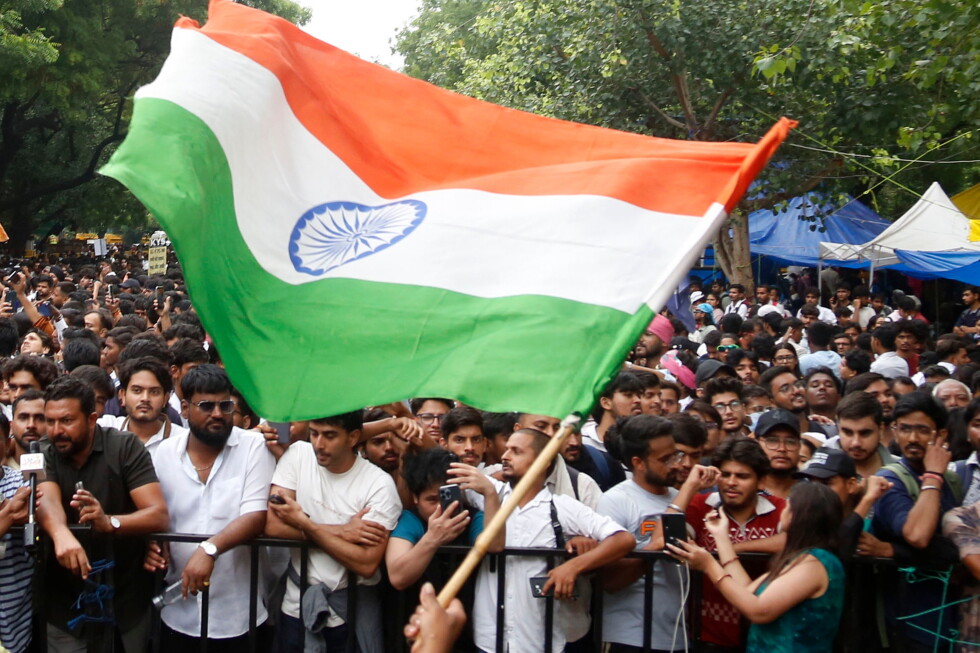
NEW DELHI – Just 24 hours after Delhi police deployed tear gas and baton charges to disperse thousands of youth-led protesters marching toward India’s Parliament, demonstrators remain defiant, announcing they will continue their sit-in demonstration at the capital’s designated protest site Jantar Mantar. What began two months ago as a satirical grassroots campaign has evolved into a nationwide movement, becoming one of the most high-profile public challenges to Prime Minister Narendra Modi’s newly formed third-term government.
Hundreds of protesters remain camped at the Jantar Mantar site, surrounded by a heavy security deployment. Their core demands have not shifted: they insist Education Minister Dharmendra Pradhan must step down over longstanding failures in India’s national examination system, which have included repeated high-stakes exam leaks and widespread irregularities that have derailed the academic and career prospects of millions of young Indians. Abhijeet Dipke, founder of the Cockroach Janta Party (CJP) that organizes the movement, confirmed the protest would not end until demands are met.
Monday’s violent confrontation marks a major escalation in the movement’s two-month campaign. What started as an online satirical initiative quickly caught the attention of India’s massive youth population, expanding its scope to address broader systemic issues including soaring youth unemployment and lack of government accountability. Footage of the crackdown spread rapidly across Indian social media platforms over the past 24 hours, sparking widespread public outrage. Videos show police beating unarmed young demonstrators with batons, dragging detainers across pavement, and clearing the protest route. Some clips capture young protesters crying and pleading for officers to stop, while others show a scene of quiet defiance: demonstrators standing firm, refusing to disperse even as they were struck.
Delhi Police official figures confirm nearly 180 people were injured in the clashes, including 118 security personnel and 60 protesters. Despite the violence, many demonstrators say the police action has only hardened their commitment to the movement. Sona Bisht, a 20-year-old student protester, said the government’s attempt to intimidate India’s Generation Z would not succeed. “If the government thinks that doing this with Gen Z, they can stop us, then that won’t happen,” Bisht said Tuesday from the protest camp. “We are here talking about education, talking about securing our future. And till the time our demands are not met, we will not move from here.”
The crackdown came even after the Indian government made its first public outreach to movement leaders Monday, following nearly a month of official silence. A senior union minister held preliminary talks with movement representatives, but the discussion failed to de-escalate tensions. Movement leaders reject empty policy assurances, demanding concrete action: in addition to Pradhan’s resignation, they call for comprehensive overhauls of India’s dysfunctional examination system, and financial compensation for families of students who died by suicide after their academic futures were ruined by alleged exam irregularities. Dipke accused authorities of acting in bad faith, saying police launched the baton charge immediately after protesters had accepted an invitation to attend the scheduled talks.
International human rights organization Amnesty International condemned the police action in a statement released late Monday, saying the incident laid bare the systemic suppression of peaceful dissent under the current Indian government. “The role of the authorities is to protect and facilitate peaceful protests, not to suppress them,” the group said. “The right to freedom of peaceful assembly is recognized under international human rights law and the Indian constitution.”
The movement gained significant national momentum over the weekend, after prominent Indian activist Sonam Wangchuk – who had completed a three-week hunger strike in solidarity with the protesters – was forcibly removed by police and taken to a hospital for mandatory medical evaluation. The unrest has drawn a broad cross-section of Indian society, including students, working professionals, and families affected by exam irregularities, marking a rare unified public pushback against Modi’s government in its third term. It has also revived longstanding international and domestic criticism of the administration’s track record of cracking down on dissent and using excessive force to disrupt peaceful opposition protests.
Many new demonstrators have joined the sit-in since Monday’s violence, saying they were compelled to act after seeing footage of the police crackdown. Rabina Kashyap, a 26-year-old working professional, arrived at the Jantar Mantar camp on Tuesday to add her support. “I have nothing to do with this protest,” Kashyap said. “But this is India, this is my country, and these are my people. So I will stand by them.”