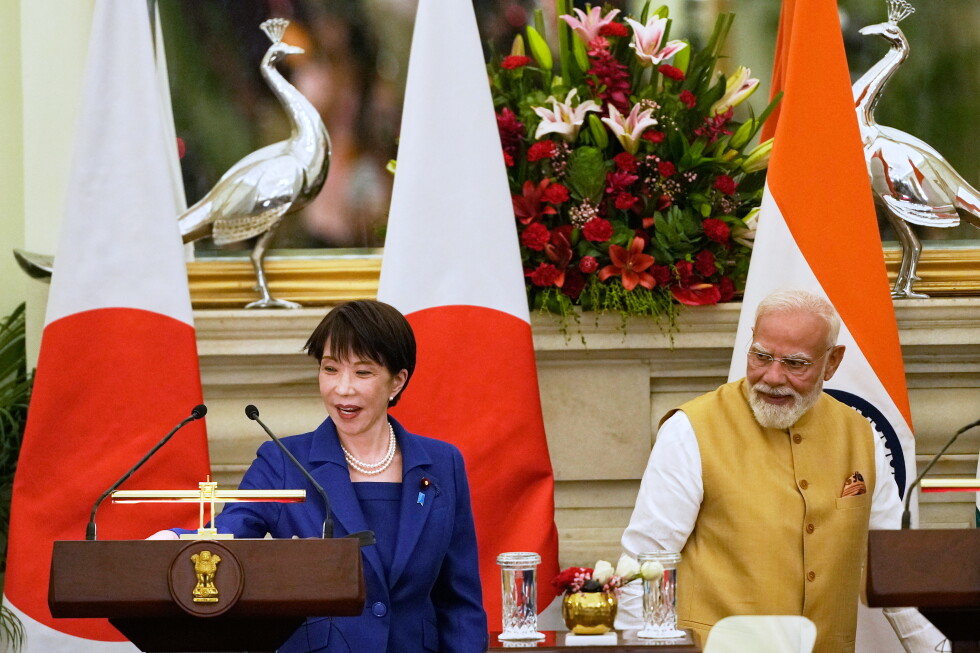
In high-stakes diplomatic talks held in New Delhi on Thursday, Japanese Prime Minister Sanae Takaichi and Indian Prime Minister Narendra Modi have concluded their summit with a sweeping package of bilateral agreements designed to deepen ties across defense, economic coordination, and maritime security.
Following the closed-door negotiations, Modi outlined the key outcomes of the meeting to reporters, noting that the two nations will move forward with joint development of naval radio antenna infrastructure and have formally adopted a shared roadmap guiding long-term economic security collaboration. Beyond these core initiatives, Modi added that the leaders had reached consensus on ramping up joint work across a portfolio of high-priority strategic sectors, including artificial intelligence, commercial and military shipbuilding, renewable biogas energy, semiconductor supply chain development, and other cutting-edge critical technologies.
“For both India and Japan, economic security is not a separate policy concern — it is a shared core security interest,” Modi emphasized in his post-summit remarks.
The deepening partnership builds on decades of growing economic ties between the two Asian powers. Japan currently ranks among India’s top sources of foreign direct investment, and has anchored signature infrastructure projects across India, most prominently the Mumbai-Ahmedabad high-speed rail line, one of India’s most ambitious modern transit upgrades. Today, more than 1,400 Japanese firms maintain active operations in India, with nearly half of those businesses focused on manufacturing activity.
Fresh official data from the Indian government puts bilateral trade between the two nations at $27.5 billion for India’s 2025-26 fiscal year. Japanese investment inflows into India between April and December 2025 alone totaled $3.2 billion, a figure that aligns with Tokyo’s 2024 pledge — made during Modi’s official visit to Tokyo last year — to more than double its cumulative investment in India to over $61 billion over the coming decade. Takaichi’s three-day visit to New Delhi was held to mark the 16th iteration of the annual India-Japan summit, a recurring dialogue that has grown in strategic importance in recent years.
Both India and Japan have made boosting bilateral collaboration in the Indo-Pacific a top foreign policy priority, and both are core members of the Quad, a regional security grouping that also includes the United States and Australia. The Quad was established to coordinate on maritime security, defense cooperation, and infrastructure development to counter the growing influence of China across the Indo-Pacific region.
Takaichi reaffirmed that New Delhi and Tokyo share unwavering commitment to Japan’s Free and Open Indo-Pacific (FOIP) initiative, which is rooted in principles of unimpeded freedom of navigation and universal respect for established international law. “Expanding our partnership on maritime security is particularly critical to upholding peace and stability across the entire region,” Takaichi stated.
Notably, the summit came as regional tensions over Indo-Pacific strategy remain high, and Chinese officials pushed back against the initiative Thursday. During a regular Beijing press briefing, Chinese Foreign Ministry spokesperson Guo Jiakun argued that some outside powers frame their initiatives as promoting “freedom and openness” while actually pursuing policies of confrontation and division within the region. Guo stressed that this kind of approach directly contradicts the widespread desire among Indo-Pacific nations for peace, shared development, and cross-border cooperation.
“The Asia-Pacific needs stability, not turmoil; it needs a laser focus on cooperation, not bloc-based division,” Guo said. Associated Press correspondent Ken Moritsugu contributed reporting from Beijing for this article.