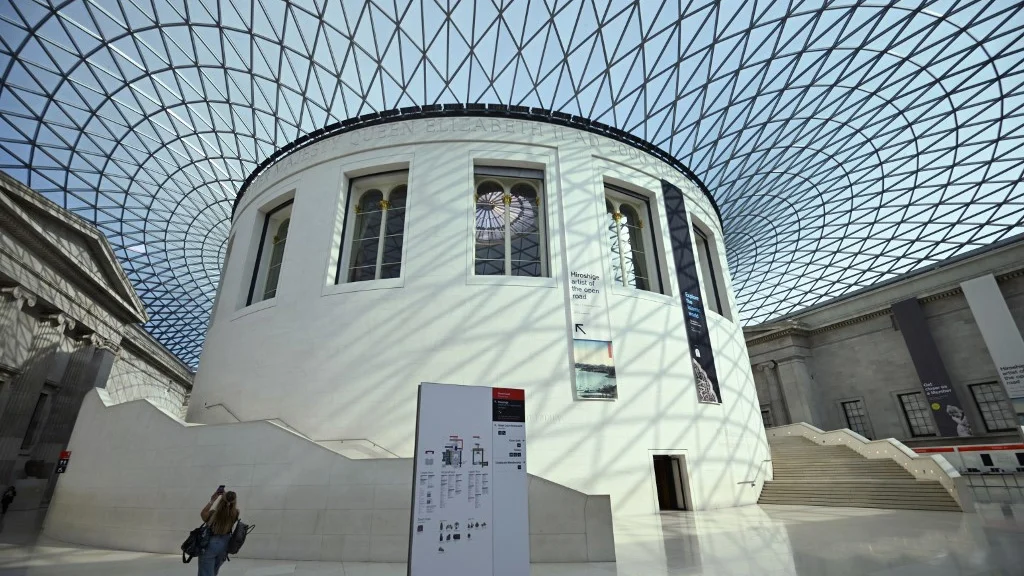
A bombshell investigation by independent outlet Middle East Eye has pulled back the curtain on the British Museum’s deceptive practices around changes to its Middle Eastern exhibits, triggering widespread calls for an independent probe into alleged ethical breaches, political interference, and misleading public statements. The report, published Wednesday, confirms that the institution’s 2024 decision to scrub the terms “Palestine”, “Palestinian”, and “Israeli occupation” from its public displays was not, as museum leadership had repeatedly claimed, the outcome of audience research or a routine gallery update — it was a direct response to months of targeted lobbying by pro-Israel advocacy groups.
Internal documents and email correspondence obtained by MEE directly contradict multiple public statements made by British Museum director Nicholas Cullinan earlier this year. In February, Cullinan claimed he had no knowledge of a formal complaint letter submitted by UK Lawyers for Israel, despite the correspondence being addressed directly to his work email and explicitly flagged for his attention by museum staff. He also insisted the terminology changes were completed months before his February comments as part of a long, deliberative curatorial review during a scheduled gallery refresh. But the investigation reveals that some of the alterations were implemented mere hours after a single complaint was lodged by pro-Israel activists.
The British Museum has repeatedly denied intentional erasure of Palestinian identity, releasing a repeat of its February statement to MEE in response to the new investigation, claiming “it is simply not true” that it removed the term Palestine, noting that it retains the wording in some historic and contemporary galleries. But campaigners and academic experts say the contradictions in Cullinan’s public accounts and the internal evidence raise fundamental questions about the institution’s commitment to transparency, curatorial independence, and ethical governance.
Campaign group Culture Unstained, which has previously challenged the British Museum’s ties to fossil fuel giant BP, has warned that Cullinan and the museum’s leadership likely violated the Museum Association’s formal Code of Ethics. The code requires all UK museums to base institutional decisions on professional best practice, maintain open and transparent governance, and prioritize public benefit. A spokesperson for Culture Unstained told MEE the investigation confirms the museum “has been swayed by undue political influence which has then undermined ethical and curatorial rigour”, adding that Cullinan’s misleading statements were deliberately crafted to confuse the public and obscure the actual decision-making process.
Leading archaeology professor Dan Hicks of the University of Oxford, author of *The Brutish Museums*, a prominent work critiquing colonial-era museum practices, told MEE the leaked emails cast serious doubt on the museum’s commitment to academic integrity and proper procedure. As public research institutions, Hicks explained, changes to gallery interpretation at major cultural institutions must be rooted in curatorial expertise and open consultation with all relevant stakeholder and community groups. In this case, he argued, unplanned top-down reactions to random social media complaints bypassed established institutional protocols, resulting in poorly considered changes to public content. Hicks called for an immediate, full public accounting from the museum, noting “the degree of redaction and sustained silence in the British Museum’s replies to MEE’s story is hard to understand. What could there possibly be to hide?”
Palestinian Ambassador to the United Kingdom Husam Zomlot said he was never convinced by Cullinan’s February 2025 reassurance during a phone call that “nothing had changed” regarding Palestinian terminology in the museum’s displays. “From day one, the British Museum’s story did not add up,” Zomlot told MEE, emphasizing that the erasure of Palestinian historical identity carries severe stakes amid the current conflict in Gaza. “This is absolutely existential for us in light of the ongoing genocide.”
Peter Leary, deputy director of the Palestine Solidarity Campaign, connected the museum’s decision to the broader context of Israel’s military campaign in Gaza, noting that just last week a United Nations independent inquiry confirmed Israel is deliberately targeting and killing Palestinian children as part of a strategy to eliminate Palestinian national future. “This chilling evidence indicates that pro-Israel groups have been simultaneously working to eliminate all mention of their past,” Leary said, urging the museum to reverse the changes and address its problematic conduct rather than “collaborate with efforts to expunge Palestinians and their history.”
The investigation also uncovered existing internal dissent among British Museum staff, who have previously raised alarms that the institution’s public position on the terminology changes is contradictory, and that pre-approved, standard responses were already available to address complaints about Israeli-Palestinian content without altering permanent displays. Staff also reported being kept completely in the dark about the museum’s 2025 hosting of an event marking the 77th anniversary of Israel’s independence, and said that management has refused to issue a public apology or respond meaningfully to a staff letter demanding clarification and a break in institutional ties to Israeli cultural organizations.
A spokesperson for campaign group Energy Embargo for Palestine accused Cullinan of repeated deception of both staff and the public, saying the scandal “makes a mockery of the pretence that the British Museum is in any way impartial or apolitical.” The spokesperson noted that the museum already holds a vast collection of Palestinian artifacts that are never put on public display, at a time when Israel has destroyed hundreds of Palestinian cultural sites and artifacts during its military campaign in Gaza, and killed or displaced countless Palestinian cultural heritage workers. “The British Museum’s culture of greed, exploitation, and corruption causes real-world pain and suffering, and we will hold them to account,” the spokesperson added.
MEE reached out to both the Museum Association and the British Museum for comment ahead of publication. The British Museum only provided a reprint of its February statement, while the Museum Association did not send a response before the investigation went live.