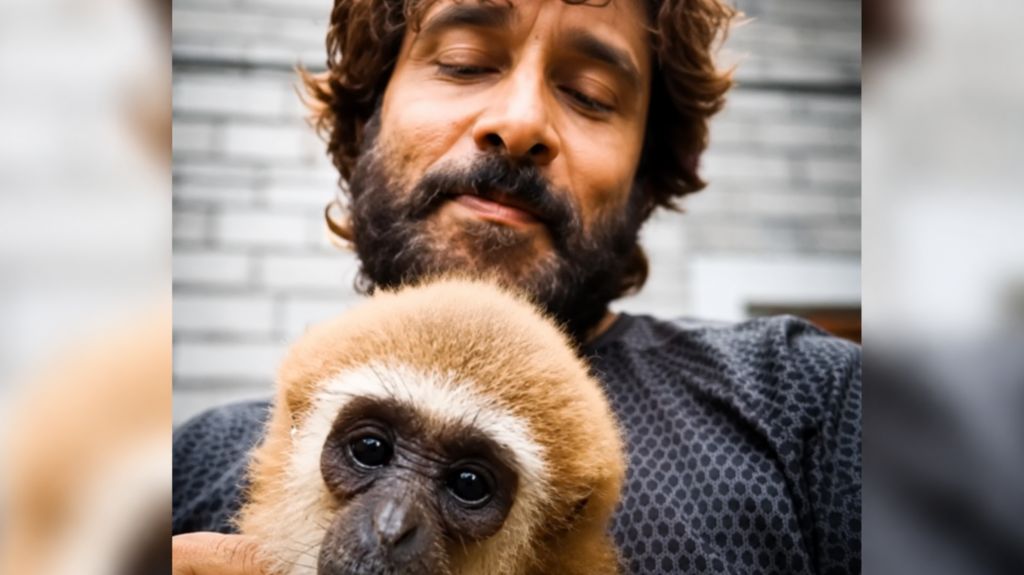
A viral social media incident involving one of Tamil cinema’s biggest stars has sparked a formal investigation by Indian wildlife authorities, shining a new spotlight on the country’s ongoing challenges with exotic wildlife regulation and illegal trafficking.
Last Monday, award-winning actor Vikram — whose real name is Kennedy John Victor and boasts a three-decade career of acclaimed, physically demanding roles — shared an Instagram clip showing himself hugging and playing with a lar gibbon, a small endangered ape native to Southeast Asia. The footage spread rapidly across digital platforms, with many outlets reporting the animal as the star’s new pet, before it was removed from his account within hours.
Officials from Tamil Nadu’s forest department confirmed this week they have launched a probe into how the primate ended up at a private Chennai home belonging to one of Vikram’s relatives. The investigation is focused on tracing the gibbon’s journey through multiple Indian states and verifying whether all legal requirements for possession, transfer, and import were followed at every step. Authorities have not yet made any accusations of trafficking, nor have they claimed Vikram owns the animal or was involved in smuggling it into the country. As of this reporting, the actor has not issued any public comment on the controversy; his public relations representative Yuvaraj told BBC Tamil that any statement from Vikram will be shared with media outlets once it is prepared.
Lar gibbons, recognizable by their light or dark brown fur and distinct white facial ring, live in small family groups in Southeast Asian tropical forests across Thailand, Myanmar, and Malaysia. The species is formally listed as endangered by global conservation bodies, with wild populations decimated by habitat destruction, hunting, and the unregulated illegal pet trade. The International Union for Conservation of Nature lists the species as endangered, and international trade in lar gibbons is strictly restricted under the Convention on International Trade in Endangered Species of Wild Fauna and Flora (CITES), an international agreement that India has integrated into its national wildlife protection laws.
Under Indian law, individuals may legally keep CITES-listed exotic species only if they obtain all required permits and register the animal with national wildlife authorities. Rakesh Kumar Dogra, Tamil Nadu’s Chief Wildlife Warden, explained to BBC Tamil that importing protected exotic animals into India requires approval from the Directorate General of Foreign Trade, a no-objection certificate, and final clearance from a senior wildlife conservator. “An investigation is under way into where the lar gibbon came from. Only then can we say whether it was brought illegally,” Dogra said.
The probe has already uncovered a paper trail that stretches more than 2,000 kilometers from Chennai to the northeastern Indian state of Manipur. A senior Tamil Nadu forest official, speaking anonymously to BBC Tamil, said investigators have linked the gibbon in Vikram’s video to a group of eight lar gibbons — four males and four females — declared by a Manipur-based individual on India’s PARIVESH portal in 2020. PARIVESH is the federal government’s official platform for registering exotic animals and securing environment, forestry, and wildlife-related permits; government records list Malaysia as the origin of this group of primates.
According to portal records, three of the gibbons — one male and two females — were transferred from Manipur to an individual in Perundurai, located in Tamil Nadu’s Erode district, for the stated purpose of adoption this past June. Investigators have so far not found documentation proving that required approval from Tamil Nadu’s Chief Wildlife Warden was obtained to bring the primates into the state. Two months after that initial transfer, on August 5, one male and one female gibbon were moved again from Perundurai to Vikram’s relative in Chennai, forest department investigators confirmed.
Wildlife conservation activists have raised additional questions about how the original group of eight gibbons entered India in the first place. Manipur shares a long border with Myanmar, and India’s northeastern region has long been identified as a major transit route for illegal exotic wildlife trafficking into the country. Still, authorities stress they have not reached a final conclusion that the gibbons in this case were trafficked. India’s federal Wildlife Crime Control Bureau (WCCB), which specializes in investigating organized wildlife crime, has also joined the probe. Thenmozhi, Deputy Director of the WCCB’s Southern Zone, told BBC Tamil the agency has requested Chennai wildlife officials to verify all existing documentation and take appropriate action based on their findings. “The lar gibbon is classified as a protected species under this agreement. They should only be handled as protected animals,” Thenmozhi said, referencing CITES regulations.
This investigation comes amid growing national concern over rising illegal imports of exotic animals into India. In recent years, Indian customs officials have repeatedly intercepted smuggling attempts, with passengers arriving from Southeast Asia often hiding live reptiles, birds, and primates in their luggage. Just in July 2025, authorities seized more than 350 exotic animals originating from Bangkok at Mumbai and Pune airports over a two-month period. Gibbons have been targeted by traffickers before: last November, Bengaluru customs officials recovered a lar gibbon among a shipment of exotic animals brought in by a Bangkok-bound passenger. Chennai has also seen its share of high-profile seizures; this past February, customs officials intercepted 31 exotic animals — including tortoises, iguanas, and snakes — from a passenger arriving from Bangkok.
As the investigation progresses, authorities continue to work to trace the full origins of the gibbon, verify permits for every stage of its transfer, and determine whether any individuals violated India’s strict wildlife protection laws.