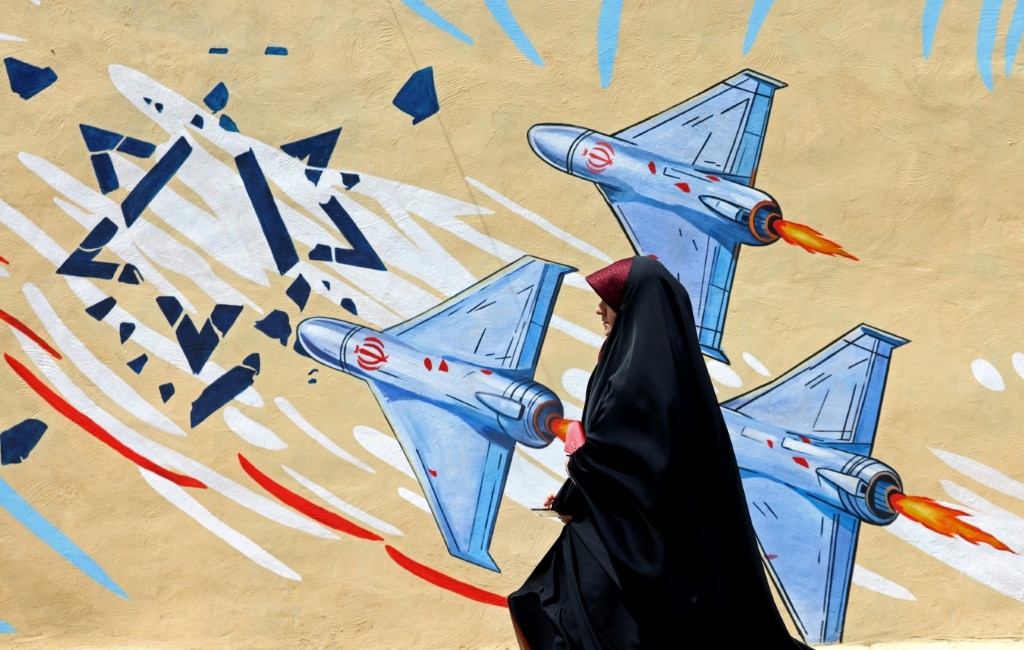
When former U.S. President Donald Trump launched a joint military campaign against Iran alongside Israeli Prime Minister Benjamin Netanyahu on February 28, he positioned the action as a definitive warning to Tehran to never challenge American military power, while calling on Iranian citizens to overthrow the country’s unpopular clerical leadership. Weeks of intense conflict ended this Tuesday with a two-week ceasefire between the two adversaries, and the outcome reveals a stark contradiction: while Trump claimed victory over the tentative reopening of the Strait of Hormuz – a waterway that Iran only closed in retaliation for the initial attack – the Islamic Republic’s governing authority has emerged more deeply entrenched domestically, and Tehran’s military operations have inflicted widespread disruption across the Middle East.
The campaign was driven largely by Israel’s long-standing strategic goal of undermining the Iranian government, which has been the Jewish state’s most bitter regional adversary for decades. For the United States, however, Trump’s objectives remained muddled and inconsistent throughout the conflict. He framed the strikes as a push to destroy Iran’s missile arsenal and block the country from developing a nuclear weapon – a puzzling framing, given that Trump had previously claimed he had already “obliterated” Iran’s nuclear sites, and formal diplomatic talks over the nuclear program were already ongoing when the war began.
As the conflict progressed, Trump walked back his early rhetoric about “librating” the Iranian people. Days before the ceasefire, he made a threat that was widely interpreted as genocidal, warning that Iran, home to one of the world’s oldest continuous civilizations, would be wiped off the map entirely. Analysts across the political spectrum have since concluded that the conflict has inflicted lasting damage to U.S. strategic interests, even as it delivered limited short-term tactical gains.
“ I think the US has lost the narrative war and the information war inside Iran, regionally in the Middle East, internationally, and even here at home,” said Alireza Nader, a veteran Iran analyst based in the United States. Nader noted that even Iranians who have long been critical of the Islamic Republic have rallied behind the country’s elite Islamic Revolutionary Guard Corps in response to U.S.-Israeli strikes that hit civilian targets including universities, bridges, and manufacturing facilities. “It is in the US national security interest to have a long-term positive relationship with Iran, and Trump really damaged that possibility for no reason whatsoever,” Nader added. “A lot of people who hate the regime are also outraged at the vast destruction of civilian infrastructure.”
Negar Mortazavi, a senior fellow at the Center for International Policy, argues that the strikes have only fueled nationalist solidarity across Iran, uniting disparate factions behind the hardline government. “For the US, they didn’t achieve any of their set goals. Nothing changed about the nuclear program. Iran still has operational missiles, it still has drones, the state has become more hardline, and there has been no regime change,” Mortazavi said.
Not all analysts see the campaign as a total loss for the United States. Michael Singh, a former top Middle East advisor to President George W. Bush and current managing director at the Washington Institute for Near East Policy, acknowledged that the U.S.-led campaign did significantly degrade Iran’s short-term military capabilities, destroying large stockpiles of missiles and drones, crippling the country’s navy and air force, and eliminating multiple senior military leaders. “From a US perspective, I would say the US was operationally brilliant but the conflict was strategically indecisive,” Singh explained.
Paradoxically, Singh added, the overwhelming display of U.S.-Israeli military power could push Iran to accelerate its nuclear ambitions. “Iran has seen that the US and Israel together have a vastly superior military capability, and of course that could create a stronger incentive to pursue nuclear weapons as a deterrent,” he said.
Despite the military disruption, Iran has emerged from the opening phase of the conflict with new diplomatic leverage ahead of planned long-term negotiations set to launch this Saturday in Pakistan. A core topic of the talks will be the future of the Strait of Hormuz, the critical chokepoint at the entrance to the Persian Gulf through which roughly one-fifth of the world’s global oil supplies pass. During the conflict, Iran proved it can quickly shut down the strait to disrupt global energy markets, a point it has made clear it will use as a bargaining chip.
Tehran has agreed to allow unrestricted safe passage through the waterway for the duration of the ceasefire, but has already floated the idea of implementing a new toll system for transiting vessels, with the revenue going toward post-war reconstruction in Iran. For its part, the United States has made a major concession during the conflict, relaxing decades-old sanctions on Iranian oil exports for the first time to bring down sky-high global oil prices – a move driven by political concerns over voter anger over energy costs ahead of upcoming U.S. elections.
Ali Vaez, Iran project director at the International Crisis Group, explained that if Tehran can secure acceptable concessions from Washington in the upcoming talks, it will be able to frame the entire conflict as a political victory. If Iran secures U.S. assurances, it can “argue that escalation produced negotiations on terms it could accept,” Vaez said. He added that the underlying balance of power in the standoff has not shifted dramatically: Iran still retains its stockpile of enriched uranium, while the United States has made clear that its immediate priority is preventing further disruption to global energy markets – particularly through the Strait of Hormuz – rather than adopting Israel’s more maximalist goal of toppling the Iranian government entirely. “That points both to Trump’s appetite for a deal and to the limitations of the strategy pursued so far,” Vaez noted.