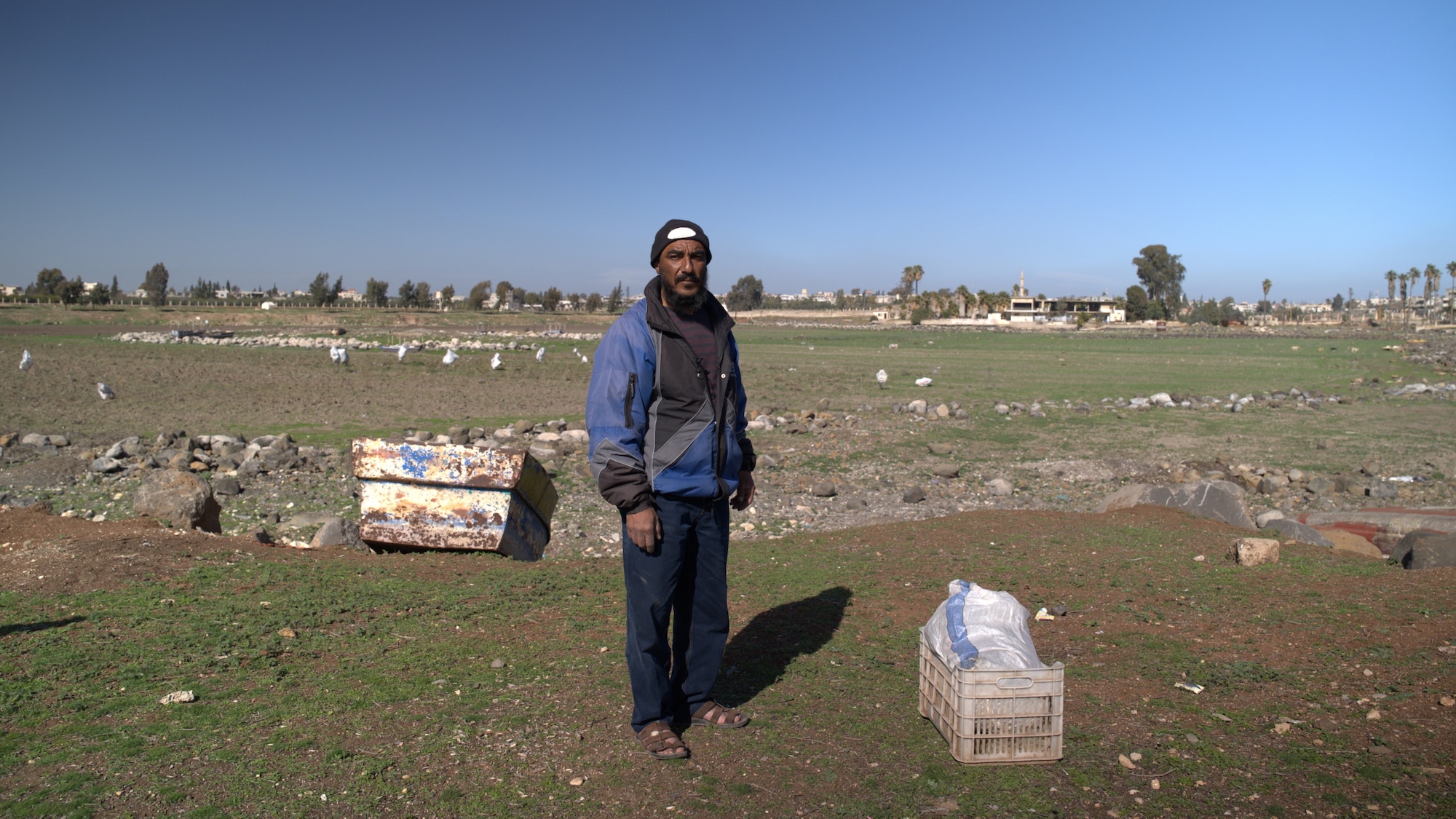
Once a sprawling, horizon-spanning body of water that anchored life and livelihoods across southern Syria’s Daraa province, Lake al-Muzayrib is no more. What remains is a vast, cracked expanse of parched earth dotted with scattered stones and sparse tufts of dead grass, where an abandoned fishing boat rests on hardened soil—a stark, silent monument to a world that has vanished. A handful of birds pick their way across the empty basin, their movements the only disruption to the stillness of a space that once teemed with the hum of human and aquatic life.
Standing at the edge of the former lake bed, 64-year-old Abdul-Munaf al-Masri, a fisherman who worked these waters for nearly 30 years, can barely bring himself to look at the barren landscape. “I don’t like to come here,” he says softly, his gaze fixed on the dry ground under his feet. “The sight of this drought breaks my heart.” For Masri, who fished Lake al-Muzayrib from 1993 until the fish population collapsed entirely in 2021, the lake was far more than a workplace—it was the center of his entire existence, tied to his childhood, his identity, and his ability to provide for his family.
Decades of accelerating decline have led to this moment. Data from Syria’s Daraa Water Resources Directorate shows that in the 1990s, the natural springs feeding Lake al-Muzayrib flowed at a rate of up to 1,000 litres per second. By 2016, that flow had plummeted to fewer than 170 litres per second. Today, the springs are completely dry. While the lake partially refilled after occasional heavy rainfall during past dry spells, by the end of 2024, it had vanished for good.
The disappearance of Lake al-Muzayrib is not an isolated disaster—it is the most visible symptom of a catastrophic collapse of water resources across southern Syria, a crisis decades in the making that has been amplified by 14 years of civil conflict and systemic mismanagement. For years, researchers tracking the impacts of the Syrian war have warned that the country’s southern region was sliding toward an unprecedented water emergency, driven by prolonged drought cycles that have been worsened by unregulated, excessive well-drilling across Daraa. Today, both surface water and groundwater reserves are declining at rates never seen in recorded history.
Engineer Hani al-Abdullah, Daraa’s director of water resources, says the crisis has reached a breaking point. Of the 16 dams that once supplied water for irrigation and drinking across the province, 14 are now partially or completely dry. The combined total storage capacity of these dams stands at 92.5 million cubic metres, but in 2025, they held less than 4 million cubic metres total—an all-time low for the 21st century, and a dramatic drop from the 65 million cubic metres stored just five years prior. Standing on the crest of the nearly empty Daraa Dam, a reservoir that once drew local visitors with its abundant fish and served as the lifeline for surrounding farmland, Abdullah describes a landscape unrecognizable from decades past. Where trees once lined the dam’s banks and echoed with the sound of children playing and birds singing, only silence and barren earth remain.
Agriculture, the centuries-old backbone of Daraa’s economy that has sustained generations of families across the Hauran plains’ fertile volcanic soil, has been brought to its knees. Long before the war, the region’s strategic position at the crossroads of Jordan, historic Palestine, and central Syria, combined with its rich natural resources, made it a hub for grain, vegetable, and livestock production famous for its high-quality tomatoes, olives, pomegranates, and grapes. But 14 years of open conflict shattered that economy: water and irrigation networks were targeted in fighting, trade routes were severed, and decades of drought pushed the system past the breaking point.
As state authority collapsed during the war, thousands of desperate farmers turned to unlicensed well-drilling to keep their crops alive, turning a temporary survival tactic into a widespread phenomenon that has accelerated groundwater depletion. In the western Daraa town of Tafas, Abu Mahmoud, a smallholder farmer who relies on his half-hectare pomegranate orchard for his family’s income, spoke to Middle East Eye under a pseudonym over fears of government reprisal, explaining that he had no other choice when drought withered his crops. “I had no alternative. We all did it. It was the only way to hold onto our land and keep working,” he says. “But even that didn’t fix anything. It cost a fortune, and within three years, the well ran dry.”
For many farmers, illegal wells have become both a lifeline and an unsustainable burden. In eastern Daraa, farmer Hatem al-Zoubi, who tends 700 olive trees and two hectares of mixed crops, drilled a solar-powered well on his property in 2020 for $70,000—a sum that has eaten nearly all his profits, given falling crop prices and rising input costs. The well now supplies not just his farm, but drinking water for dozens of local families, especially as summer demand surges and displaced populations increase strain on existing resources. “A well isn’t a luxury. It’s a lifeline, for me and for dozens of families in this town,” he explains. “Without it, we would have faced catastrophic drinking water shortages already.”
Local residents and water officials alike confirm that this unregulated extraction has driven catastrophic declines in groundwater levels. Abdullah says that in some areas, groundwater tables have dropped by five to 10 metres, with solar-powered pumping allowing faster extraction than ever before. Masri estimates that more than 7,000 illegal wells now operate in the Lake al-Muzayrib area alone. “People don’t understand the risk. A farmer digs a well to water his own trees, but in doing that, he destroys the water supply for an entire community,” he says.
The crisis has pushed water out of reach for many low-income families, turning a basic necessity into an expensive commodity. The cost of 1,000 litres of water has risen to roughly $5—a staggering expense in a region where the average monthly salary ranges from just $75 to $150. Water officials have taken steps to curb unregulated drilling: the Daraa governor issued an order last year to confiscate unlicensed drilling equipment, issue fines to illegal well operators, ramp up monitoring, repair damaged irrigation infrastructure, drill regulated wells in high-need areas, and truck in emergency water from neighbouring regions. Dozens of drilling rigs have been seized, but the problem has become so widespread that enforcement remains extremely limited.
Returning residents displaced by the war are adding new strain to a system already on the brink. Basel al-Zoubi, a student who returned to the small town of Tseel after living as a refugee in Jordan, says much of the town’s original water infrastructure was destroyed during the conflict, leaving most residents reliant on expensive water delivered by private tankers. The town urgently needs new pumping systems to transport water from natural springs and state-managed wells to residential areas, he says, calling for stronger enforcement of well regulations to protect existing drinking water sources. “Water is a lifeline. There’s no replacement, especially when people are already struggling with such bad economic conditions,” Zoubi says.
The disaster has wiped out Daraa’s once-thriving fishing sector entirely. Masri is one of roughly two dozen fishermen who once worked Lake al-Muzayrib; all have either left the country or been forced to take odd jobs to survive. Since he stopped fishing in 2021, Masri has scraped by doing plumbing and household work. “I’m like a fish out of water. If I leave this place, I die,” he says. “The drought destroyed us. I was born and raised here, and it’s devastating to lose something that precious.”
Amin al-Haibi, another Daraa fisherman, confirms the sector has been completely destroyed: only the al-Wehda Dam on the Jordanian border still has enough water to support limited fishing, leaving the rest of the province without a working fishing industry. Masri still remembers the bountiful catches of the 1990s and early 2000s, when he could pull 200 to 300 kilograms of fish from the lake in a single day, enough to support his family comfortably. “It made you happy, coming home with a full catch,” he recalls. Today, the fishing boats that once fed 100 families across the region have been sold for scrap.
Masri joins other local residents in calling for stronger regulation of well drilling, public awareness campaigns to encourage conservation, and the creation of a fisherman’s union that could support efforts to restock dams if water levels ever recover. But current efforts to address the crisis remain fragmented and under-resourced, highlighting the urgent need for a comprehensive national strategy that balances urgent water conservation measures with support for local livelihoods in a region where access to water is now synonymous with survival. Standing on the empty lake bed that once defined his life, Masri holds out quiet hope for a return to the world he lost. “Nothing makes me want to come here anymore. The drought, the cut trees—it’s all so painful,” he says. “We just hope life can come back here, the way it used to be.”