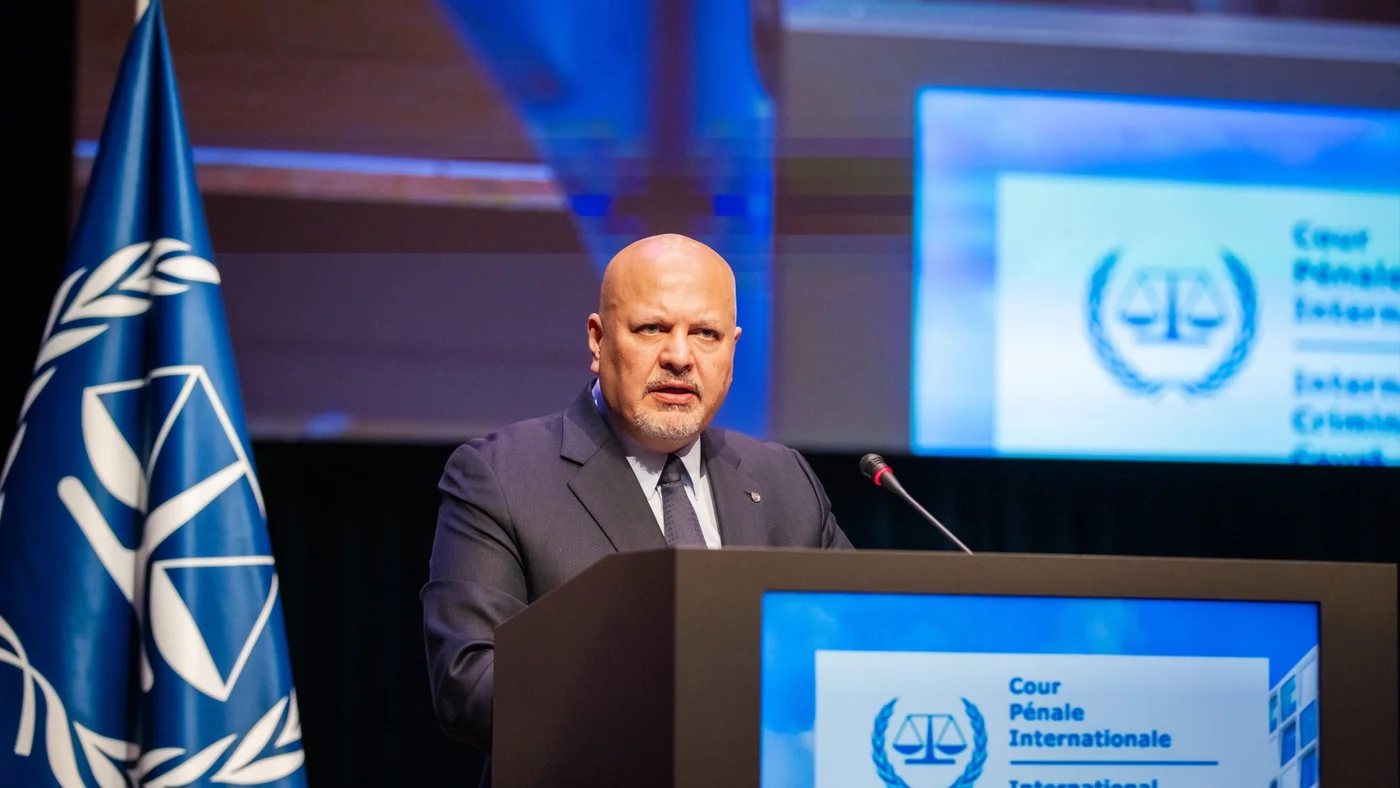
In a move that has thrown the International Criminal Court (ICC) into unprecedented institutional uncertainty, the 21-member executive bureau of the ICC’s Assembly of States Parties (ASP) voted on Monday to immediately suspend Chief Prosecutor Karim Khan, directly rejecting the findings of an independent judicial panel that cleared Khan of all wrongdoing. The suspension paves the way for a full vote by the broader 125-member ASP on whether to permanently remove Khan from his post, in a disciplinary process that legal experts warn risks eroding the court’s independence.
The bureau announced that a qualified majority of its members backed the suspension, which will remain in force until the full ASP issues a final ruling on the case. The decision invoked Rule 28 of the ICC’s Rules of Procedure and Evidence, after two-thirds of voting bureau members supported a formal finding of “serious misconduct”—a procedural step required to advance the matter to a full vote of the ASP. In its official statement, the bureau emphasized that the suspension is not the final outcome of the disciplinary process, and it has moved to convene a special session of the full ASP as quickly as possible to resolve the dispute.
The bureau’s determination drew on an investigation conducted by the United Nations Office of Internal Oversight Services (OIOS), along with underlying evidence, input from an ad hoc expert judicial panel, and submitted written arguments. The body has also committed to keeping all related documentation and deliberations confidential, calling for full respect for the privacy and legal rights of all parties involved, as well as the integrity of the ongoing process.
Per ASP rules, the full body will first need to uphold the finding of serious misconduct via a two-thirds majority of states present and voting. If that threshold is met, a second vote will be held on removing Khan, which requires an absolute majority of the 125-member ASP—at minimum 63 votes—to pass.
The controversy stretches back to May 2024, when unproven allegations of sexual misconduct emerged against Khan, which he has repeatedly and vehemently denied. After the complainant declined to cooperate with the ICC’s internal investigative body, the ASP commissioned the independent OIOS-led probe. The UN investigation’s findings were then passed to a three-judge expert panel, tasked with advising the bureau on whether Khan had committed serious misconduct, minor misconduct, or no misconduct at all.
Middle East Eye (MEE) first reported in March that the judicial panel issued a unanimous ruling that the evidence presented in the UN investigation failed to establish any misconduct or breach of duty under ICC rules. Just weeks later, however, a majority of the bureau voted to set aside the panel’s independent finding, moving forward with the disciplinary process anyway.
Legal observers have raised sharp alarms about the decision to overrule the independent judicial panel, warning that the move risks turning the misconduct probe into a politicized process. The entire affair has already left the ICC in uncharted institutional limbo, with ongoing uncertainty surrounding Khan’s future and unauthorized media leaks of the unproven allegations against him.
Khan has already signaled his next steps if the full ASP votes to remove him: he has confirmed he will appeal any dismissal to the Administrative Tribunal of the International Labour Organization (ILOAT), the independent body that handles employment appeals for ICC staff. A separate legal opinion shared with ICC member states last month, prepared by former International Court of Justice judge Abdul Koroma, supports this path: Koroma found that the ILOAT could order Khan to be reinstated and order the ICC to pay up to €1.5 million (equivalent to $1.74 million) in damages if his removal is found to be unlawful.
Critics have also noted that the disciplinary proceedings against Khan align with a sustained campaign by the United States and its allies to derail his office’s high-stakes investigation into alleged war crimes and genocide committed by Israeli officials in Gaza. Khan, a British barrister elected as the ICC’s third chief prosecutor in 2021, has overseen investigations into serious international crimes against leaders across the globe: his office has issued arrest warrants for Russian President Vladimir Putin, Israeli Prime Minister Benjamin Netanyahu, Myanmar’s junta leadership, and Taliban officials in Afghanistan.
Khan’s aggressive pursuit of high-profile cases against powerful leaders has already drawn retaliation from opposing states: the Trump administration imposed sweeping sanctions on Khan in February 2025, and Russian courts have issued an arrest warrant for him in absentia. While the U.S., Russia, and Israel are not ICC member states, the court exercises jurisdiction over crimes committed by their nationals on the territory of any member state. The U.S. later expanded sanctions to target two additional deputy prosecutors, eight sitting ICC judges involved in the Palestine and Afghanistan investigations, the UN special rapporteur on Palestine, and multiple Palestinian non-governmental organizations that provided evidence to the court’s investigations.