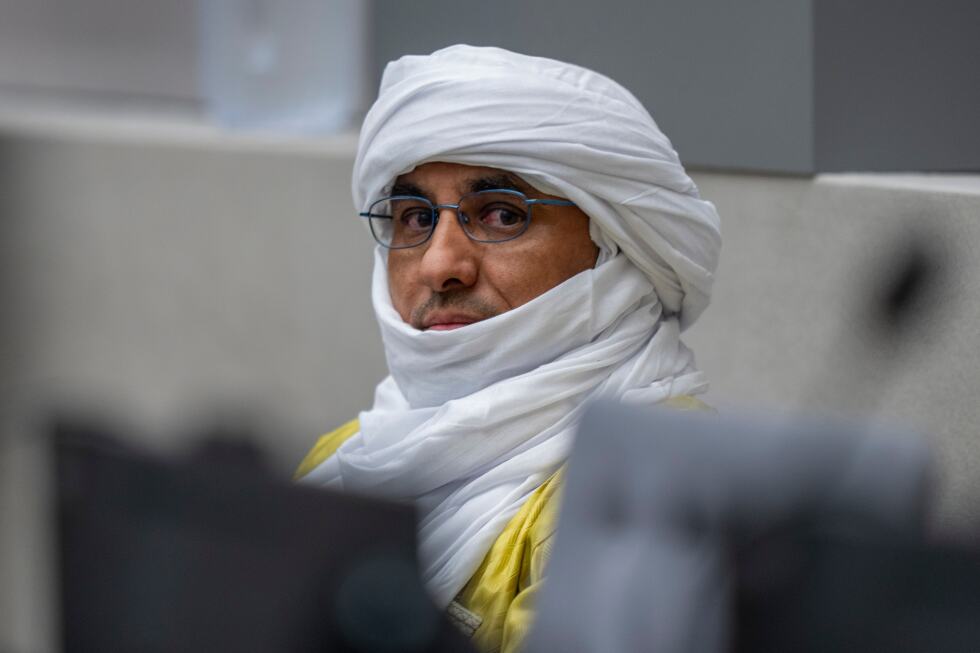
THE HAGUE, Netherlands — In a landmark ruling for victim justice Tuesday, the International Criminal Court (ICC) ordered a senior al-Qaida-linked extremist leader to pay 7.2 million euros ($8.4 million) in reparations for widespread atrocities he directed while leading the Islamic police in Mali’s ancient desert city of Timbuktu following the 2012 extremist takeover.
The defendant, Al Hassan Ag Abdoul Aziz Ag Mohamed Ag Mahmoud, was convicted by the ICC last year on charges including torture, religious persecution, and multiple crimes against humanity, receiving a 10-year prison sentence. Judges confirmed that Al Hassan was a central architect of a brutal reign of terror that descended on Timbuktu after Islamic extremist rebels seized control of the city in 2012, leaving tens of thousands of residents harmed by systemic violence.
Presiding Judge Kimberly Prost told the The Hague-based courtroom that legal responsibility for the harm rests squarely with the convicted perpetrator. “Mr. Al Hassan, as the person found responsible for the crimes, which caused the harm to the victims, is the person financially liable for the cost of repairing the harm,” Prost said.
However, the court will not be able to collect the ordered sum directly from the 49-year-old, who was confirmed to be indigent before and during his trial, and was represented by a court-appointed attorney funded by the ICC. Instead, the ordered reparations for more than 65,000 identified victims will be disbursed through the ICC’s Trust Fund for Victims, a body established by the court’s member states to deliver compensation and support to those harmed by crimes falling under ICC jurisdiction.
Deborah Ruiz Verduzco, executive director of the Trust Fund for Victims, explained the body’s unique role under the ICC’s founding framework, the Rome Statute. “We are one of the many innovations of the Rome Statute,” Ruiz Verduzco told the Associated Press, noting that the fund exists specifically to address harm stemming from crimes within the court’s jurisdiction.
The fund’s 24-person team carries out a broad mandate: supporting victims and their families, developing community recovery programs in regions shattered by violence, and securing the financial resources needed to meet its commitments. In the fund’s 20 years of operation, this marks only the second time a perpetrator has been ordered to pay reparations — and only the first case where a court-ordered award will actually be distributed to mass victims. Previous payments from a perpetrator came in a separate earlier case.
ICC Presiding Judge Prost emphasized that significant targeted fundraising will be required to raise the full 7.2 million euro sum. The majority of the funds will be contributed by ICC member states, though the trust fund also accepts private donations from global supporters. Most recently, Germany donated 40,000 euros ($46,000) to the fund in March, and Sweden and the Netherlands stand as the body’s two largest national contributors.
While ICC judges oversee and finalize how reparations funds are allocated, they actively incorporate input from victims through their legal representatives and the trust fund. In Al Hassan’s case, the court ruled that the funds will be directed toward three core areas: socio-economic support for harmed communities, educational programs and vocational training for residents, and specialized psychological support for survivors. The ruling explicitly requires that programming prioritize women and girls, who faced disproportionate harm and gender-based violence during the extremist occupation of Timbuktu.
This is not the first time the trust fund has delivered recovery support to Timbuktu communities. In 2016, another al-Qaida-linked militant, Ahmad Al Faqi Al Mahdi, pleaded guilty to the war crime of destroying Timbuktu’s iconic historic mausoleums. The trust fund launched a restoration project for the ruined cultural sites in 2021, marking an earlier step toward recovery for the region.
The ruling comes amid ongoing widespread instability in the Sahel region of West Africa. Mali, along with neighboring Burkina Faso and Niger, has faced a decade-long insurgency waged by armed extremist factions with ties to al-Qaida and the Islamic State group. All three nations have experienced military coups in recent years, and their ruling juntas have expelled long-time Western security partners, most notably French counter-terrorism forces, and turned to Russia’s Wagner mercenary network for security assistance. The ICC’s decision was issued just days after an alliance of al-Qaida-linked militants and separatist fighters carried out the largest coordinated attack in Mali in more than 10 years, underscoring the persistent insecurity gripping the country.