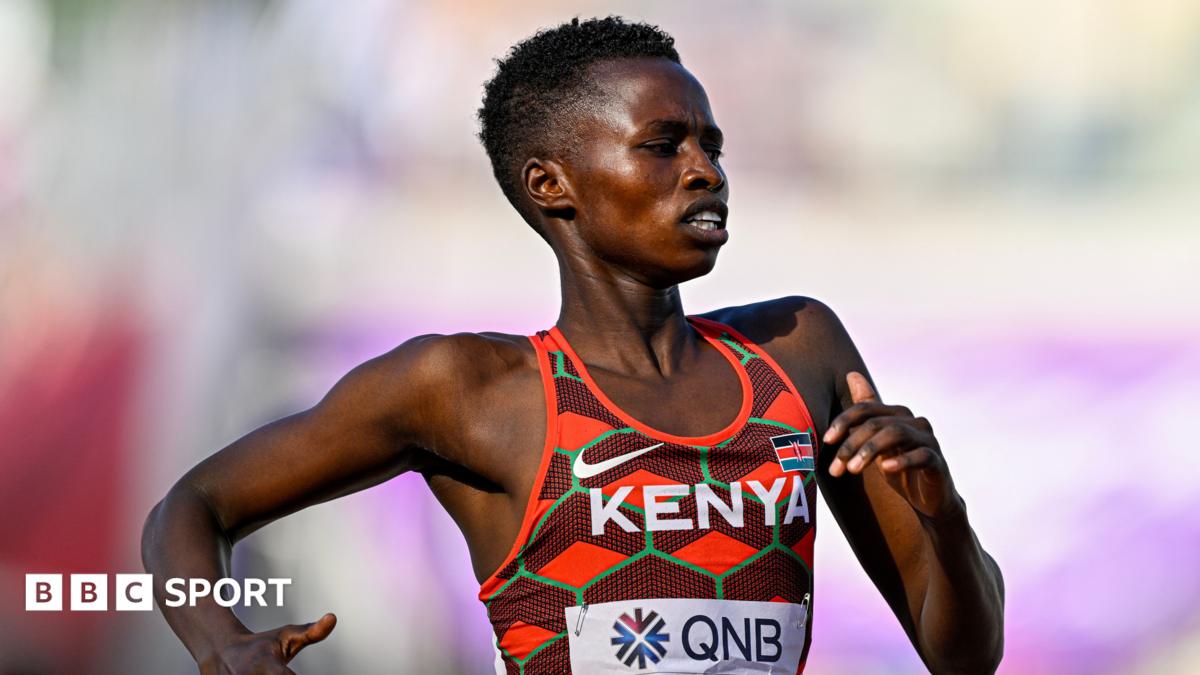
Kenyan middle-distance runner Naomi Korir has turned a 13-year battle with a congenital disabling condition into a story of global athletic success, reaching new career heights this summer when she crossed the line in fifth place at the 2024 Commonwealth Games mile final in Glasgow. But for the 28-year-old, reaching the world stage of elite track and field looked nearly impossible earlier in her life.
Born with congenital genitourinary fistula, a condition characterized by an abnormal opening between the bladder and vagina that causes constant, uncontrollable urine leakage, Korir fell in love with sport as a young girl, but her condition forced her to drastically adjust her early relationship with running. “I played most of the sports activities: football, netball, athletics, even rugby,” Korir recalled in an interview with BBC Sport Africa. “But it was difficult because [of] the training, and the urine is flowing continuously. It’s bad. I reduced my running to shorter distances to reduce the leaking. I began doing 100m hurdles.”
Beyond the physical discomfort, the condition carried severe social stigma that left Korir isolated from peers. Many people avoided her due to misunderstanding of the condition, but her love of athletics became a lifeline that kept her connected to activity and gave her a sense of purpose. “I could do it because I loved it, because most of the people could avoid me, I did a lot of activities just to pass time and not to feel that I’m excluded,” she said.
Fistula, a condition that affects an estimated 500,000 women globally, can develop either as a complication of prolonged obstructed childbirth or, as in Korir’s case, be present from birth. While widespread access to obstetric care and low-cost corrective surgery has all but eliminated the condition in high-income nations, it remains a persistent public health challenge in sub-Saharan Africa, where high-quality specialized care is often out of reach for low-income communities.
Korir endured two failed corrective surgeries before a third successful procedure finally brought her relief in August 2013, when she was 13 years old. The operation was performed at Eldoret’s Gynocare Hospital, a Kenyan facility that specializes in fistula treatment, obstetric care and reproductive health, which has treated thousands of patients from across East Africa since opening in 2011.
Caroline Mabeya, director of Gynocare, explained that the social isolation and stigma surrounding fistula often creates as much harm as the physical condition itself. “It’s a difficult condition to live with every day,” Mabeya said. “They are ostracised in the society. That’s the psychological torture that they face with the fistula.” Unlike many treatment providers, Gynocare offers free care for low-income patients and combines surgical intervention with long-term support to help women rebuild their self-esteem and reintegrate into their communities after treatment. “When they come into the facility, they are crushed, they have low esteem. So, there’s a huge amount of effort that is put in to make them at least be strong enough to be reintegrated and get back into the community,” Mabeya added.
For Korir, successful surgery opened the door to a second chance at both education and her athletic dreams. Through Gynocare’s Young Fistula Programme, she was able to complete her secondary education, while the end of her chronic symptoms allowed her to return to full-distance running training. By 2019, she had turned professional, quickly climbing the ranks of international track and field: in 2021, she claimed a silver medal in the 2x2x400m mixed relay at the World Relays in Poland alongside teammate Ferguson Rotich, followed by a gold medal in the 4x400m relay at the 2022 African Championships in Mauritius.
Her 2024 Commonwealth Games appearance marked her first start in a major global senior final, a milestone that has cemented her role as a beacon of hope for women living with fistula around the world. “I’m giving hope to young women maybe who have lost hope,” Korir said. “They need to come back again in living and enjoying life.”
Mabeya noted that Korir’s journey has become a powerful inspiration for both current patients at Gynocare and the hospital’s staff, who face daily challenges treating the condition and addressing its long-term social impacts. “She makes them realise that you can actually pull yourself out of these struggles and still make it in life and succeed,” Mabeya said. “Naomi actually is one of those patients that inspires us to continue working very hard, because we struggle with this condition and these women. The work is not easy.”
Once a young girl who assumed music would be her future, singing in church and playing keyboard, Korir now has her sights set on even bigger athletic milestones: the 2025 World Athletics Championships in Beijing and the 2028 Olympic Games in Los Angeles. Reflecting on her journey so far, she remains grounded in what her biggest victory has already been. “I know I’m a champion in life, because conquering fistula alone is being a champion,” she said. “Now I’m looking forward to be a champion in sport.”