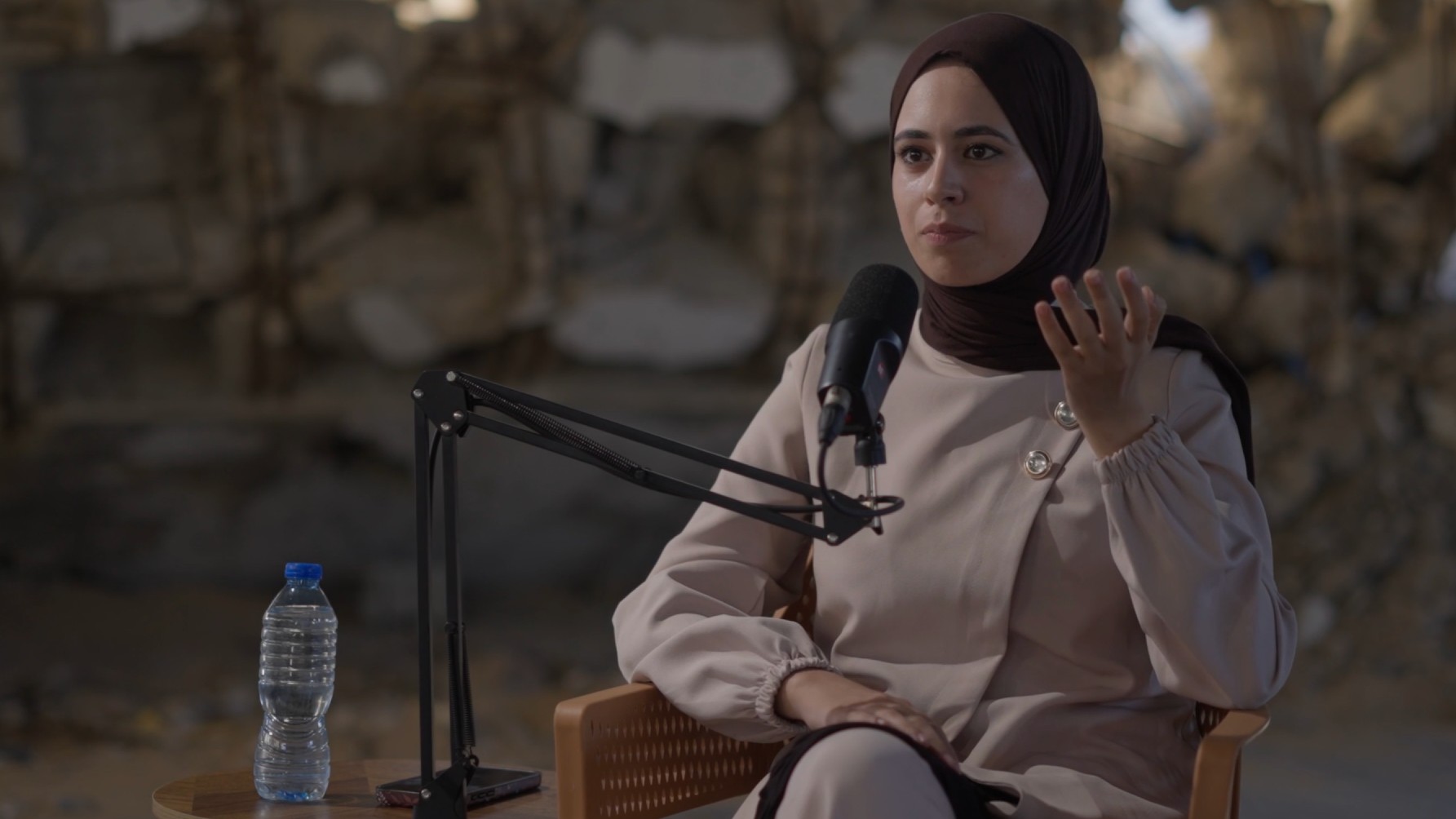
In a raw, firsthand account recorded inside the besieged Gaza Strip for the premiere episode of Middle East Eye’s *The Gaza Podcast*, 24-year-old newly graduated Palestinian doctor Maryam Youssef has laid bare the unimaginable realities of practicing medicine amid ongoing conflict, systemic deprivation, and unprocessed collective trauma.
Youssef’s journey at Nasser Hospital in Khan Younis began after her family was displaced for the second time by Israeli military operations, leaving her with no safe alternative but to volunteer at the facility that would become both her workplace and her home. Like nearly every medical center across Gaza, Nasser has faced repeated Israeli targeting, sieges, and raids—including a weeks-long major military siege in early 2024 and a deadly double-tap airstrike in August 2025 that left dozens dead.
Just 48 hours into her role at the hospital, Youssef contracted chickenpox, a highly contagious infection that forced her to isolate alone in a small room for four to five days while Israeli bombs pounded the surrounding area. She hid her illness from her grieving mother, who had recently lost her brother, waiting weeks to share the news to avoid adding to her family’s pain. “The first two days no one knew. On the third day, my colleagues noticed and got me some medication,” Youssef recalled to podcast host Hussam Tannera. Like all residents of Gaza during Israel’s complete blockade on food entry, Youssef lived with constant hunger: “I think I was hungry most of the time, just as everyone else was. I was drained because even before this, I was staying in the hospital most of the time.”
Systemic shortages of medical supplies have forced Gaza’s medical workers to make impossible compromises that compromise patient care, Youssef explained. “Because of the blockade, we have had to re-use single-use items. You have to hold scissors at a certain angle if you want them to cut. That’s not the best way to treat patients, but because of our situation we have to think about what not only is best, but also what do we have.”
The trauma of conflict has left deep, unprocessed scars for Youssef, who lost her uncle and his entire family in an Israeli strike—learning of their deaths only through a Telegram news alert, when she could not reach her mother by phone to confirm the news. Rather than stepping back to grieve, she threw herself into treating wounded civilians in the hospital’s emergency department to cope: “There were multiple casualties downstairs, and that’s how I kept myself busy.”
For months, Youssef operated in a constant state of “survival mode,” a psychological defense mechanism that allowed her to keep caring for patients but prevented her from processing her own loss and trauma. It is only in recent weeks, after the October 2025 ceasefire, that she has begun to unpack what she lived through. “I don’t think I have processed it. I’m processing right now. When you’re in that mode, you’re in survival mode, and I think I just recently unlocked this mode, because this is a very big burden, and I didn’t feel like I am ready to face it yet,” she said. Today, she uses dark humor as a coping mechanism: “I make a lot of jokes about what life was like at the hospital. I think this is my way of processing it. It’s a defence mechanism.”
Youssef’s account is far from an individual story. It reflects the broader humanitarian and health crisis that continues to grip Gaza months after the ceasefire was declared. According to World Health Organization (WHO) data, more than 1.7 million Palestinians remain internally displaced, most living in overcrowded makeshift shelters with inadequate access to clean water, sanitation, and basic shelter. The UN Office for the Coordination of Humanitarian Affairs (OCHA) reports that 94 percent of Gaza’s population is in urgent need of shelter and basic household assistance. As of last week, the WHO confirmed only 19 of Gaza’s 36 pre-war hospitals are even partially functioning, with no facility operating at full capacity. Critical supplies including essential medicines, diagnostic tools, medical equipment, and fuel remain in catastrophic short supply. The WHO has also estimated that roughly one million Gazans require mental health and psychological support to address the prolonged trauma of war and displacement.
Contrary to widespread international narratives that life has returned to normal in Gaza after the ceasefire, Youssef says the war has merely reshaped itself into a constant, grinding reality. “Most people believe that life is going on and we have moved on,” she said. “The war reshaped itself. It’s not constant bombing all the time, and it’s not like before when 100 people are dying every day… but it’s still happening, it’s a constant rhythm.” Palestinian authorities confirm that at least 1,402 Palestinians have been killed and nearly 5,000 injured since the October 2025 ceasefire took effect.
Youssef’s comments come as the gap between official reconstruction plans and on-the-ground reality continues to widen. Last week, the US-backed Board of Peace unveiled its long-awaited recovery framework for Gaza, with senior adviser Jared Kushner, US President Donald Trump’s son-in-law, acknowledging that progress has been far slower than projected. While the board says $18 billion in reconstruction funding has been pledged internationally, only $280 million has actually been disbursed for on-the-ground projects. Full recovery and reconstruction are estimated to cost $71.4 billion over the next decade.
Board of Peace director-general Nickolay Mladenov admitted that major political obstacles have delayed implementation, particularly amid ongoing Israeli election cycles that have made diplomatic negotiations far more fraught. “Discussions with Israel right now are not easy because of the elections there. Everything is a little bit more emotional, a little bit more politically sensitive,” Mladenov said, adding that the board has no fixed timeline for delivery: “We are not bound by a calendar – we’re bound by verification.”
Today, Youssef continues her medical internship at a primary healthcare clinic in Gaza, still working to care for a population grappling with the unending consequences of war, while slowly working through her own trauma. Her account offers an unflinching reminder of the human cost of conflict that persists long after ceasefire declarations make global headlines.