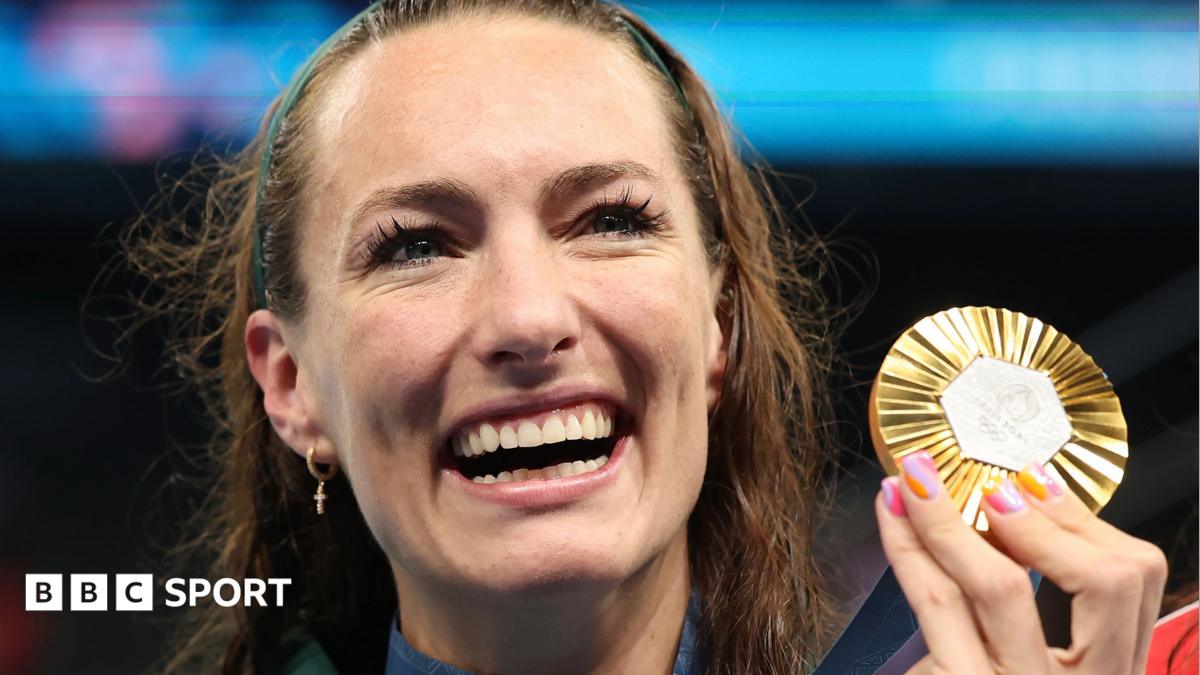
South Africa’s most decorated Olympian Tatjana Smith has opened up about the burnout and systemic challenges that pushed her to retire from competitive swimming immediately after claiming the nation’s only gold medal at the 2024 Paris Olympic Games — and why she has reversed that decision to chase a new goal at the 2028 Los Angeles Olympics.
Smith, 29, captured her second individual Olympic gold in Paris with a win in the women’s 200m breaststroke, adding to her 100m breaststroke title from the 2020 Tokyo Games. She also took home silver in both Tokyo and Paris, bringing her total Olympic medal count to four — a mark matched only by South African swimming star Chad le Clos, who earned one gold and three silvers across the 2012 London and 2016 Rio Games. But her sudden retirement right after Paris shocked many, given her continued dominant performance at the sport’s highest level.
Looking back, Smith says she had long lost her passion for the sport that shaped her entire life. After stepping away from competition for two years between Tokyo and Paris, a break that included months where she did not swim at all, Smith said she finally felt free from the pressures that turned her love of swimming into a chore. “My whole life, I was kind of a robot towards swimming,” she shared in an interview with BBC World Service’s Newsday. “You’re so zoned in, you’re obsessed with something, so there isn’t actually time for you to think about things outside of the pool that you potentially have a passion for.”
While many argued her retirement timing was poor, Smith said she remains convinced the decision was right for her at the time. Beyond burnout, financial instability and a misaligned national sports system also drove her exit. Smith recalled relying on her parents for financial support until she broke a world record at the Tokyo Olympics, when sponsorship interest finally picked up. But she noted that most athlete sponsorships are tied directly to performance, creating constant pressure to deliver results to earn a living. Combined with a dispute with Swimming South Africa over prize money and a system she says does not prioritize athlete well-being, the burden became too heavy to bear.
Smith, who changed her surname from Schoenmaker after marrying sports agent Joel Smith in 2023, added that shifting life priorities also factored into her choice to step away. As a woman considering starting a family, athletic career planning requires careful timing, she explained: “if you’re pregnant, it’s not like you can still compete.”
The post-retirement transition was far from smooth, Smith admitted. Having built her entire daily routine around swimming for decades, she experienced the common “post-Olympic emptiness” that many retired athletes describe. “It was such an emptiness in my life, because my whole life revolved around swimming,” she said. “The world is so overwhelming. It’s like, in which direction to go? It was definitely the toughest season that I had to go through.” She initially took on public speaking engagements to cover expenses, but quickly learned the work was not for her: “I hate public speaking. I hate being in front of people.”
What began as a casual return to the pool for fitness eventually sparked an unexpected change of heart. After a short-lived experiment with triathlon — which she abandoned because the intense training made her realize she missed swimming more — Smith gradually reconnected with the joy of the sport. Over a year and a half away from competitive pressure, she rediscovered the feeling that drew her to swimming as a child.
Now, Smith is coming out of retirement to pursue a new challenge: the 50m breaststroke, an event added to the Olympic program for the first time for the 2028 Los Angeles Games. Calling the move a chance to reinvent herself, Smith explained that the sprint event requires a completely different physical and training approach than the 100m and 200m distances she dominated for years. “It’s like a 400m runner and a 100m runner. It’s two different body types, two different trainings, and that’s where I’m going,” she said.
To protect her renewed love for the sport and maintain a balanced lifestyle, Smith has cut her training volume dramatically: from eight swimming sessions a day with 12 kilometers of distance daily to just three sessions a week, totaling 12 kilometers for the entire week, with a new focus on explosive power rather than endurance. Though she already has 20 years of endurance training behind her, she is working to build the fast-twitch muscle fibers required for sprint swimming, a whole new challenge for her body.
After two decades of competing under external pressure and expectations, Smith says this return is entirely on her own terms. “Swimming was an opportunity given to me by my parents and I believe I took it on full heartedly. But, for the first time, it’s my decision whether I want to come back. I’m choosing swimming. I’ve achieved way more than I ever dreamed in my whole life, so I have nothing to prove.”