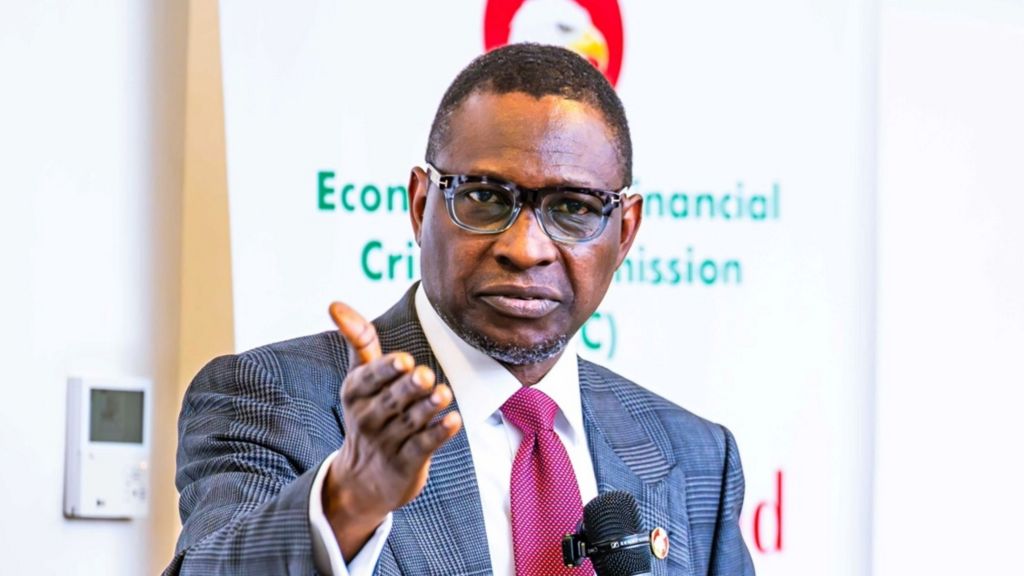
Nigeria’s top anti-graft watchdog has carried out a major internal clean-up, removing more than four dozen of its own employees over allegations of corruption and financial misconduct in the three years since current leadership took office. The announcement came from Ola Olukoyede, chairman of the Economic and Financial Crimes Commission (EFCC), during a public briefing in the nation’s capital Abuja, where he outlined the agency’s progress and structural reforms since he assumed leadership in October 2023.
According to Olukoyede, more than five of the dismissed staff have already been formally charged and are facing prosecution in court, while investigative case files are still being compiled for the remaining terminated employees to move forward with legal proceedings. The EFCC, Nigeria’s primary agency tasked with probing financial crimes including advance fee fraud, money laundering, and public sector corruption, regularly pursues high-profile cases against sitting politicians, senior public officials, prominent business leaders, and other figures accused of diverting or misappropriating public funds.
In comments to reporters at the briefing, Olukoyede confirmed the scale of internal accountability measures, noting that he had personally authorized the dismissal of over 40 staff members over his three-year tenure over proven charges of corruption and financial malpractice. As part of a broader package of internal reforms to strengthen ethical standards across the agency, Olukoyede revealed that the EFCC’s existing Department of Internal Affairs has been formally rebranded as the Department of Ethics and Integrity, to reflect its renewed mandate of upholding professional integrity within the commission.
To further mitigate risks of conflicts of interest and improper influence, the EFCC has also introduced a new mandatory policy regulating gifts and hospitality received by agency staff. The new rule requires all EFCC officers to formally declare any gifts received that exceed an undisclosed monetary threshold, a requirement that extends even to gifts sent by relatives living outside of Nigeria.
Olukoyede emphasized the non-negotiable need for internal probity in the agency’s anti-corruption mission, stating: “You must be sure that your hands are clean. You can’t be fighting corruption when your hands are soiled with corrupt practices.” When the BBC reached out to the EFCC to request additional details on the specific allegations against the dismissed former employees, the agency declined to release further information, noting the data was not currently available for public disclosure.
Beyond internal reforms and staff dismissals, Olukoyede highlighted a string of strong enforcement outcomes achieved during his tenure, announcing that the EFCC had recovered a record 1.23 trillion naira (equivalent to approximately $925 million or £683 million) in stolen funds, with an overall conviction rate for prosecuted cases exceeding 75% between October 2023 and July 2026.
Breaking down the agency’s operational output, Olukoyede reported that over the 33-month period, the EFCC received 49,673 public petitions alleging financial crimes, completed investigations into 39,615 separate cases, filed 14,476 formal charges with the courts, and secured 10,872 criminal convictions. In the first half of 2026 alone, the agency secured 1,370 convictions from just 1,889 filed cases, a result Olukoyede said demonstrates the commission’s improving efficiency and focus on evidence-based prosecutions.
“These results reflect diligence, resilience and a prosecutorial approach anchored on evidence and courtroom outcomes,” he added. Data presented at the briefing also revealed a shifting priority in the EFCC’s caseload, with a growing share of investigations now focused on cybercrime and cyber-enabled fraud, alongside traditional corruption cases involving high-profile public officials.