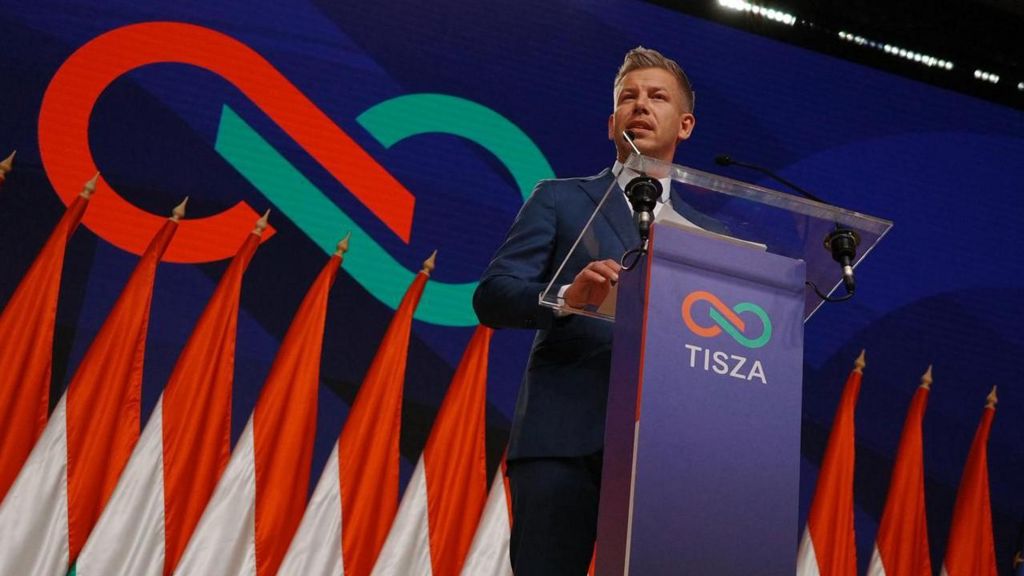
One day after delivering a historic political upset that ended Viktor Orbán’s 16 consecutive years in power as Hungary’s prime minister, Péter Magyar, leader of the newly victorious Tisza party, laid out his bold domestic and foreign policy agenda during a marathon three-hour press conference on Monday.
Magyar opened his remarks by revealing that he had already held introductory conversations with 10 European leaders in the immediate aftermath of his landslide victory, signaling a sharp shift away from Orbán’s often Euroskeptic and Russia-aligned agenda. On the topic of Russia, which had maintained a close partnership with Orbán’s outgoing administration, Magyar struck a clear, firm tone: he would not be the one to initiate contact with Russian President Vladimir Putin, though he would take the call if Putin reached out. “If Vladimir Putin calls I’ll pick up the phone,” Magyar told assembled reporters. “I don’t think it’ll happen, but if we did talk I’d tell him to please, after four years, put an end to the killing and end this war.”
The Kremlin responded to Magyar’s victory with a measured statement, saying it respects the election outcome and expects to maintain pragmatic bilateral relations with the new Budapest government.
Magyar mirrored his stance on another high-profile relationship, saying he would not reach out to former U.S. President Donald Trump, who had openly endorsed Orbán’s re-election bid and received public backing from U.S. Vice President JD Vance during a two-day campaign stop in Hungary last week. If Trump contacts him, however, Magyar said he would affirm that the two are strong NATO allies and extend an invitation to Hungary for the 70th anniversary of the 1956 Hungarian uprising against Soviet occupation, scheduled for next October.
A one-time insider within Orbán’s own Fidesz party, Magyar launched his political movement as a grassroots campaign centered on rooting out systemic corruption and cronyism that had flourished under Orbán’s long tenure. Preliminary official election results, adjusted after an initial count, give Tisza 136 seats in Hungary’s parliament — still a comfortable two-thirds supermajority, enough to allow the new government to amend the national constitution. With roughly 400,000 ballots still left to tally, Magyar said he remained optimistic his party would pick up additional seats in the final count. He emphasized that Sunday’s result was far more than a routine change of government: it was a mandate for complete regime change.
European Commission President Ursula von der Leyen, one of the 10 leaders Magyar had already spoken to on Monday, summed up the bloc’s reaction in one line: “Hungary has chosen Europe.” Magyar doubled down on that sentiment, stressing that Hungary’s place is firmly within the European Union regardless of the outgoing government’s past positioning, and that joining the eurozone is a core national interest for his country. He also outlined his first round of diplomatic visits, which will take him to Poland, Austria, and Germany — three nations he said Hungary shares deep historical and political ties with.
The contrast between Magyar’s agenda and Orbán’s outgoing administration could not be clearer on the war in Ukraine. For years, Orbán has blamed the EU and Ukrainian President Volodymyr Zelenskyy for prolonging Russia’s full-scale invasion, a narrative he repeated throughout his election campaign. Last month, Orbán blocked a proposed €90 billion EU aid package for Kyiv, drawing widespread accusations of disloyalty from fellow EU member states.
Magyar rejected that framing outright, telling reporters: “Every Hungarian knew that Ukraine was the victim of the war with Russia.” He added that the war is also senseless from Russia’s perspective, noting “tens of thousands of Russians have lost their lives, and tens or even hundreds of thousands of Russian families have been destroyed”, including Russian-speaking communities living in Ukraine. He joked that any call with Putin would likely be brief, adding “I don’t think he’d end the war on my advice.”
Orbán’s government has long faced questions over its close ties to Moscow, with scrutiny intensifying in recent months after Hungarian Foreign Minister Péter Szijjártó admitted he shared information about EU sanctions discussions with Russian officials both before and after EU meetings. A leaked recording also alleged Szijjártó told Russian Foreign Minister Sergei Lavrov “I am at your service”, a revelation that prompted Orbán to order a domestic wiretapping investigation into the leak.
Midway through Monday’s press conference, Magyar was handed an urgent note that led him to make a fresh allegation: Szijjártó’s foreign ministry was actively shredding confidential documents related to the government’s dealings with Russia and sanctions policy on the very same day. As of the press conference, the outgoing foreign ministry had not issued any comment responding to the claim.