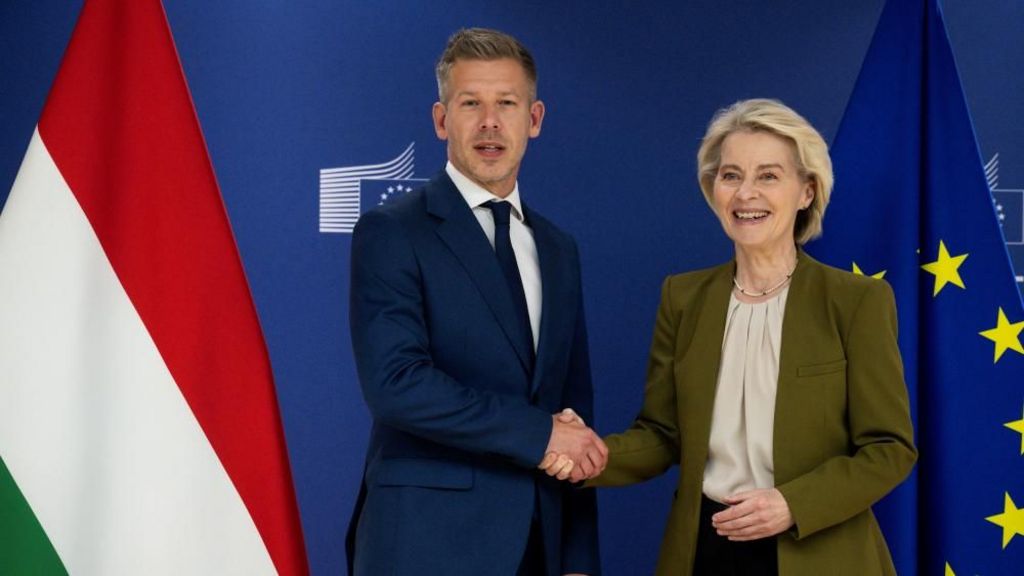
Weeks after ending 16 years of nationalist rule under Viktor Orbán in a landslide election victory, Hungary’s incoming Prime Minister Péter Magyar has already begun urgent high-stakes diplomacy in Brussels to unlock billions of euros in frozen European Union funds, even before his formal swearing-in next month.
Magyar, whose newly formed Tisza party secured a two-thirds parliamentary supermajority in the April 12 election, held his first in-person talks with European Commission President Ursula von der Leyen during his debut visit to the EU capital. He described the negotiations as “extremely constructive and successful,” leaving confident that long-blocked EU resources will flow to Hungary in the near term.
For years, more than €32.8 billion in combined EU recovery, cohesion, and defense funding has been frozen over the Orbán government’s documented democratic backsliding, systemic corruption, and repeated clashes with EU rule of law standards. On top of the frozen allocations, Hungary has been forced to pay €1 million in daily fines for violating EU migration policies, a penalty Magyar has vowed to end.
The most pressing deadline facing the incoming government is the expiration of the €10.4 billion EU Covid-19 recovery fund at the end of August. If Budapest fails to meet a pre-set series of anti-corruption and judicial reform milestones by that date, Hungary will lose access to the allocation permanently. Beyond the recovery funds, an additional €6.3 billion in cohesion funds remains blocked over rule-of-law concerns, while another €16.1 billion in low-interest EU defense loans is available once reforms are implemented.
Magyar moved quickly to reassure both Brussels and Hungarian voters that unlocking the funds will not require concessions harmful to national interests. He emphasized that the unblocked billions will provide a much-needed boost to Hungary’s stagnant economy, which has recorded near-flat growth for three consecutive years. Márton Hajdu, a senior Tisza party official, outlined the straightforward conditions Brussels has required: independent judiciary free from government interference and robust measures to eliminate public sector corruption. While Magyar is pushing for a rapid agreement scheduled to be signed during his return to Brussels on May 25, analysts note the incoming government faces a steep challenge to deliver on the required reforms in such a compressed timeline.
Von der Leyen struck a collaborative tone after the meeting, saying the European Commission stood ready to support Magyar’s government as it works to realign Hungarian policy with shared European values. Magyar also held talks with European Council President António Costa, and reaffirmed Hungary’s unwavering place in the European Union in a post-meeting social media statement.
Not yet sworn in until May 9, Magyar has already moved at a breakneck pace to reset Hungary’s relationship with the EU: just two days after his election win, he placed a personal call to von der Leyen to press for progress on fund release. Beyond economic and EU policy, the new government is also moving to repair strained ties with Ukraine. Orbán’s long-held veto on a €90 billion EU loan package for Ukraine was lifted last week at an informal summit the outgoing prime minister declined to attend, and Magyar has extended an offer to meet Ukrainian President Volodymyr Zelenskyy in early June in the Hungarian-majority Ukrainian town of Berehove.
Political analysts note Magyar enters his term with rare advantages for advancing his reform agenda: his party’s parliamentary supermajority gives Tisza the power to amend the Hungarian constitution unilaterally, and the EU has already signaled significant goodwill toward the new government after years of friction with Orbán’s administration. What remains to be seen is whether Magyar can meet Brussels’ tight reform requirements to unlock the vital funds before the critical August deadline.