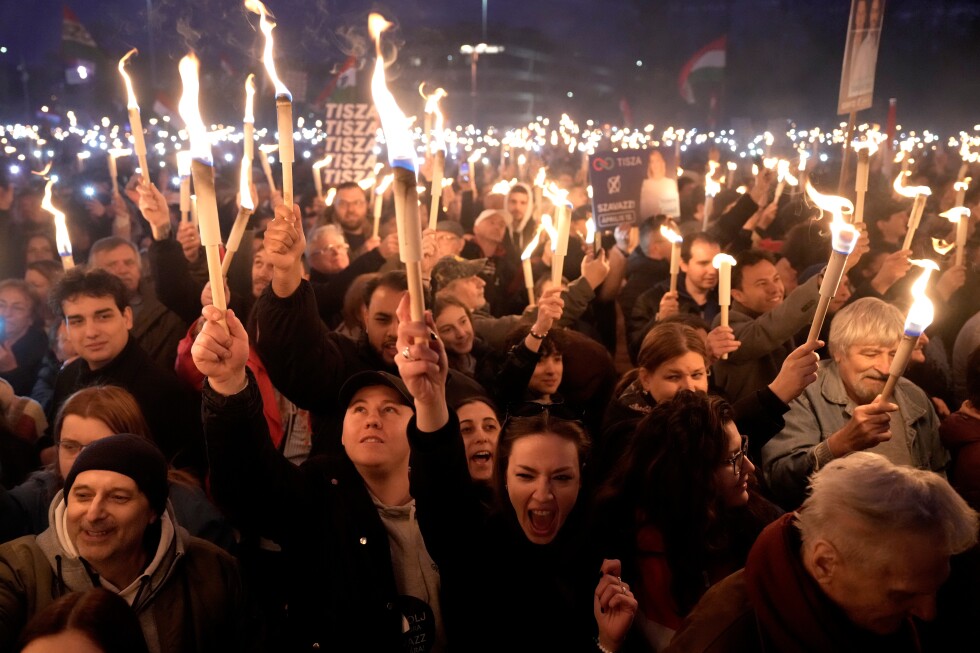
On the eve of Hungary’s most consequential national election in over a decade, the country’s two largest political factions wrapped up chaotic, high-stakes campaign seasons Saturday with closing rallies that laid bare the stark divides shaping Sunday’s vote. For incumbent Prime Minister Viktor Orbán, the ballot box marks the greatest existential threat to his 16-year grip on national power, as challenger Péter Magyar’s upstart center-right Tisza Party has surged to double-digit leads in most independent public opinion surveys. A Tisza victory would oust Orbán in one of the most dramatic political upsets in modern Hungarian history, though many analysts caution the final result could be far closer than polling suggests, noting Orbán’s ruling Fidesz party retains a deeply loyal, highly mobilized base across rural Hungary.
Magyar, a 45-year-old lawyer and one-time insider within Fidesz’s own political circle, has spent the past two years crisscrossing the country, stopping in hundreds of small towns and rural communities to court voters who have long backed Orbán. Saturday, he brought his closing argument to Debrecen, Hungary’s second-largest city and a longstanding Fidesz stronghold, where thousands of cheering Tisza supporters packed University Square to hear him speak.
Striking an optimistic, defiant tone, Magyar framed Sunday’s vote as a defining turning point for the nation. “This election will enter Hungarian history books as the day of resurrection, the renewal of the Hungarian nation, and of the real change of regime,” he told the crowd. Rejecting the divisive rhetoric that has defined Orbán’s tenure, Magyar extended an olive branch to Fidesz voters, promising his first act in office would be to pursue national reconciliation. “As the winner of the election, we will have to extend a hand to our fellow countrymen,” he said, outlining a plan to reunite a country split by years of polarized rule.
Addressing one of the core pillars of his campaign, Magyar reaffirmed his commitment to keeping Hungary anchored in the European Union, reversing Orbán’s gradual shift toward closer political and economic ties to Moscow. As supporters waved Hungarian flags and chanted “Európa! Európa!”, he declared, “many millions” of voters would confirm on Sunday that “Hungary’s place was, is, and will be in Europe.”
Annamária Matkovics, a 50-year-old farmer and local Tisza activist in the eastern Hungarian town of Balmazújváros, who joined the party when it launched in 2024, said even in traditional Fidesz heartland, discontent with the incumbent has reached a breaking point. While many voters report fears of retaliation — including losing their state-supported jobs — if they are caught backing the opposition, Matkovics said most dissidents are still prepared to vote for change. “When we’re campaigning on the street, people tell us that they’re worried that they’ll lose their jobs if they don’t vote for Fidesz, and they’re still planning to vote for Tisza,” she said. “They’ve had enough of the division.”
A few hundred kilometers away in Budapest, Orbán closed his campaign to thousands of supporters on the city’s historic Castle Hill, doubling down on the core message that has defined his reelection bid: framing the election as a choice between stability and risky change, amid what he calls a wave of external threats endangering the Hungarian people. With Russia’s ongoing full-scale war in neighboring Ukraine top of mind, Orbán warned the country could not afford to hand power to an inexperienced newcomer.
“We are in an age of danger,” Orbán told the crowd. “Hungary is facing serious challenges. We need to say no to major power groups in the world in order to defend ourselves, and this requires knowledge, experience and routine. Now is not the time to take risks, to change, to renew and to adventure. Now we need to protect and secure what we have.”
Orbán’s campaign has been hobbled by multiple headwinds this cycle: stubbornly poor economic performance that has driven high inflation and rising living costs for ordinary Hungarians, growing public scrutiny of his administration’s increasingly close ties to the Kremlin, and persistent allegations of systemic corruption that benefit a small circle of political allies close to the prime minister. To shore up support, Orbán has leaned heavily on his high-profile relationship with former U.S. President Donald Trump, who has repeatedly endorsed his reelection. Earlier this week, U.S. Vice President JD Vance traveled to Budapest for a two-day campaign stop, headlining a publicly funded rally alongside Orbán to boost his bid for a fifth term.
In contrast to Orbán’s focus on external threats and geopolitical risk, Magyar has centered his campaign on bread-and-butter issues that directly impact Hungarian households: soaring inflation, skyrocketing living costs, and the crumbling state of public healthcare and transportation infrastructure. He has also made a core campaign promise to root out what he calls endemic government corruption that has enriched a tiny elite at the public’s expense — allegations Orbán has repeatedly denied. With turnout expected to be high across the country, all eyes now turn to Sunday, when Hungarian voters will decide whether to extend Orbán’s 16-year tenure or usher in the most sweeping political change the country has seen in a generation.