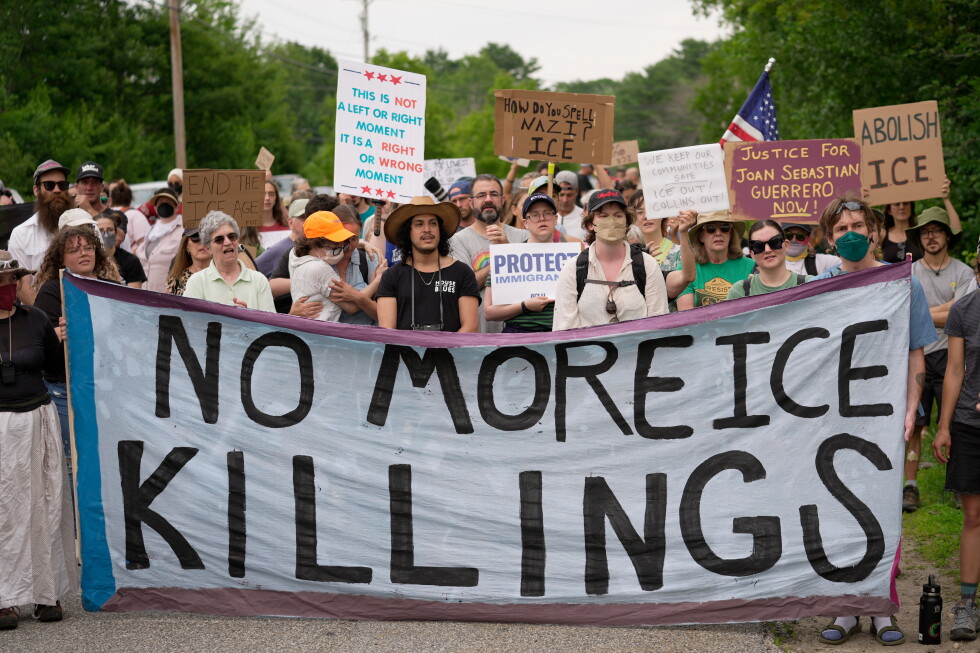
BIDDEFORD, Maine — Hundreds of demonstrators gathered across southern Maine on Tuesday to denounce the fatal shooting of 26-year-old Colombian national Johan Sebastián Durán Guerrero by a U.S. Immigration and Customs Enforcement officer, an incident that has sparked national outrage over conflicting official accounts of the deadly encounter and growing scrutiny of the Trump administration’s aggressive immigration enforcement agenda.
The shooting unfolded Monday as ICE agents carried out surveillance on a Biddeford residence connected to an individual facing a final deportation order for unlawful presence in the United States. Initial public accounts from federal officials have already shifted, creating confusion around the circumstances of Durán Guerrero’s death. In a post on the social platform X, the Department of Homeland Security claimed the ICE officer opened fire after the vehicle Durán Guerrero was driving attempted to flee the stop, saying the agent acted “fearing for public safety.”
This account contradicts an earlier description shared by Maine Senator Angus King, who said Homeland Security Secretary Markwayne Mullin told him the officer fired after Durán Guerrero attempted to use his vehicle as a weapon against agents. King also confirmed that agents were not serving an arrest warrant for Durán Guerrero at the time of the encounter, raising additional questions about why the 26-year-old was targeted.
The Colombian Embassy formally confirmed Durán Guerrero’s identity to the Associated Press, and outgoing Colombian President Gustavo Petro — who has had repeated public clashes with President Donald Trump — issued a scathing rebuke of the shooting on X. Petro called the incident a deliberate targeted killing “at the hands of the U.S. government,” accused ICE agents of treating Durán Guerrero as “an inferior being without rights,” and called on the Trump administration to release a full public explanation for the shooting.
Outrage over the killing quickly spread across Maine, with hundreds of protesters assembling outside the ICE detention center in Scarborough, a coastal community between Biddeford and Portland. Demonstrators carried signs reading “Stop the murder” and “End this terror,” with event organizer Todd Chretien telling the crowd, “These people are killers and they must leave our state now.”
The shooting marks the second fatal use of force by ICE in just one week, and the ninth deadly incident tied to the agency since Trump launched his administration-wide immigration crackdown. Compounding growing calls for transparency, the officers involved in the Biddeford shooting were not wearing body cameras, leaving key details of the encounter unaccounted for. Key unanswered questions include how close the officer was to the vehicle when shots were fired, whether agents ordered Durán Guerrero to stop before opening fire, and what specific threat to public safety ICE claims the driver posed. In a brief statement, an ICE spokesperson declined to disclose details of agency tactics, saying only, “We are always evaluating our procedures to keep our officers safe and criminals off our streets.”
Maine’s senior Republican Senator Susan Collins confirmed that the DHS Office of Inspector General is leading the investigation in partnership with the FBI. The Maine Attorney General’s office, which is also cooperating with federal investigators, said initial statements indicate Durán Guerrero was attempting to flee toward the shooting officer when shots were fired. The unnamed officer has been placed on administrative leave pending the outcome of the probe, and photos of the vehicle show multiple bullet holes in the front windshield.
Security camera footage from a nearby local business obtained by the AP shows Durán Guerrero’s white car slowly approaching a nearby intersection before circling the area multiple times. A law enforcement SUV blocks the vehicle’s path, after which two officers pull open the driver’s side door and drag out a limp body. The timing of the gunfire is not visible in the clip. Daniel Boucher, a nearby resident who heard the gunshots and ran to the scene, said he saw Durán Guerrero bleeding from the face and head, and clearly heard the victim say, “I tried to stop.” Boucher also recalled the shooting officer telling him, “He tried to run me over,” shortly after the incident.
Community members who knew Durán Guerrero described him as a friendly, regular presence in the Biddeford neighborhood, where he lived with his wife and young daughter. Two advocacy groups, the Maine Immigrants’ Rights Coalition and Presente!, say Durán Guerrero held valid work authorization to live and work in the United States. Neighbors noted he rarely spoke with locals due to limited English proficiency, but was a familiar sight around the area. Sadie Dilboy, co-owner of a local laundromat that Durán Guerrero visited often, said he frequently came to the business with his young daughter, who he would give quarters to buy candy. “Everyone knows him,” Dilboy said. Claudia Morton, a nearby neighbor who often waved to Durán Guerrero, described herself as distraught over the killing, saying Tuesday, “The whole world should be crying.”
Just one week before the Maine shooting, another ICE officer fatally shot 52-year-old Lorenzo Salgado Araujo in Houston as he drove to a construction job site, following a pursuit by federal agents in unmarked vehicles. The back-to-back shootings come as the Trump administration ramps up its mass deportation agenda: ICE data shows the agency arrested more than 10,000 people over just five days at the end of June, a sharp surge in enforcement that signals an expansion of crackdown efforts after the administration shifted away from targeted city-wide raids. This is not the first time the administration’s enforcement policies have faced widespread condemnation: last winter, two killings in Minnesota — that of Alex Pretti and Renee Good — sparked national outcry over aggressive deportation tactics.
Reporting for this story was contributed by Astrid Suarez in Bogota, Colombia, Rebecca Santana in Washington, D.C., and John Seewer in Toledo, Ohio, with original reporting from AP correspondents in New Orleans and New York.