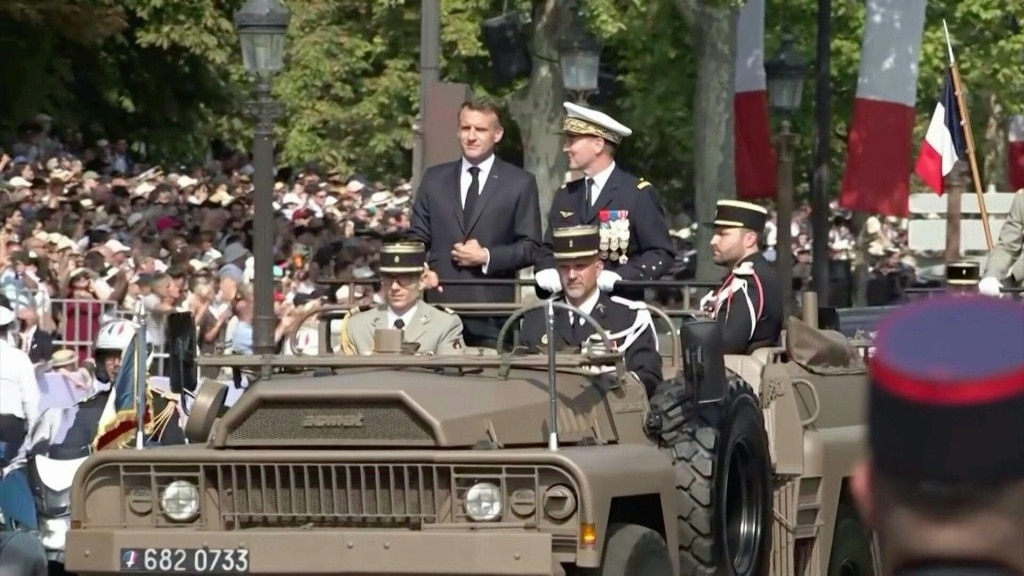
On July 14, France hosted the largest national day parade in its history, turning the iconic Champs-Élysées avenue between the Arc de Triomphe and Place de la Concorde into a showcase of collective military power and pan-European solidarity, as the continent accelerates rearmament efforts in the wake of Russia’s full-scale invasion of Ukraine. The ceremony, marking the 235th anniversary of the storming of the Bastille that launched the French Revolution, marked the final Bastille Day parade led by sitting President Emmanuel Macron before he leaves office in 2025 after two full consecutive terms, and brought together more than two dozen global heads of state and government alongside thousands of troops from across Europe.
Ukrainian President Volodymyr Zelenskyy took the role of guest of honor at the event, which came one day after Macron hosted a fresh summit of Ukraine’s international supporting allies, four and a half years into Russia’s ongoing full-scale invasion. Among the other high-profile leaders in attendance were German Chancellor Friedrich Merz and British Prime Minister Keir Starmer, who joined Macron in leading joint European efforts to sustain military and political support for Kyiv. This appearance marked one of Starmer’s final foreign engagements early in his new premiership.
In total, nearly 6,700 military personnel, 98 aircraft, 31 helicopters, and 315 military vehicles took part in the procession, breaking records for the size of the annual Western European parade. Around 500 soldiers from the Coalition of the Willing, the group of mostly European nations backing Ukraine against Russian aggression, marched in the parade, with 25 Ukrainian troops following behind coalition contingents in a deliberate symbolic gesture. For the first time in the event’s history, French aircraft flew over the Champs-Élysées carrying dummy armaments including Scalp cruise missiles, a public demonstration of France’s combat-ready posture. Newly modernized French military equipment, including Griffon and Jaguar armored vehicles and truck-mounted reconnaissance drones, was also displayed to highlight progress on armed forces upgrades in recent years.
In a poignant nod to European air support for Ukraine, Ukrainian pilots who had completed training in France co-piloted two French Mirage 2000 fighter jets during the aerial flyover. The Mirage 2000 is among the combat aircraft France has transferred to Ukraine to bolster its air defenses against Russian drone and missile strikes. The United Kingdom also sent its largest contingent to the parade in more than 20 years, with soldiers from the Grenadier Guards marching alongside France’s elite Garde Républicaine.
Tens of thousands of civilian spectators gathered along the parade route, enduring a severe seasonal heatwave after registering for entry via special QR codes to clear tightened security perimeters. The event also carried a somber undercurrent: 2026 marks the 10-year anniversary of the 2016 Nice Bastille Day attack, where a terrorist driver rammed a truck into crowds leaving a fireworks display, killing 86 people and injuring more than 400 others. Macron planned to travel to Nice later the same day to lead a memorial commemoration for the victims.
Senior French officials framed the parade as a clear statement of European unity in the face of mounting security threats. “What is marching past is a Europe united and determined to support Ukraine in the face of Russia — a Europe confident in itself,” French Deputy Defence Minister Alice Rufo told broadcaster RTL radio. Chief of the Defence Staff General Fabien Mandon described the event on social media platform X as “a physical embodiment of the strategic solidarity between our countries.” Mandon, who sparked public controversy last year for stating France must prepare to “accept losing its children” in a potential future conflict with Russia, has repeatedly warned that European nations must build up their defensive capabilities to counter Russian aggression.
Macron, who has made European strategic autonomy and reduced reliance on the United States a central plank of his foreign policy, doubled down on this stance in remarks ahead of the parade. On Monday, he stated that Europe was prepared to fight to defend its freedom, even if that requires European troops to sacrifice their lives. “Yes, we cherish freedom and the rule of law. And yes, we stand ready to fight to defend them. Always, and at the cost of blood if necessary,” Macron said.
Zelenskyy welcomed his country’s inclusion in the historic parade, saying it represented “a sign of respect and recognition of the strength of Ukraine, our people, and our armed forces.”
The event closes out a tenure for Macron that has seen consistent increases to French defense spending and deeper defense cooperation with European allies. Notably, the 2017 Bastille Day parade, early in Macron’s first term, famously hosted then-US President Donald Trump for his first major state visit to Europe. A decade later, with Trump back in office and widely viewed as an unpredictable ally on security issues, European leaders have moved to accelerate their own defense integration and rearmament. After the parade, Parisians and visitors were set to gather on the Champs-Élysées in the evening to watch the World Cup semi-final match between France and Spain.