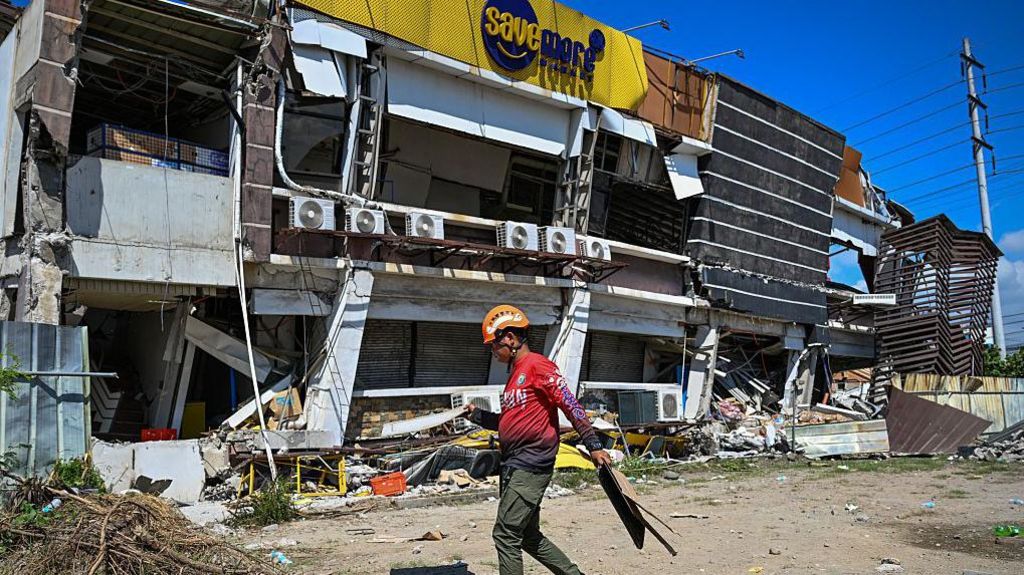
A powerful magnitude 7.8 earthquake that struck the southern Philippine island of Mindanao early Monday has left at least 37 people dead and 487 others injured, with disaster officials warning the casualty count is likely to climb as emergency teams reach cut-off coastal communities. Hundreds of aftershocks have continued to rattle the disaster zone, hampering rescue and recovery efforts across the region.
The seismic event left a trail of catastrophic destruction in its wake: multi-story buildings have collapsed, paved roads have split open or been swallowed by landslides, and large portions of Mindanao remain completely cut off from power and communications infrastructure. The initial quake also triggered widespread tsunami warnings across regions as far as southern Indonesia and Japan’s Pacific coastline, forcing tens of thousands of residents to evacuate their homes for higher ground.
As search operations entered their first full day, disaster response officials confirmed that priority remains focused on pulling survivors from rubble and reaching isolated communities. “We hope the death toll does not increase further, but we are expecting it to move. Our priority today is search and rescue,” Bernardo Alejandro, assistant secretary of the Philippines’ disaster response oversight agency, told local radio station DZMM. As of initial assessments, close to 2,000 residential structures and more than 6,000 public schools have sustained damage across the affected region.
The Philippines sits along the geologically active Pacific Ring of Fire, making it highly prone to major earthquakes and volcanic eruptions. Monday’s temblor originated from tectonic movement along the Cotabato Trench, a fault zone off the country’s southern tip that has produced some of the deadliest seismic events in the nation’s recorded history. In 1976, a magnitude 7.9 quake from the same trench generated a devastating tsunami that killed an estimated 5,000 people.
On-the-ground accounts from survivors capture the chaos and terror of the two-minute-long quake. In Lebak town, public school teacher Cesar Sundo described the shaking as feeling like being violently rocked in a hammock, with the intensity building by the second. Thousands of young students, most under 10 years old, panicked and cried as the ground bucked beneath them. By chance, the entire school was gathered outside for their weekly Monday morning flag ceremony when the quake hit, a circumstance that likely saved countless lives.
“They were lucky to be outside. They were able to stay put and sit down,” explained Renato Solidum, the Philippines’ science minister and a veteran seismologist, confirming that the outdoor assembly saved many students from injury or death when structures collapsed around them. “These areas have experienced strong earthquakes before. This is one of the strongest.”
Viral footage captured from the scene shows a branch of popular local fast-food chain Jollibee in General Santos City crumble to the ground as onlookers scream and retreat to safety. The chain released an official statement Monday night confirming that all its employees across earthquake-impacted areas are unharmed.
Philippine President Ferdinand Marcos Jr. has mobilized the full capacity of the national government to coordinate disaster response. Both the transportation and health secretaries have traveled from the capital Manila to Mindanao to oversee relief efforts on the ground. Health secretary Teodoro Herbosa noted that medical teams treating injured survivors have been interrupted repeatedly by strong aftershocks even as they work.
Access to many hard-hit communities remains severely limited. In Jose Abad Santos, a coastal town on Mindanao’s eastern Davao Occidental province, landslides have buried the region’s only paved highway, cutting off half the town from overland access. “Relief goods have to be flown in to far-flung barangays (villages),” Mayor Jason John Joyce told DZMM.