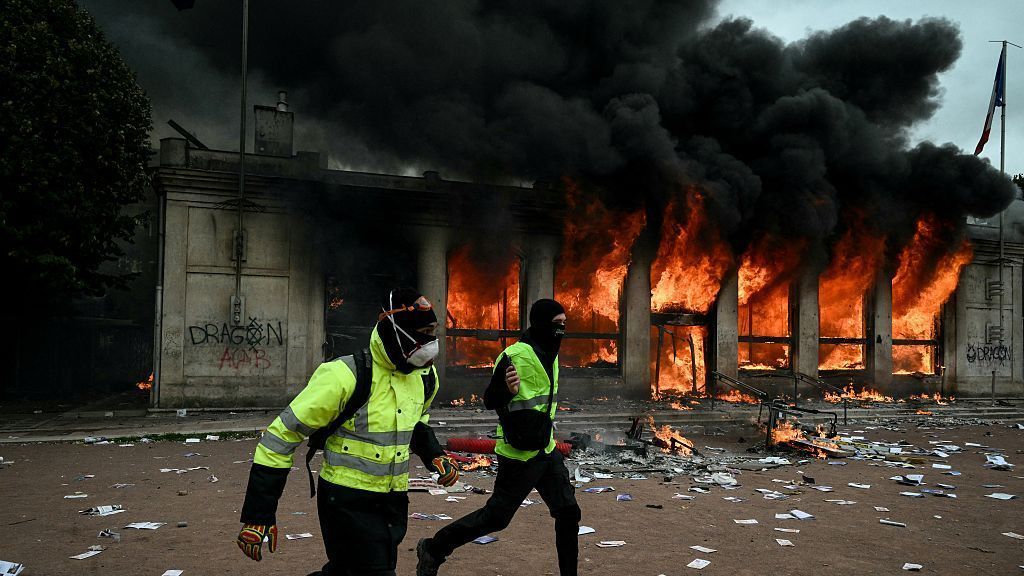
On Saturday, mass demonstrations against declining education standards and soaring living costs across France descended into widespread civil disorder, leaving a trail of destroyed property, hundreds of arrests, and deep political division in the country. An estimated 550,000 protesters gathered in cities from Paris to Marseille, marking the latest escalation of weeks of growing public unrest that has compounded existing pre-election political uncertainty.
While the bulk of the officially organized march in central Paris remained peaceful through the afternoon hours, pockets of unrest broke out across the capital and other major urban centers. By the end of the day, at least 400 people had been taken into police custody, a figure the French government cited as evidence of a sharp escalation in violent activity during the demonstrations. Riot police deployed tear gas and water cannons to disperse disruptive crowds in multiple locations, including Paris’ iconic Place de la République, where vehicles and street fixtures were set ablaze by agitators.
In Lyon, one of the hardest-hit cities, demonstrators set fire to the city’s central tourism office, a historic 19th-century structure that stood as a landmark for the community. Lyon Mayor Grégory Doucet called the destruction a devastating loss for the city, telling local outlet BFMTV that the damage “breaks our hearts because it’s a very iconic, well-known historic building.” Local law enforcement officials reported that hostile groups of protesters blocked firefighters from reaching the blaze, preventing them from containing the fire before the building was destroyed. In Paris, a popular local bar named La Barrique was also burned to the ground, multiple shops were ransacked, and at least one central restaurant was completely gutted by fire. Looting spread across the country: an Apple Store in the northern city of Lille was broken into and emptied, while clothing and grocery stores across Paris were targeted by raiders. Reports of vandalism, arson and looting were also confirmed in Marseille, Rennes, Toulouse, Angers, Grenoble, Avignon, Pau, Montpellier and Valence, with city halls, private businesses and public infrastructure bearing the brunt of the damage.
The current wave of protests first began as a student-led movement over recent weeks, with hundreds of thousands of secondary school students (who attend lycées for students aged 15 to 18) walking out to protest severe staff shortages and crumbling, dilapidated campus facilities. On Saturday, the student movement was joined by thousands of trade union members and other activist groups, swelling the size of the protests and amplifying broader anger over the rising cost of living across France. Many peaceful protesters who spoke to the BBC expressed frustration with the lack of political progress on their demands, with a group of young demonstrators saying they identified as pacifists who “just trying to make things change, but nothing is moving.”
This outbreak of unrest comes as France enters a period of profound political uncertainty ahead of next year’s presidential election. Polling indicates the race is likely to be a tight contest between Marine Le Pen, leader of the right-wing National Rally, and Jean-Luc Mélenchon, head of the hard-left La France Insoumise. Both national leaders have weighed in on the Saturday violence, trading sharp political blame. Mélenchon, who participated in the demonstrations, condemned the arson and looting while accusing police of “unleashing” excessive force against peaceful protesters. Prime Minister Sébastien Lecornu blasted Mélenchon’s comments as “dangerous and cynical,” noting that officers faced “violence of extreme intensity” and arguing that rogue groups were using the protests as a “warm-up” for next year’s election. “No-one will impose their political agenda through violence,” Lecornu said. Le Pen, for her part, said the “legitimate demands” of protesters had been “held hostage by the far left” and blamed Mélenchon for fueling the violence that unfolded Saturday. Outgoing President Emmanuel Macron echoed the prime minister’s hard line, stating that all people found responsible for damaging property, attacking public buildings and looting “will be prosecuted and punished.”
In an attempt to de-escalate the student-led component of the unrest, Education Minister Édouard Geffray announced an apparent concession earlier this month, promising to add 3,000 new temporary supply teachers to understaffed campuses during an October 8 television interview. The gesture has done little to quell public anger, however, and protests have continued to grow in intensity in the weeks since the announcement.