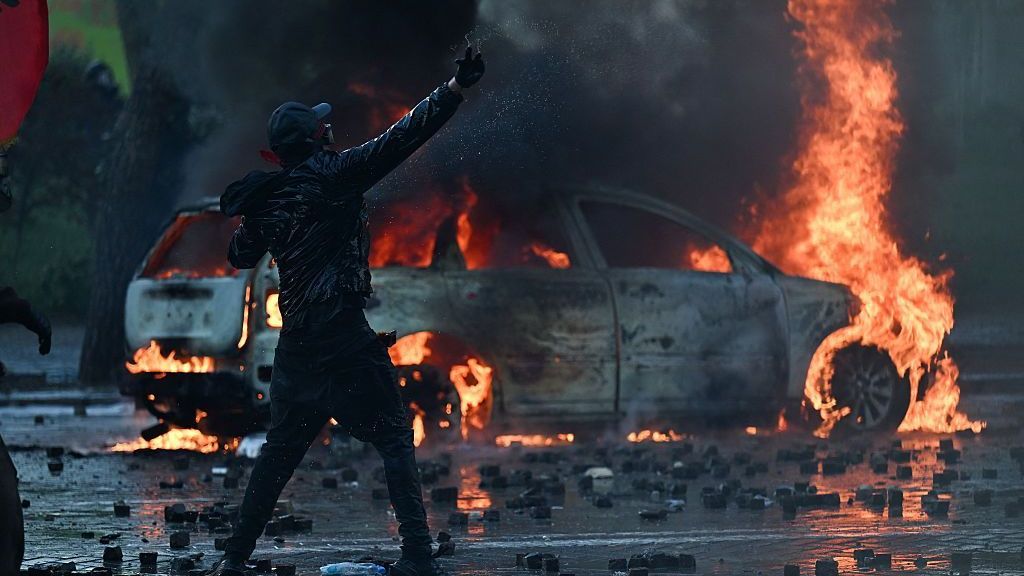
On Saturday, the Albanian capital of Tirana descended into its most chaotic day of civil unrest since anti-government demonstrations began five consecutive days prior, turning the city’s central districts into battlegrounds between thousands of young protesters and lines of riot police.
What started as small-scale student-led demonstrations over education policy grievances in early summer has rapidly evolved into a broad, cross-demographic anti-government movement fueled by widespread allegations of systemic corruption tied to Prime Minister Edi Rama’s administration, with demonstrators unified by a core demand that the long-serving leader step down immediately.
By Saturday, the violence had reached new levels of intensity. Masked demonstrators, a large share of whom are high school and university students, launched repeated assaults on the Albanian Ministry of Education—one of the primary focal points of the movement—hurling cobblestones, rocks and incendiary petrol bombs at police lines defending the building. In response, security forces deployed high-pressure water cannon and repeated volleys of tear gas to disperse the crowds, with unconfirmed reports indicating that rubber bullets were used against demonstrators for the first time since the unrest began.
As the afternoon progressed, the center of action shifted to Rama’s official office located on Tirana’s main central boulevard, where crowds swelled to sizes far larger than those seen on any previous day of protest. Riot police faced a relentless hail of stones and fireworks, responding with continuous barrages of tear gas; many canisters landed deep in the assembled crowds, triggering waves of panic. Protesters, enraged by the gas, would wait for the fumes to clear before renewing their charges on police lines. Demonstrators came prepared for the confrontation: many wore gas masks or protective face coverings, and volunteer medics distributed saline syringes to flush tear gas from irritated eyes. The constant thud of exploding petrol bombs echoed across the city center, while black smoke billowed from a burning vehicle and the wail of police sirens and ambulance alarms cut through the chaos. As dusk fell, elite police special forces were deployed to reinforce overstretched riot police units.
To date, the unrest has left dozens injured on both sides, with 80 people already charged with public disorder offenses and hundreds more either arrested or currently under investigation for their role in the demonstrations. The core of Tirana now resembles a makeshift war zone, its streets littered with shattered glass, charred debris and abandoned projectiles.
George, a 19-year-old medical student who works as an electrician to cover his tuition costs, stood near the fire-damaged education ministry building Saturday, wrapped in a protective face scarf and goggles, clutching two rocks intended for police lines. When asked if he feared harming officers, he explained that protesters had maintained 135 days of peaceful demonstrations without seeing any policy or leadership changes. “We have mothers too. We have family too,” he said. “Our government doesn’t want peace, so we are using violence, just like the protests in France. We are trying to bring about real change.”
Many participants are even younger: 17-year-old Klea, a first-year university student in Tirana, told reporters that nearly all students have boycotted classes to join the movement, walking out of campuses to demand systemic political change. She also alleged that unknown provocateurs have infiltrated the demonstrations, smashing storefronts and bank branches to discredit the protest movement and paint participants as violent rioters.
Rama, leader of the Socialist Party, has held power for 13 years and dominated Albanian politics, following a pattern of concentrated authority similar to that of his long-ruling predecessor, opposition Democratic Party leader Sali Berisha. Protesters have rejected the entire established political class as corrupt, not just Rama’s administration, leaving open questions about what political structure would replace the current government. Osman Stafa, a prominent Albanian journalist and pro-reform activist, has put forward a proposal for a one-year neutral caretaker government that would oversee new, early parliamentary elections to resolve the crisis.
A key layer of irony surrounds the unrest for European policymakers: Rama has long been viewed favorably by the European Union, which Albania has been seeking to join, and he has campaigned on a promise to secure Albanian membership by 2030. In a social media statement posted Saturday morning, Rama urged Albanians to “not forget that we have achieved extraordinary things” under his leadership, blaming the unrest on the opposition Democratic Party and what he called a “sinister agenda of foreign actors, intent on halting our progress” toward EU accession. He did not name any specific foreign actors in the post.
The protests have already seriously damaged Rama’s carefully cultivated public image as a charismatic progressive leader steering Albania toward economic growth and European integration. Compounding his political woes is a growing corruption investigation being conducted by Albania’s special prosecution service, a body established in 2019 under pressure from the EU and United States to root out systemic political corruption. Prosecutors recently arrested Vlora Hyseni, Albania’s powerful former intelligence service chief, on charges that she helped Ergys Agasi—a prominent businessman, former government official and close personal friend of Rama—evade prosecution. Agasi, 39, is also in custody, and both he and Hyseni have denied the allegations: Agasi’s lawyer says his client has no connection to corrupt activity, while Hyseni told prosecutors she only contacted Agasi to recruit him for the intelligence service. Multiple independent Albanian media outlets have alleged that Agasi acted as a middleman between Rama and organized criminal networks, claims Rama has denied, acknowledging he knows Agasi but saying he had no knowledge of any illegal activity linked to the businessman.
Political analyst Lutfi Dervishi, a university lecturer, told reporters that Rama is now caught in an intractable political position. “He’s the victim of his own success,” Dervishi explained. “By concentrating so much power in his own hands, he has made himself the only person the people blame for their grievances.” With Rama’s Socialist Party holding a comfortable 83-seat majority out of 140 total seats in Albania’s parliament, and the next scheduled parliamentary election not set to take place until 2029, the country now faces a prolonged period of political uncertainty as the unrest continues to escalate.