The 2024 Humanoids Summit Tokyo kicked off Thursday, bringing dozens of the world’s leading robotics developers to showcase cutting-edge humanoid technology: dexterous mechanical hands capable of threading a needle, child-sized dancing androids, and full-scale units designed to support last-mile delivery and industrial logistics. While the event featured well-established industry players from Japan and the United States, including Boston Dynamics and Toyota Motor Corp., attendees and analysts widely agreed that Chinese robotics firms have emerged as the new dominant leaders in the commercial humanoid space.
A growing number of new Chinese entrants to the industry, such as Booster Robotics and LimX Dynamics, have built on foundational humanoid technology first developed in Japan and the U.S., refining the designs to enable affordable, scalable mass production that outcompetes existing offerings on the global market. This pattern mirrors shifts seen in other sectors that Japan once led, from consumer electronics to smartphones and electric vehicles, where Japanese initial technological advantage failed to translate into widespread commercial success. Japan led early humanoid innovation but never translated that lead into large-scale, market-ready commercial solutions, analysts note.
Tim Hornyak, author of *Loving the Machine: The Art and Science of Japanese Robots*, who attended the summit, attributes this gap to Japan’s well-documented “Galapagos syndrome” — a trend where innovative Japanese products develop in isolation from global market demands, ultimately failing to gain traction outside domestic borders. “I really hope that Japan can come up with a Ford Model T-version of humanoid robots. But I think China has already stolen their lunch. It’s a bit too little too late,” Hornyak told reporters on site.
One clear example of Chinese manufacturers’ accessible commercial approach is the Mini Pi Plus, a compact dancing robot from Chinese firm High Torque. While the consumer-focused bot is not yet built for heavy industrial work or household chores, its approachable design and modest price point — starting at just $5,500 — position it to capture a large slice of the emerging consumer and small-business humanoid market. Another high-profile demonstration of Chinese robotics influence in Japan comes from Tokyo-based AI and robotics firm GMO, which is developing a camera-equipped humanoid to handle cargo handling and other daily tasks at Tokyo’s Haneda Airport for Japan Airlines. The project, designed to address Japan’s worsening domestic labor shortage by building robots that can step into existing human workplaces seamlessly, relies entirely on core robotic components supplied by Unitree Robotics, a leading Chinese humanoid and quadrupedal robot developer that is also working on a dog-like quadruped “stellar explorer” designed for space exploration.
Industry analysts note that Japan has long been an ideal incubator for robotics innovation: the country’s world-leading manufacturing precision creates a strong foundation for technical development, and Japanese society has historically held unusually positive attitudes toward robotic integration. A 2024 Pew Research Center global survey reflects this trend: while 50% of U.S. respondents report anxiety over artificial intelligence and advanced robotics, just 28% of Japanese respondents express similar concerns.
Established Japanese robotics developers still showcased their decades of technical expertise at the summit. Honda Motor Co., which launched its trailblazing walking humanoid Asimo in 2000, displayed a new four-fingered motorized robotic hand capable of screwing and unscrewing tiny bolts and threading a needle with the same dexterity as a human hand. Keisuke Tsuta, Honda’s assistant chief engineer, downplayed concerns over competition from Chinese manufacturers, noting that Honda’s proprietary technology offers greater durability and power than many competing offerings, and Japanese manufacturers have a long track record of perfecting high-quality mass production.
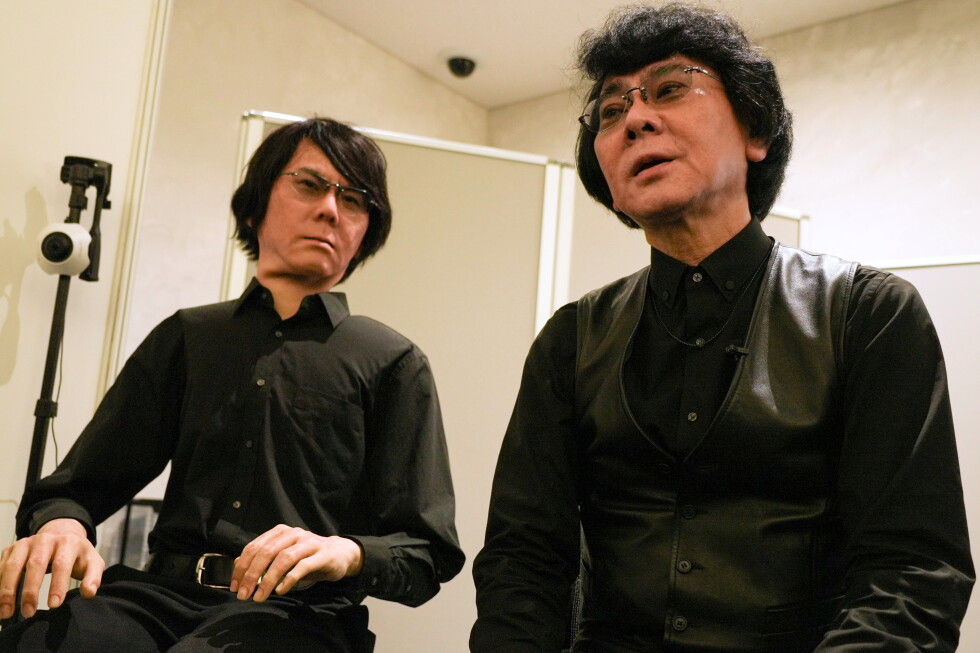
Veteran humanoid researcher Hiroshi Ishiguro, a professor at Osaka University who has worked in the field for decades and famously built a lifelike robotic clone of himself, also remained unfazed by the growing Chinese market presence. “What’s significant is that Japan has a culture that’s receptive to robotics. If we’re going to really start using robots in society, Japan is the ideal place,” Ishiguro said, emphasizing that Japanese society broadly accepts robotic integration without the prejudice seen in many other regions. During the summit, Ishiguro’s robotic clone — dressed in an identical all-black outfit to its creator — fielded an audience question about the purpose of robots, answering in a slightly monotonous but distinctly human-like tone: “I think robots will coexist with people. Robots are the mirror of human beings.” Sitting beside his identical robotic counterpart, Ishiguro joked about the attention the clone draws: “No one is interested in me. All everyone cares about is my robot. As long as people identify with what I have produced, I am a success.”