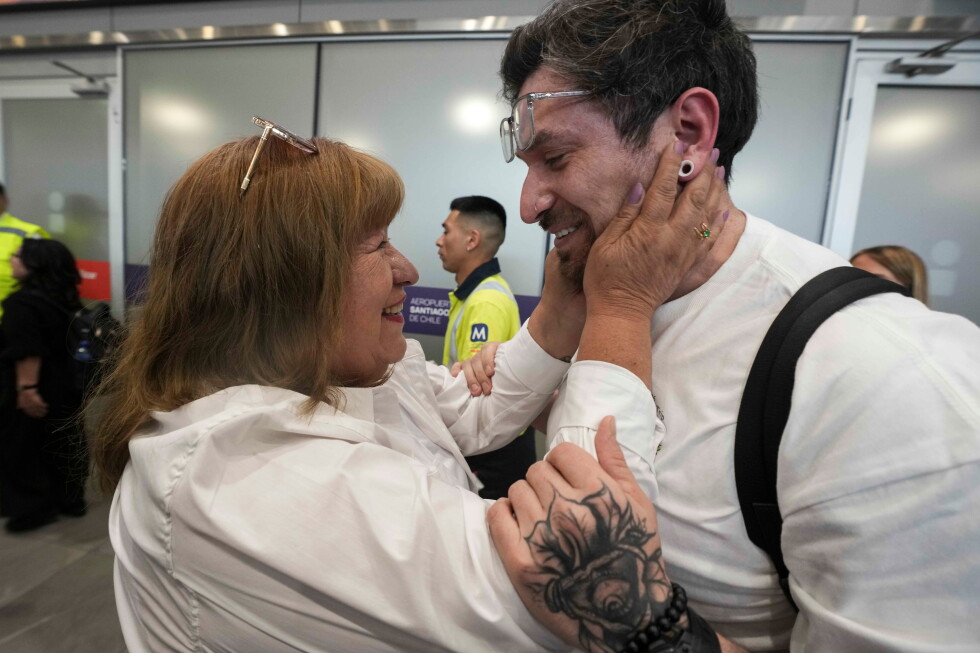
Thirty-six years after he was trafficked out of Chile for an illegal international adoption, Kyle Adler — born Marcos Antonio Navarrete — has finally stepped into the arms of the mother who never stopped wondering where her baby went. His decades-long journey of identity discovery, from a comfortable upbringing in a Chicago suburb to an emotional reunion in Chile earlier this year, shines a long-overdue spotlight on the thousands of stolen children separated from their families during Augusto Pinochet’s 17-year military dictatorship, and the ongoing fight for accountability that continues today.
Adler was just an infant when he was taken from his birth mother, Ana Maria Navarrete, a 19-year-old single working woman living in the southern Chilean coastal city of Coronel. Unable to afford housing that would allow her to care for her newborn full-time, Navarrete arranged for a local caregiver to house the baby while she worked night shifts at a local fish shop, visiting him every time her schedule allowed. But one day, she was told the baby had been placed with an American couple by a local priest, who claimed the infant was “in need of a family.” No one has ever been held accountable for his disappearance, and a police investigator later confirmed his case was tied to a sprawling illegal adoption ring that counted adoption agencies, immigration officials, judges, medical workers and nurses among its complicit members. For decades, Navarrete grieved her lost son, eventually abandoning hope of ever seeing him again, calling the years after his abduction the worst of her life.
Adler, for his part, was adopted by a loving American couple when he was 9 months old in 1987, and raised in an affluent Chicago suburb. He describes his adoptive parents as kind, and says he has no doubt they had no knowledge of the illegal circumstances of his adoption; the couple passed away in 2022, after initially hesitating to support Adler’s search for his biological roots. As an adult, Adler achieved professional success, but still felt a hollow lack of meaning that pushed him to pursue answers about his origins. “I knew I was adopted and at that point, I was just like, I need to find my mom,” he explained.
His search for answers gained momentum in 2017, when a Google search for “Chilean birth mom search” led him to *Nos Buscamos*, a Chilean nonprofit that tracks cases of stolen children from the Pinochet era. Founded by Constanza Del Rio, the organization maintains a public database of thousands of stolen adoption cases, and has helped hundreds of survivors reconnect with their birth families. According to Chilean government estimates, more than 20,000 children were stolen from their families between 1973 and 1990, when Pinochet’s dictatorship ruled the country. Human rights lawyer Jimmy Lippert Thyden González, himself a survivor of illegal adoption, explains that the campaign of child theft deliberately targeted low-income and Indigenous Chilean families as part of a state-backed effort to eliminate marginalized populations.
“It was an effort to eliminate and eradicate the poor class. It was a way of eradicating the Indigenous population, the uneducated population,” Lippert Thyden González said. Three years ago, he filed a lawsuit against the Chilean government over the stolen adoptions, and plans to take the case to the Inter-American Court of Human Rights to push for nationwide accountability. He also founded Grafting Hope, a nonprofit that educates U.S. policymakers and advocates for survivors of fraudulent adoption.
Within three months of Adler connecting with *Nos Buscamos*, Del Rio confirmed his origins and arranged an initial virtual meeting with Navarrete. The revelation that his adoption had been illegal sent Adler into a years-long identity crisis that required intensive therapy, but it also steeled his resolve to pursue a full confirmation of his roots. Last year, he took a free DNA test provided by MyHeritage, a global genealogy company that partners with *Nos Buscamos* and another nonprofit, Connecting Roots, to provide free testing for Chilean adoption survivors. The test confirmed an immediate match with Navarrete, who now lives in Santiago.
Connecting Roots founder Tyler Graf, himself a stolen adoptee who reunited with his own birth mother decades after his abduction, traveled with Adler to Chile for the long-awaited in-person reunion. Graf now devotes his work to reconnecting surviving stolen children and their families, saying, “Now it’s time to mend these families and bring everyone back home so they can see where they came from.”
The emotional reunion took place in Chile on Valentine’s Day 2025, two days after Navarrete’s 56th birthday. When Adler stepped out of the international arrivals gate, tears flowed freely as Navarrete ran to embrace her son, who had grown into a 6-foot-tall man with dark hair. Both wore white to mark the joyous occasion, as Adler bent to press his face into his mother’s hair. Over the following week, the pair visited Coronel, the beach where Navarrete once dreamed of taking her son, the hospital where Adler was born, and the home where he was taken from as an infant. They recovered a copy of Adler’s original birth certificate, and Adler met three of his four biological siblings (he had already connected with one in Miami earlier). He brought Navarrete mementos from his life in the U.S.: framed copies of his college diploma, childhood photos, and the tiny baby shoes his adoptive parents had saved for decades.
Though the joy of reunion was profound, the pain of 36 years apart lingers. Adler does not speak fluent Spanish, so the pair rely on translation help from Connecting Roots and language apps to communicate, and Adler returned to his home in Miami after the reunion. Navarrete said the week together left her grieving the loss all over again: “It took me so long to find him. And then to spend a week together only to have him leave, it’s like I found him but I’ve now lost him all over again.” Still, the pair are already planning a second reunion this December, and Adler is working to process the decades of fractured identity. For Navarrete, the reunion is just the first step: she is working with legal teams to push for criminal charges against everyone complicit in the theft of her son, saying she wants justice not just for herself, but for the life she and her son lost together.
For Adler, the journey has brought a new sense of wholeness he never felt before. “It’s been so eye-opening to see who my people are,” he said. “I feel the love, I feel the compassion, the care — it’s nice to have a family again.” He now hopes his mother can let go of the trauma that defined her life for 36 years, telling her: “I’m not just the son that you lost, I’m the son that you found. I’m back to being your son.” The Chilean government has not yet responded to AP requests for comment on the case or broader efforts to address stolen adoption cases from the Pinochet era.