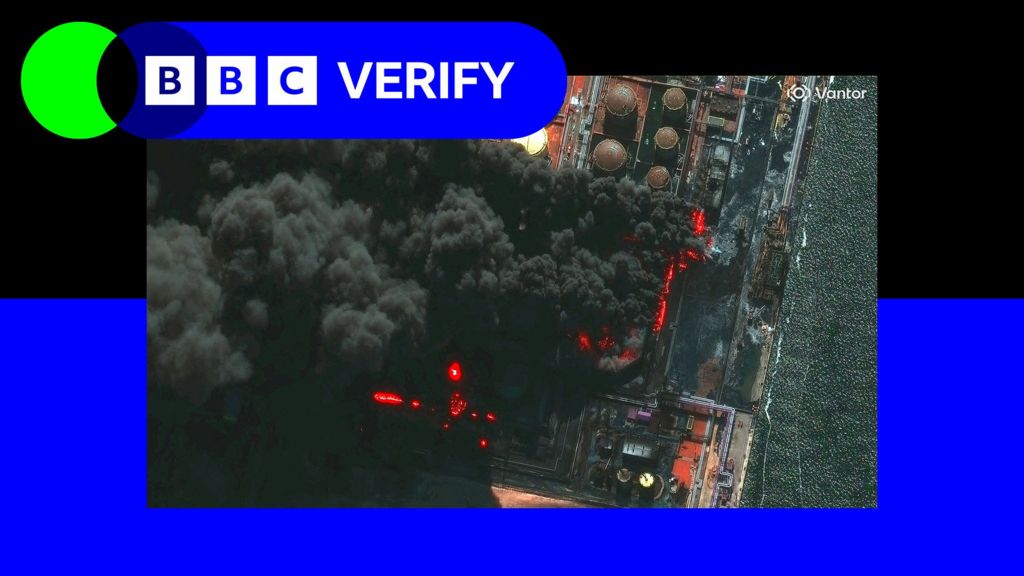
Ukraine has executed a sophisticated series of drone strikes against Russia’s critical oil export infrastructure in the Baltic Sea region, inflicting significant damage to facilities responsible for nearly half of Russia’s maritime oil exports. Satellite imagery and verified visual evidence confirm coordinated attacks between March 23-28 targeting three strategic locations in Russia’s Leningrad region: the ports of Ust-Luga and Primorsk, along with the inland Kirishi oil refinery.
The precision strikes, confirmed by BBC Verify through multiple intelligence sources, have resulted in extensive damage to at least eighteen storage tanks across the three facilities. Intelligence firm Vantor captured substantial smoke plumes emanating from Ust-Luga on March 27, while subsequent imagery revealed continuing fires at Primorsk as recently as Monday, contradicting Russian officials’ claims that blazes had been contained.
According to analysis by the Finland-based Centre for Research on Energy and Clean Air (Crea), the targeted facilities handled 42% of Russia’s total oil exports in 2025, with Primorsk accounting for 22% and Ust-Luga for 20%. The disruption has been severe enough to halt all oil loading operations at Russia’s three Baltic ports for two consecutive days—the first such occurrence since Russia’s full-scale invasion began in 2022.
Commander Robert Brovdi of Ukraine’s military drone forces stated the operation specifically targeted Russia’s ‘oil arteries, refining capacity and crude export infrastructure’ with the objective of ‘demilitarizing’ resources that support Russia’s military operations. Ukrainian officials emphasize that the Kirishi refinery produces fuels directly supporting Russian armed forces.
The financial impact has been substantial. Reuters calculations indicate at least 40% of Russia’s oil export capacity was halted following initial attacks, while Crea estimates Russia earned approximately £7.1 billion from oil exports during the final three weeks of March as prices surged due to broader Middle East tensions.
Ukrainian President Volodymyr Zelensky acknowledged international pressure to scale back energy sector attacks amid global market concerns, but maintained that such operations would continue until Russia ceases targeting Ukraine’s energy infrastructure. Analysts suggest Ukraine’s strategy aims to offset revenue advantages Russia gains from elevated global oil prices, though continued operations may face increasing diplomatic pressure as the conflict persists.