CEUTA, Spain — By the end of last weekend, the Spanish North African exclave of Ceuta had begun to return to a superficial sense of normalcy. Storefronts that had closed amid the unprecedented border crisis had reopened their doors, and open-air terraces, restaurants and cafes across the city — home to just 84,000 permanent residents — were once again filled with locals and casual visitors. Yet the chaos that unfolded earlier that week remained the focal point of every conversation, leaving deep, unresolved rifts across the multi-cultural community.
Earlier that week, an estimated 60,000 migrants, the majority of whom were young men, crossed into Ceuta from Morocco in a sudden mass border breach. Many swam across the coastal waters, climbed over border barriers, and pushed through frontier checkpoints to enter the tiny territory. By Sunday, most of these migrants had voluntarily returned to Morocco, while a smaller contingent remained in Ceuta, attempting to integrate into daily life undetected. As the city cleared out, Spanish Civil Guard vessels continued to comb the coastal waters near the breached urban beach, searching for the bodies of migrants who did not survive the crossing.
Spanish authorities confirmed that at least 72 people lost their lives in the surge: some drowned in the choppy coastal waters, while others were killed in a deadly stampede as crowds pushed across a concrete breakwater barrier. This sudden humanitarian catastrophe has reignited fierce, long-simmering debates over immigration policy across Europe, drawing political actors from across the ideological spectrum to Ceuta in the wake of the crisis.
Many local residents, including Ceuta native Mohamad Abdelkader Driss, a 44-year-old fried fish restaurant waiter, place blame for the crisis squarely on political leadership, not the migrants themselves. “If you open the border, of course everyone comes in, but the young men aren’t to blame. The authorities are responsible,” Driss explained. Migrants who returned to Morocco after the surge also reported that the border was effectively open, with Moroccan authorities taking little to no action to stop thousands of people from crossing into Ceuta over the two-day surge on Thursday and Friday. At the peak of the crisis, the influx of migrants swelled Ceuta’s total population by more than 70%, a staggering strain on the small city’s infrastructure. Driss added that despite the unprecedented disruption, the migrants who entered behaved far more calmly than many residents feared, noting “It could have been much worse.”
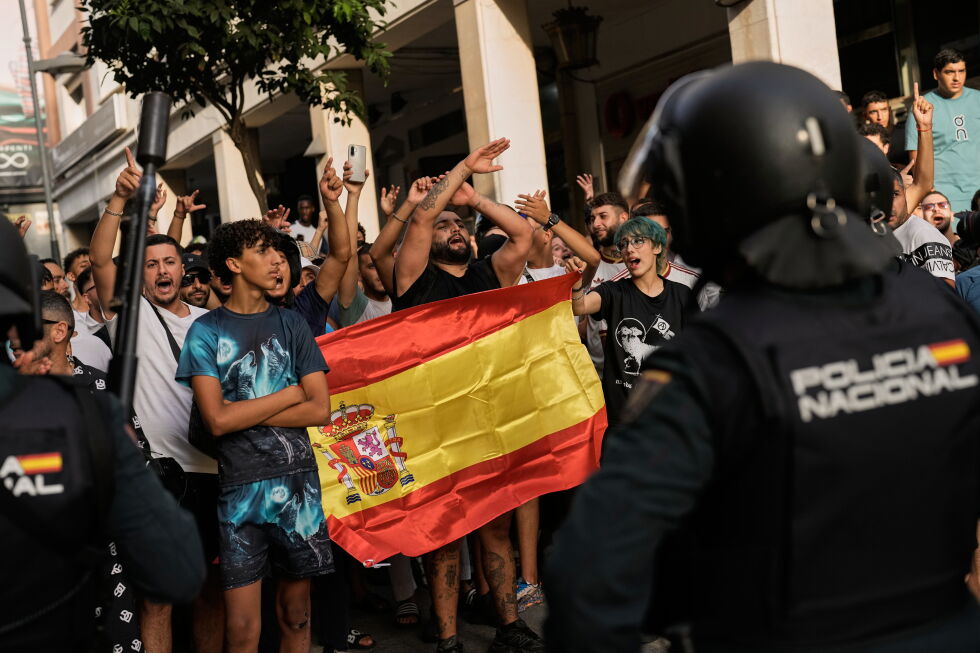
The crisis quickly drew far-right anti-immigration political figures and high-profile right-wing influencers to Ceuta over the weekend, a move that sparked immediate counter-protests from the city’s large Muslim community, many of whom are of Moroccan descent. On Saturday evening, far-right Member of the European Parliament Alvise Pérez delivered a public call for all remaining migrants to be expelled, speaking to a small group of supporters before he was confronted by an angry crowd of counter-protesters. Pérez was forced to take shelter in a local bar, where residents banged on the windows in protest, until police could escort him out of the area.
Noor Ahmed, a 20-year-old university student and lifelong Ceuta resident who joined the counter-protests, denounced far-right figures like Pérez as opportunists seeking to exploit a humanitarian crisis for political gain. “They just want to take advantage of the humanitarian crisis Ceuta is currently experiencing,” Ahmed said.
Vox Party leader Santiago Abascal, the head of Spain’s largest far-right political party, visited Ceuta on Sunday, doubling down on harsh criticism of the Spanish central government. Abascal framed the migrant surge as “an invasion” and accused the sitting government of failing to protect Spain’s territorial borders. “The frontiers of Ceuta and Melilla are the walls of our home and homeland, and they are not being protected by a corrupt and traitorous government,” Abascal said.
Beyond the high-profile political clashes, the crisis has put Ceuta’s long-held reputation as a haven of cross-cultural tolerance under unprecedented strain. For decades, the city has prided itself on the peaceful coexistence of its four major religious and cultural communities: Christians, Muslims, Jews, and Hindus. But the events of the week have sown doubt among some long-term residents.
Eva Barrientos, a logistics worker and Ceuta resident who attended Saturday’s far-right gathering, said she believed another mass surge would happen in the near future, and questioned the national loyalty of Ceuta’s foreign-born residents. “In Ceuta, we have always lived together. We have four cultures living very well, without any problems,” she said. “But the only thing we are realizing now is that there is an enemy within.” Barrientos accused many foreign-born residents of holding greater loyalty to Morocco than to Spain, their country of residence.
The international community has begun to weigh in on the crisis as well. Pope Leo XIV, who has made immigration reform a central priority of his papacy and highlighted the issue during a recent visit to Spain’s Canary Islands — one of Europe’s busiest entry points for migrant arrivals — released a statement Sunday addressing the situation. “I am following with concern the alarming situation in Ceuta, asking God … that solutions of peace, stability and justice may be found,” the Pope said.
In the wake of the crisis, Spanish authorities have begun installing a new sea barrier along Ceuta’s border with Morocco to prevent future mass breaches, even as local residents remain divided over what caused the surge, who bears responsibility, and how the city should move forward from the event that upended its quiet, multi-cultural way of life.