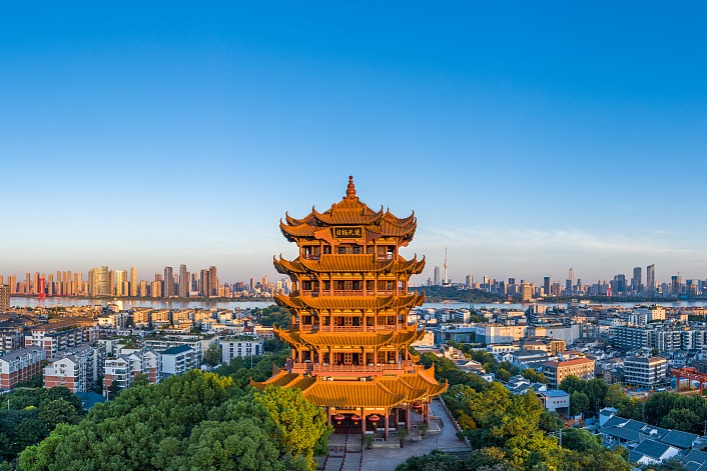
At a press briefing held Friday in Wuhan, the capital of China’s Hubei province, senior regional officials outlined an ambitious 5-year strategy to leverage the province’s unique geographic advantage and integrated transport infrastructure to reinforce its role as a core driver for Central China’s rise, while expanding its contributions to both the national domestic market and the global economy through 2030.
Governor Li Dianxun noted that during the 15th Five-Year Plan period (2026–2030), Hubei will combine the strengths of its comprehensive multi-modal transport network—covering inland waterways, high-speed and conventional rail, intercity highways, commercial aviation, and energy pipelines—to build one of the most efficient logistics and transport ecosystems in inland China. A standout asset in this network is Ezhou Huahu International Airport, Asia’s first purpose-built air cargo hub, which launched commercial operations four years ago and already boasts the largest number of air cargo routes across China.
According to data from local newspaper Hubei Daily, the airport currently operates 117 cargo routes, 56 of which are international services connecting 57 destinations across five continents, establishing a robust global cargo connectivity framework for the region. Beyond infrastructure expansion, Li added that Hubei will target reduced logistics costs and improved operational efficiency by attracting leading modern logistics firms, streamlining processes across cargo collection, long-haul transport, centralized warehousing, and last-mile distribution, while partnering with international stakeholders to expand cross-border logistics networks.
Executive Vice-Governor Zhang Wenbing pointed out that Hubei holds an unmatched geographic advantage, sitting at the natural intersection linking China’s economically developed eastern coast with the fast-growing western interior, and connecting the northern and southern regions of the country. Its multi-modal transport system has seen consistent upgrading in recent years, with Hubei’s total high-speed rail mileage ranking fifth nationwide. As of the end of the first quarter of 2026, Xinhua News Agency reports, the province’s operational high-speed rail network has expanded to 2,585 kilometers, enabling 1 to 2-hour rail connections from Wuhan to multiple neighboring provincial capitals including Changsha (Hunan), Nanchang (Jiangxi), Hefei (Anhui), and Zhengzhou (Henan).
Under the new development plan, Zhang said Hubei will continue upgrading key inter-regional transport corridors, constructing large-scale integrated transport hubs, and strengthening the province’s end-to-end logistics system. Key projects include developing a modern international shipping center along the middle reaches of the Yangtze River, and establishing a national assembly and distribution center for China-Europe freight trains in Wuhan. In addition to expanding Huahu Airport’s cargo capacity, the province will also enhance the passenger service capabilities of Wuhan Tianhe International Airport to support growing business, tourism, and people-to-people exchange demand.
Officials also emphasized that Hubei will deepen mutually beneficial practical cooperation with global partners across multiple sectors, including cross-border trade, direct investment, scientific and technological innovation, financial cooperation, and cultural exchange. Early signs of this growing global engagement are already visible: Wuhan-based construction firm China Construction Third Bureau First Engineering Co. reported strong overseas performance in the first quarter of 2026, with newly signed overseas contracts doubling year-on-year and overseas output value jumping 96 percent from the same period last year.
Ma Yikui, general manager of the company’s international business division, said the firm has prioritized high-growth key markets including Malaysia, Cambodia, and Indonesia, establishing dedicated regional marketing centers and optimizing project development mechanisms to secure high-quality infrastructure projects and build long-term collaborative partnerships with major global clients. Leveraging the company’s technical and operational strengths in industrial facility construction and data center development, Ma added, the firm has captured nearly 40 percent of the total data center construction market in Southeast Asia, cementing Hubei enterprises’ growing footprint in global infrastructure development.