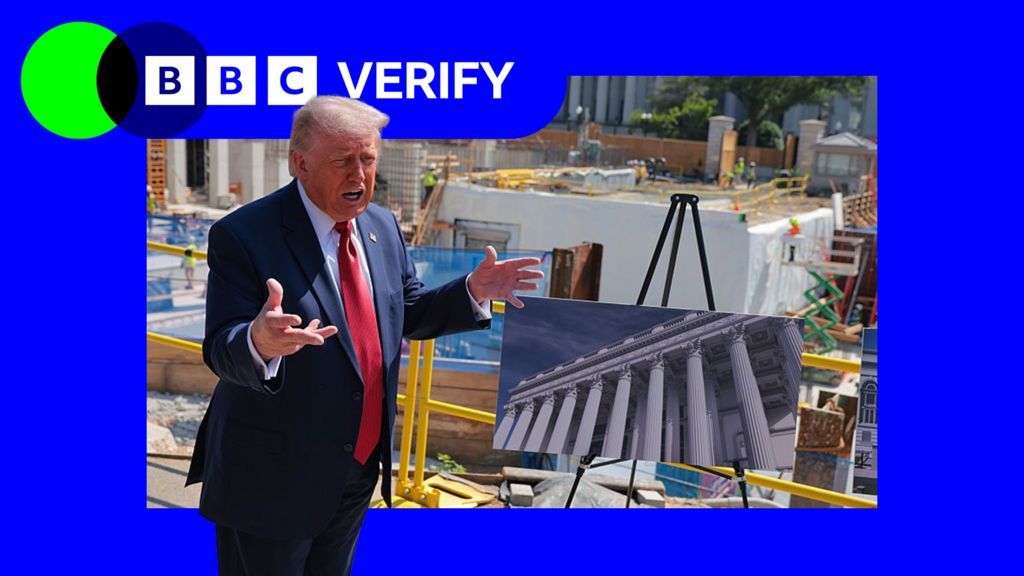
One year after former (and current) U.S. President Donald Trump first unveiled plans for a new White House state ballroom, the proposal has ballooned far beyond its original scope, with a projected price tag that has doubled to $400 million and new additions that include high-security features ranging from a rooftop drone port to an underground three-story hospital and top-secret military facilities. The expansion of the project comes as congressional Republicans have pushed for hundreds of millions in taxpayer funding for the complex, at a moment when American households are already grappling with soaring living costs tied to the ongoing Iran conflict – even as Trump has repeatedly insisted the entire build would come at no cost to public coffers.
The proposal’s evolution, tracked by BBC Verify through public statements and social media posts from the president, offers a rare window into how one of the most sweeping changes to the White House complex in decades has shifted dramatically over 12 months. It all began on June 6 last year, when Trump shared the news on his social media platform Truth Social, saying he had already inspected the proposed construction site. He framed the project as a lighthearted side endeavor amid his work on global economic policy and international relations with major powers including China and Russia, promising the ballroom would be built quickly and designed to complement the White House’s existing historic aesthetic.
A month later, the Trump administration formally revealed the full initial plan: a new 90,000-square-foot state ballroom would replace the aging, extensively modified East Wing, with architectural design matching the historic main residence. The new space would hold 650 guests, a major jump from the 200-person capacity of the main residence’s East Room, which has served as the White House’s primary venue for official state events and ceremonies for decades. In recent years, large state gatherings – including 2022’s state dinner for French President Emmanuel Macron, which hosted more than 300 guests – have been forced to move to temporary tents erected on the South Lawn, a gap the new ballroom is intended to fill. The administration initially announced construction would begin by the end of that year and be completed well before the end of Trump’s second term in January 2029, with Trump emphasizing the build would not damage or interfere with the existing White House structure.
By October, when Trump announced groundbreaking on the site, plans shifted: the 120-year-old East Wing, which previously housed dozens of offices including the First Lady’s workspace, would be fully demolished and modernized as part of the project. Within just a few days, the entire East Wing and its connecting hallway to the main White House building had been cleared by construction crews.
It is after groundbreaking that the project’s scope expanded dramatically. In an update shared to Truth Social this past April, Trump revealed the new design would add a suite of security-focused features: bomb-resistant blast shelters, a cutting-edge underground medical facility, classified military command space, and a dedicated rooftop landing pad for drones. Recent satellite imagery confirms extensive excavation work for the three-story underground section of the complex.
Trump’s public framing of the project has also shifted, with growing emphasis on its national security purpose. Where he made no mention of security in 2025’s posts, he has referenced the project’s security benefits at least 10 times on Truth Social in 2026 alone, a ramp-up that followed an assassination attempt at the April White House Correspondents’ Association dinner. Speaking at a White House press conference immediately after the shooting, Trump argued the new facility was a critical demand from both the U.S. Secret Service and the military, noting it would be drone-proof and fitted with bulletproof glass. He has since claimed the ballroom’s roof will be resistant to missile attacks, and shared an AI-generated rendering of the rooftop “DronePort” that he says will protect Washington D.C. for decades to come.
When contacted by BBC Verify to ask about the shifting scope and purpose of the project, the White House has denied any changes to the original plan.
Funding for the project has emerged as a core point of controversy. Trump has repeatedly stated the ballroom, which was originally estimated to cost $200 million, would require zero taxpayer dollars, claiming the entire cost would be covered by his personal funds and private donations. But this May, congressional Republicans requested $1 billion in a broad security spending package that reportedly earmarked $220 million specifically for security works tied to the new ballroom complex. That initial request was rejected by Congress and withdrawn, but Republicans have since introduced a separate $400 million security bill linked to the project, co-sponsored by Senator Lindsey Graham, who says the funding would be raised through new fees on imported goods and international travelers entering the U.S.
The project’s direct construction cost estimate has also doubled over the past year, rising from the original $200 million to the current $400 million, according to BBC Verify’s analysis of 35 Trump Truth Social posts about the project published over the past year. Trump has defended the cost increase, telling reporters during a May visit to the construction site that the project remains on schedule and on budget, and the only change is that the project size was doubled at the request of the U.S. military. The Department of Defense did not respond to BBC Verify’s request for comment on what specific changes it requested. When asked about the push for taxpayer funding tied to the project, Trump argued the requested funds are for general White House grounds security upgrades, not the ballroom itself.
When construction began last October, the administration released an initial list of private donors that included major tech firms such as Amazon, Google and Meta, as well as multiple billionaire investors, but no updated details on donor contributions have been released since. The White House also declined to provide BBC Verify with a breakdown of how much of the final cost will be covered by Trump personally, by private donors, and by public funds, saying it had no additional information to share.
Beyond funding, legal questions have been raised about whether the administration has the authority to demolish and rebuild the portion of the White House complex. The U.S. National Trust for Historic Preservation has filed a lawsuit to halt construction, arguing that no sitting president has the legal right to demolish sections of the historic White House without formal public or regulatory review. The Trump administration has pushed back by pointing to past renovation projects carried out by previous presidential administrations, but historians note that the current proposal is the most extensive change to the White House in more than 70 years. Political historian Dr. Matthew Dallek of George Washington University notes that President Harry Truman’s sweeping mid-20th century White House renovation faced little opposition because it was prompted by severe structural decay that threatened the entire building – a justification that does not apply to the current project.
A federal judge initially issued a temporary order blocking construction after the National Trust’s lawsuit, but the Trump administration appealed the ruling, and construction was allowed to resume pending a full hearing scheduled for this June.