As India readies for its 16th national census – the eighth since achieving independence in 1947 – a new curated exhibition has pulled back the curtain on a little-known chapter of the country’s demographic history: how its sprawling postal network served as an unexpected foundation for nation-building and public trust in the world’s largest statistical exercise, long before smartphones and digital government apps transformed data collection.
Curated by Vikas Kumar, an economics professor at Bengaluru’s Azim Premji University, the exhibition draws on rare archival materials including commemorative stamps, promotional postmarks, letters, and pre-census postcards to trace how the postal service turned routine mail into a tool for mass public mobilization. For the newly independent Indian republic, a reliable national census was far more than a bureaucratic task: it was an urgent foundational requirement. Reliable demographic data was needed to run fair elections based on universal adult franchise and to lay the groundwork for a centrally planned economy. So critical was this project to the new nation that the Constituent Assembly passed the Census Act in 1948, more than a year before the country’s final constitution was formally adopted.
From the very first post-independence census in 1951, the Indian government turned to the post office to solve two critical, immediate challenges: reaching a dispersed population across a vast, mostly rural and low-income nation, and convincing ordinary people to participate – a hurdle shaped by the legacy of distrust left by colonial-era censuses. Parts of India had boycotted the 1931 and 1941 colonial headcounts, and the 1941 count in Punjab and Bengal was tainted by widespread allegations of communal manipulation, making public trust a non-negotiable priority for the new republic.
At the time, India’s postal network was the most expansive unified communication system the state operated, growing faster than nearly all other public services including banking in the decades after independence. By 1968, more than 100,000 post offices delivered mail daily to 300,000 villages, with weekly service reaching an additional 300,000 rural communities. Postmasters and postmen also served as informal community intermediaries, often acting as readers and scribes for low-literacy villages – making the network perfectly suited for spreading census messaging.
The exhibition showcases how this outreach evolved alongside the nation across decades. In 1951, one of the earliest known bilingual postmarks, stamped on an envelope mailed from Nandikotkur to Madras (now Chennai), featured a portrait of a three-person family alongside ‘Census of India, February 1951’ printed in both Hindi and English. For the 1961 census, inland letter cards posted across Assam carried clear, approachable postmarks urging recipients to ‘Get yourself & family counted’ and encourage friends to join in. A 1971 commemorative issue marked the centenary of modern Indian censuses, printing 3 million stamps that wove diverse Indian faces into the shape of the number 100, framing the census as a source of national pride and noting that data processing had transitioned to electronic computers for the first time.
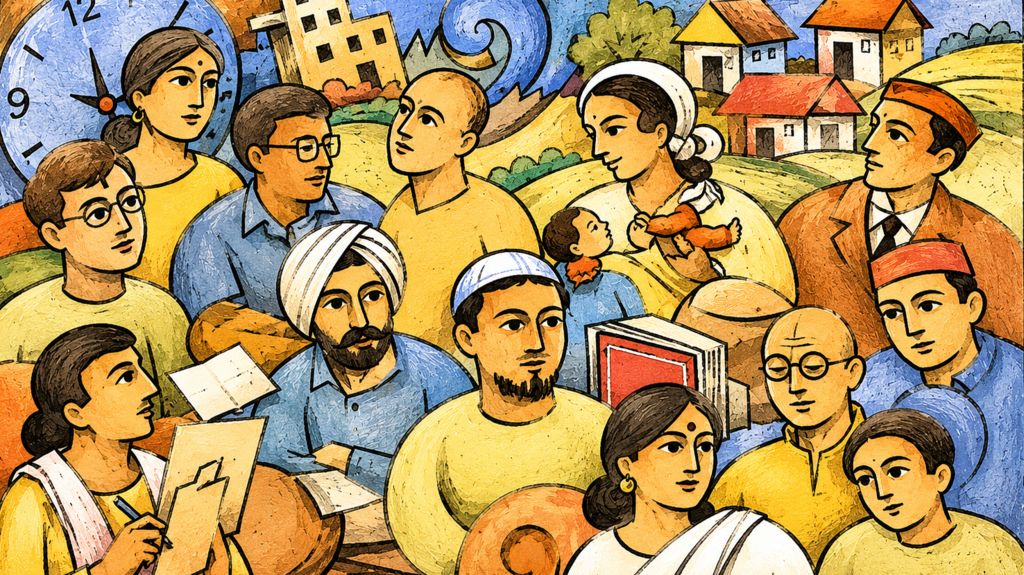
By the 2001 census, messaging framed the headcount as a ‘Mirror of the Nation’ and a ‘Group Photograph of the Nation’, with multilingual promotional postcards printed in 13 languages distributed across the country to emphasize the exercise’s role in national development. The 2001 commemorative stamp featured a four-person family under the slogan ‘People Oriented’, with a first day cover illustrating India’s diversity through a vibrant crowd scene, and a postmark depicting men, women and children holding hands in a semi-circle to symbolize the nation counting itself. Later messaging also began to tie population counting to public policy priorities like population control, reflecting the social anxieties of the era. The 2011 census marked a transition toward the digital age, with a commemorative stamp showing families linking hands with an enumerator alongside the census emblem, paired with a first day cover that paired a pixelated map of India with the official census symbol.
For Kumar, these fragile, fading postal artifacts are more than a collection of bureaucratic memorabilia: they capture how the Indian state worked to build legitimacy and public trust through everyday, routine communication, weaving the census into core national narratives of development, diversity, and collective identity.
That core challenge of building public trust remains just as relevant today, as India prepares to launch its first fully digital census. The upcoming headcount, which will cover 36 states and union territories, more than 7,000 sub-districts, over 9,700 towns, and nearly 640,000 villages, remains a staggering undertaking. Millions of households will be surveyed by enumerators drawn from local government staff, teachers, and community officials. For the first time, enumerators will use mobile apps to collect and upload data in real time, replacing pen and paper methods of the past. The new census will also deliver critical data for policy planning, welfare distribution, and political representation in the world’s most populous nation, and will mark the first time in decades that the exercise will collect detailed caste data – a politically sensitive project in a country where caste continues to shape social and economic opportunity.
While digital tools promise faster data processing, Kumar warns that technology alone cannot replace the work of building public confidence. As the reach of the traditional postal network has faded, he argues, the government must develop new strategies to raise awareness and earn the trust of ordinary Indians. From family illustrations on postmarks to instant digital data uploads, India’s census has changed dramatically in 75 years. Yet the core challenge that the postal network solved decades ago – convincing more than a billion people to trust the state enough to add themselves to the collective story of the nation – remains unchanged.