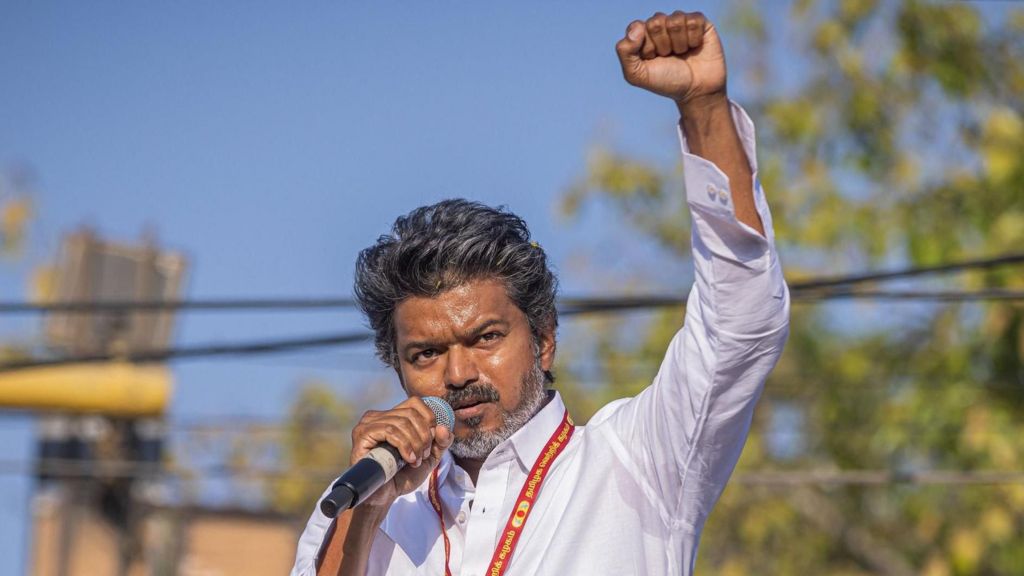
In one of the most shocking political upsets in modern Indian electoral history, Tamil actor-turned-politician Chandrasekhar Joseph Vijay — universally known by his fan nickname Thalapathy (Commander) Vijay — has led his newly formed political party Tamilaga Vettri Kazhagam (TVK) to become the single-largest faction in Tamil Nadu’s 234-seat state assembly, defying every pre-election prediction and upending the southern state’s decades-old political order.
The stunning outcome was foreshadowed by one underdog race that encapsulated TVK’s entire electoral surprise. When 42-year-old meat shop owner Madhar Badhurudeen, a first-time TVK candidate, filed to run in the Madurai Central constituency — a Hindu-majority seat anchored by the iconic Meenakshi Amman temple — no political observer gave him a shot at victory. A Muslim candidate from a non-political, working-class background, Badhurudeen ran a low-key grassroots campaign with no high-profile celebrity rallies, no visits from party leader Vijay himself, and none of the glitzy, high-decibel campaign events that defined his rivals’ bids.
His opponents were political heavyweights: the Dravida Munnetra Kazhagam (DMK) fielded sitting state minister and senior party leader Palanivel Thiaga Rajan, while the All India Anna Dravida Munnetra Kazhagam (AIADMK) — the two entrenched regional parties that have dominated Tamil Nadu politics for decades — tapped well-known actor-filmmaker Sundar C. Both opponents held massive, star-studded processions and drew thousands to public rallies, leaving Badhurudeen’s quiet door-to-door outreach invisible to most traditional political analysts. Yet when results were announced last week, Badhurudeen defeated both rivals by a comfortable margin of more than 19,000 votes.
“My only strength was our leader Vijay and the party’s electoral symbol, the whistle,” Badhurudeen told reporters after his win. “I campaigned on our leader’s pledge of a corruption-free government, and that was enough.”
Badhurudeen’s upset was far from an isolated anomaly. Across the state, 108 TVK candidates — the vast majority of them political newcomers — won their seats, leaving the party just 10 seats short of a full majority. After days of post-election negotiations to secure a governing mandate, Vijay was sworn in as Tamil Nadu’s chief minister on Sunday, closing out a political journey that began just two years ago when he launched TVK after decades as one of Tamil cinema’s biggest box office draws.
The question on every political observer’s mind after the upset is simple: how did a first-time political party, led by a celebrity who campaigned in person for less than three weeks total, pull off such a decisive victory against two well-established political machines?
Vijay’s campaign faced major disruptions long before election day: he paused all campaigning for more than two months after a fatal crowd crush at one of his September 2024 rallies killed dozens of attendees, and dozens more scheduled public events were canceled over what the party cited as logistical constraints and time shortages. The answer, experts say, lies not in traditional ground campaigning, but in a revolutionary digital strategy that rewrote the rules of Indian electoral politics.
“This was almost certainly the first election in India won almost entirely through social media,” explained Anup Chandrasekharan, a Bangalore-based independent media strategist. “Vijay’s supporters didn’t just use digital platforms — they ushered in a full digital revolution in Indian campaigning.”
Unlike traditional Indian election campaigns, which rely on massive ground rallies, door-to-door canvassing, printed banners and endless offline outreach, TVK turned a pre-existing network of 85,000 Vijay fan clubs — built over the actor’s 30-year film career — into a coordinated, 24/7 online campaign army. When Vijay launched his party in 2024, this massive grassroots fan network seamlessly transitioned into an organized political operation focused on digital outreach.
Vijay himself broke with traditional political norms: he gave no national media interviews, held no press conferences, and delivered far shorter public speeches than rival party leaders. Instead, he communicated directly with supporters through social platforms, and every public appearance was quickly repackaged into bite-sized, shareable content by the party’s well-funded IT wing and thousands of volunteer supporters. Clips of his speeches, edited selfie videos, and campaign messaging were cut into Instagram Reels and YouTube Shorts, then shared across hundreds of thousands of WhatsApp groups and social feeds, reaching millions of voters without a single expensive ground rally.
One edited selfie video of Vijay from a Madurai party conference amassed nearly 90 million views in just 24 hours, a level of organic reach no traditional campaign ad could match. For years, Vijay built his film brand portraying a crusader against corruption, injustice and inequality, championing the rights of underprivileged and marginalized communities — a narrative that translated seamlessly to his political campaign, resonating with voters hungry for change after decades of rule by the two established Dravidian parties.
The strategy proved particularly effective with young Gen Z voters and women, who turned out in large numbers to back TVK and its anti-corruption platform. Unlike many new political entrants in India, TVK’s victory came without widespread allegations of voter intimidation or financial graft, a rare feat in a political landscape long dominated by money, caste and religious identity politics.
Still, experts caution that the digital-first model that delivered electoral success will not be enough to govern effectively. “This model worked because Vijay is a new entrant with no political baggage,” Chandrasekharan noted. “Now that he is in power, he has to deliver results, and he needs to strengthen his on-the-ground party structure — you can’t govern solely from the digital world.”
Critics have also raised questions about Vijay’s lack of formal administrative and political experience as he takes on the role of chief minister. But TVK leaders reject those concerns, pointing to the 1967 election that first brought the DMK to power in Tamil Nadu, when the party was also a new, untested political force.
“What kind of experience did DMK have when they took power in 1967?” Badhurudeen said. “Our goal is to deliver a clean, transparent administration, and our leader is exactly the person to do that.”
There is no question that Vijay has made history: he took on two of India’s most entrenched regional political machines and single-handedly upended the state’s political order, thanks to a revolutionary digital campaign strategy that will likely reshape how Indian elections are fought in years to come. But as post-inauguration celebrations wind down, the reality of governing is setting in. For Thalapathy Vijay and his army of digital campaigners, the real test of their political project is only just beginning.