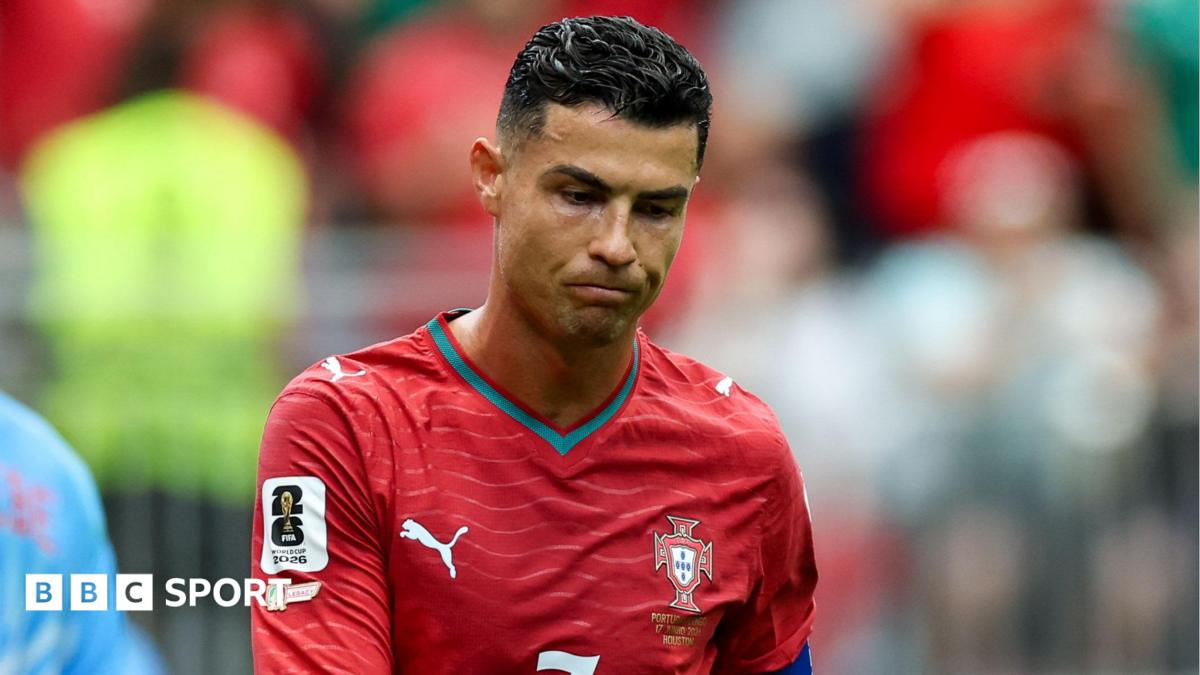
What was supposed to be a celebratory, record-breaking final World Cup for Cristiano Ronaldo has instead devolved into a messy public feud that has split Portuguese football just days into the 2026 tournament.
The 41-year-old, who is making his sixth and final World Cup appearance to match an all-time record, has been at the center of growing controversy since Portugal’s opening group-stage 1-1 draw with DR Congo. What stoked tensions most wasn’t the underwhelming result itself, but a seemingly harmless comment from 21-year-old Paris Saint-Germain midfielder Joao Neves, who scored Portugal’s only goal in that match. When asked about Ronaldo’s role in the current squad, Neves offered a measured response: he acknowledged Ronaldo’s legendary contributions to Portuguese football, but noted that the captain is just another squad member working to contribute, no different from any other player.
That mild comment quickly spiraled out of control online. Thousands of diehard Ronaldo supporters flooded the social media accounts of Neves, playmaker Bruno Fernandes and other squad members, accusing them of disrespecting the captain. What makes this backlash extraordinary even for a global superstar of Ronaldo’s stature is that members of the forward’s own inner circle amplified the tension. Partner Georgina Rodriguez shared a reaction to a fabricated quote attributed to Neves’ girlfriend before deleting the comment, while Ronaldo’s sisters Katia and Elma Aveiro posted public content claiming a faction of the squad was trying to freeze the captain out of the team. Even Portugal’s highest-viewed television network, CMTV, in which Ronaldo holds a stake, saw a long-time legal and business representative for the striker cite a fake Zinedine Zidane quote in a public defense of the captain.
The chaos quickly spilled over into Portugal’s closed training camp in Palm Beach, where reporters have repeatedly pressed squad leaders on whether the national team is now split between pro-Ronaldo and anti-Ronaldo factions. “This shouldn’t even be a topic of discussion,” defender Ruben Dias said in a tense press conference. The next day, full-back Diogo Dalot added: “We know there are a lot of people who don’t want Portugal to win,” declining to name those he was referring to, adding “If I had to do that, we’d never leave here. It’s not my role.”
At the heart of the tension is a brutal on-pitch drought for Ronaldo that stretches back four years. The captain has now gone 10 consecutive matches across the World Cup and European Championship without scoring, dating back to a penalty against Ghana at the 2022 Qatar World Cup. In the opening draw with DR Congo, he took three shots—more than any other Portugal player—but failed to put any on target. That drought has reignited long-simmering questions about whether Ronaldo still deserves a starting spot in the squad, despite his historical legacy.
Statistics from manager Roberto Martinez’s tenure underscore the unspoken reality of Ronaldo’s role: across 30 matches where Ronaldo started under Martinez, he has been substituted 13 times, but only once before the 60th minute. While Martinez publicly refuses to call Ronaldo untouchable, the numbers tell a different story of a starting spot secured by legacy, not current form.
Luis Mateus, executive director of leading Portuguese football outlet A Bola, summed up the critique of Ronaldo’s current role: “His goals used to make up for his lack of defensive contribution. Now he is no longer scoring and he is affecting the entire attack. Mentally, because his team-mates still want to serve him even when there are better options, but also because he has become something of a square peg in the whole attacking process. He is on the pitch because of gratitude, not because of how he is playing.”
A recent public poll conducted by Portuguese football website Zerozero found that 63% of participating Portuguese fans do not want Ronaldo to start in the team’s upcoming second group match against Uzbekistan. For the Portugal squad, only a convincing win against Uzbekistan—ideally with a Ronaldo goal to end his drought—can calm the ongoing public feud.
This is not the first time Ronaldo has entered a World Cup facing heavy criticism for a goal drought. Back in 2010, he arrived at the South Africa tournament having not scored in a competitive match for Portugal in two full years. At the time, he brushed off pressure with a light-hearted quip: “Goals are like ketchup. When they come, they come all at once.” He ended that drought in a 7-0 group-stage win over North Korea, notching his only goal of the tournament before Portugal was knocked out in the round of 16 by Spain.
Current Porto president and former top club manager Andre Villas-Boas framed the current moment as a necessary reckoning for a squad that still carries world-class talent. “It is now time to rethink a few things, to spend less time at the beach [a reference to recent off-field controversy around Ronaldo’s public appearances] and more time in the meeting room,” he said. “Our ambitions remain enormous, because this is a golden generation and we want the man who has given so much to our country to leave the game holding the World Cup trophy, the same way Messi did in Qatar. But the coach will manage his playing time as he sees fit. I still believe we have enough talent to leave a much better impression.”
For now, that balanced, team-first approach remains the only path to quieting the noise that has overshadowed Portugal’s 2026 World Cup run before it has truly begun.