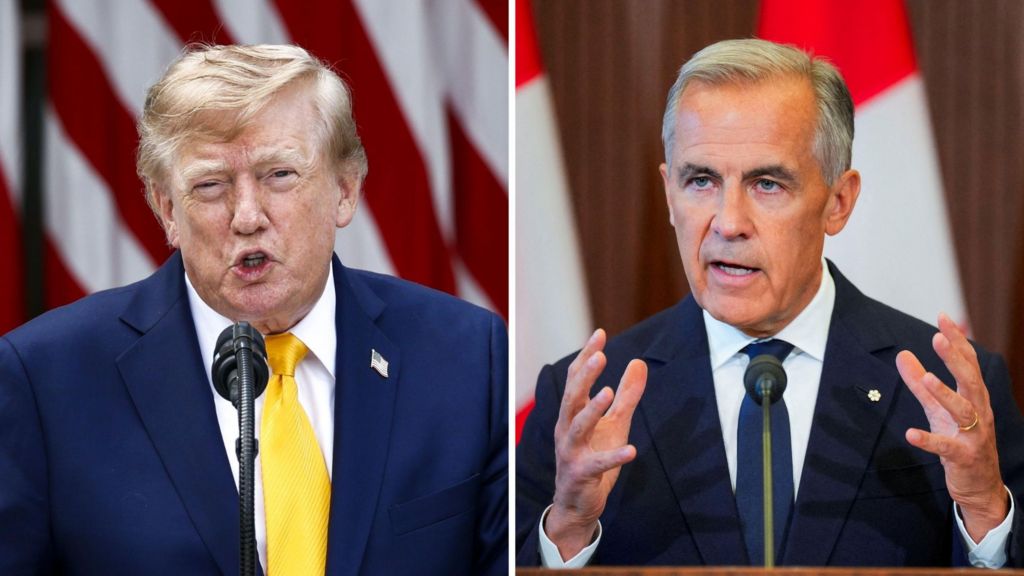
As a spiraling trade conflict between Canada and the United States intensifies, Canadian political leaders across provincial and federal levels are pushing back aggressively against new tariff threats from the Trump administration, laying out the significant economic leverage Canada holds over its southern neighbor. With nearly 70 percent of Canada’s total goods exports flowing to the U.S. market, many observers have questioned Ottawa’s ability to stand firm against the world’s largest economy. But trade analysts and policymakers point out Canada wields far more negotiating power than it is often credited with: Canada is the number one export customer for 26 U.S. states, including border swing states Michigan, Maine, and Wisconsin, and ranks among the top three trading partners for 45 of the 50 states, giving Prime Minister Mark Carney ample room to maneuver in the escalating standoff.
Currently, the Canadian government is finalizing planned “dollar-for-dollar” retaliatory tariffs, strategically targeted at U.S. steel, dairy products, household appliances, agricultural equipment, electronics, and pulp and paper. Public opinion data shows that a majority of Canadians would reject significant concessions to the U.S., giving the federal government broad public support for its hardline approach. This anti-concession sentiment is echoed by Ontario Premier Doug Ford, one of Trump’s most outspoken critics in Canada, who made headlines for his blunt response to recent tariff threats, telling the U.S. president to “kiss my ass”.
One of Canada’s most impactful potential leverage points lies in its energy exports to the U.S. Carney emphasized over the weekend that Canada supplies the vast majority of U.S. natural gas and electricity imports, and accounts for roughly 60 percent of all U.S. crude oil imports. “I don’t think they want us to stop sending any of that energy,” Carney noted. While energy restrictions are not included in Canada’s current announced countermeasures, officials have explicitly refused to rule the option out, though some provincial leaders have expressed hesitation to use this tool. Ford, whose province is the center of Canada’s auto manufacturing sector, has broken ranks to declare that an energy surcharge on U.S. exports remains a viable option. Back in 2025, he first proposed a 25 percent surcharge on all electricity exports to the U.S., a measure his government estimated would directly impact 1.5 million households and businesses across Michigan, Minnesota, and New York.
Beyond energy, Canada dominates global supplies of other critical commodities that the U.S. economy depends on. The country is the world’s largest exporter of potash, a key ingredient in agricultural fertilizer. “I’d love to see [Trump] run cars without any oil. I’ll love to see him grow vegetables and fruit without the potash,” Ford stated Monday. “President Trump underestimates us, and that’s the biggest mistake.” Canada also holds massive reserves of critical minerals required for the clean energy transition and advanced manufacturing, including lithium, nickel, and graphite. The U.S. is the top export destination for all of these minerals, giving Ottawa another pressure point. Ford has again led hardline rhetoric on this front, telling the Associated Press that the U.S. “won’t get a grain of sand out of Ontario” if the dispute escalates.
Canada has already demonstrated that its retaliatory measures can deliver tangible economic harm to U.S. industries. Early last year, in response to the first wave of U.S. tariffs, most Canadian provinces implemented bans on U.S. alcohol sales in government-run liquor stores. The impact was immediate and severe: U.S. wine exports to Canada plummeted 78 percent year-over-year, representing a $357 million loss in export revenue, according to official Canadian data. The U.S. Wine Institute described the drop as the “most significant market disruption in decades” for American winemakers. U.S. spirit exporters faced similar damage, with exports falling more than 70 percent following the provincial bans. Today, the boycott remains in place across 11 of Canada’s 13 provinces and territories, and it remains a major source of friction for the Trump administration.
In addition to official government actions, a grassroots movement of Canadian consumers boycotting U.S. travel and goods has already cost the U.S. economy billions. National travel data shows that even with a small uptick in cross-border road trips in April 2026, Canadians still made 800,000 fewer trips to the U.S. that month than in the same period of 2024, before Trump returned to the presidency. This ongoing travel boycott cost U.S. businesses an estimated C$3.3 billion ($2.35 billion) in lost revenue in 2025, prompting multiple U.S. border cities and states to run targeted ad campaigns and offer special promotions to encourage Canadian visitors to return.
Beyond direct economic pressure, Canada is also leveraging political timing, as U.S. midterm elections approach with the Republican hold on Congress hanging in the balance. Canadian officials are well aware that the trade dispute will inflict short-term economic pain on Canada as well: financial analysts estimate that the recent 50 percent U.S. tariffs on roughly $20 billion worth of Canadian imports will reduce Canada’s GDP by between 0.3 and 0.6 percent in the near term. Even so, public support for Ottawa’s hardline approach remains extraordinarily high. A recent Angus Reid poll conducted over the weekend found that 76 percent of Canadians support the government’s willingness to walk away from negotiations, even as many respondents report personal worry about their own job security. Canadian political leaders have also maintained a rare united front against the U.S. tariffs.
With U.S. voters prioritizing economic issues ahead of the midterms, and the Republican majority in Congress looking increasingly fragile, Canadian leaders note that the trade dispute could directly damage the GOP’s electoral prospects. Two of the most competitive U.S. Senate races this cycle are in Michigan and Maine, both border states that send the majority of their exports to Canada. Independent analysis from the Yale Budget Lab finds that Trump’s existing global tariffs already cost the average American household roughly $1,100 per year. Any further escalation of tariffs and trade barriers will only increase costs for U.S. consumers and put more pressure on U.S. businesses, further eroding public support for the administration’s economic policies.
Carney warned Monday that Trump’s recent threat to raise tariffs on Canadian autos and auto parts to 50 percent after January 1 will directly harm U.S. manufacturing workers. “What is the message sent out to the workers in Michigan, Ohio, Kentucky, Alabama? These workers depend absolutely on Canada, their largest consumer,” Carney said, adding that Canada purchases more American-made vehicles than the European Union and all other major markets combined. British Columbia Premier David Eby echoed that assessment Monday during an interview with CNN, noting that U.S. consumers will feel the impact of Trump’s tariffs across a huge range of everyday goods. “If you’re building a new home, on plywood, if you’re replacing your floor, on veneers, if you’re getting married, on cut flowers, if you’re going out fishing, on fishing poles,” Eby listed. “It is a bizarre policy for Americans. It’s going to hurt them.”
Ford, who has emerged as the most vocal Canadian opponent of the Trump administration’s trade policies, has not ruled out targeting retaliatory measures specifically at Republican-leaning U.S. states to maximize economic pressure, saying he is committed to “making sure America’s economy feels the pain”. When asked about the upcoming U.S. midterms, Ford joked: “If I were allowed to, I’d be down there door-knocking”.