### Widespread Public Backlash Against Data Center Expansion Forces U.S. Political Shift Ahead of Midterms
Across the United States, a rapidly growing wave of public opposition to the explosive expansion of AI-powered data centers is upending political calculations, forcing lawmakers at every level of government to reverse long-held positions and draft new legislation to curb unregulated growth. What was once a niche local issue has quickly emerged as a key voter priority ahead of the upcoming midterm elections, splitting parties and pitting grassroots community organizers against big tech and the White House.
Just 12 months ago, a senior Democratic U.S. senator paid little mind to the proliferation of data centers across the country. Today, according to his senior policy advisor, who spoke to the BBC on condition of anonymity, the senator holds regular briefings to track the local impact of data center projects and is actively working on new federal legislation to rein in their rapid expansion. “This happens sometimes, something starts slow and then it goes fast,” the advisor explained. This 180-degree policy shift is not an isolated case; it mirrors a nationwide sea change in political sentiment driven by fierce grassroots pushback from communities that now view these massive computing facilities as a threat to their quality of life.
Data centers, the sprawling warehouse facilities packed with rows of seven-foot-high server racks that power global internet traffic and underpin the recent boom in artificial intelligence development, were once seen as little more than neutral infrastructure for the digital economy. Now, they have become the physical face of public anxiety over unregulated AI growth, with ordinary citizens leading a coordinated opposition movement that has caught political leaders off guard.
Angelita Soriano, an Indiana resident who now faces a 26-building Amazon data center complex directly across from her home, summed up the frustration felt by thousands of opponents. When complete, the project will cover more than one square mile of her neighborhood and operate 782 diesel-powered generators. Soriano told the BBC, “I don’t want to be the guinea pig for this.” Her opposition is far from unique: the planned data center complex in Ohio, a joint venture between OpenAI, Nvidia, SB Energy, and the U.S. Department of Energy, will cover roughly six square miles, an area equivalent in size to many entire U.S. townships.
Current Pew Research Center data estimates there are already roughly 3,000 operational data centers across the U.S., and that number is projected to double within the next few years. Historically, data center permitting has fallen entirely under local jurisdiction, meaning federal lawmakers have had little to no input on where these facilities are built. But as opposition has grown and intensified at the local level, politicians from both major parties have been forced to abandon their neutral stances and take public positions on the issue.
Chloe Autio, an AI policy advisor, notes that opposition to unregulated data center expansion is not confined to one end of the political spectrum. “This isn’t just an issue on the left, there is huge pushback among conservatives to data centers,” she explained. “Whoever articulates a clear position and sticks to it, in either party, really stands to benefit.” This analysis is echoed by the congressional advisor working on new data center legislation, who told the BBC, “There is a clear policy need here that we’re looking to fill. This is a major backlash across the country – constituents are seeing the impacts of data centers and they do not like them.”
This widespread opposition has already put members of Congress from both parties in direct conflict with former President Donald Trump, who has been a vocal champion of unconstrained AI growth. Trump has dismissed the backlash as a “sick conspiracy” and has labeled communities opposing data center development as “backwards and poor” — a position that Democratic candidates have already weaponized to win over disaffected voters ahead of the midterms.
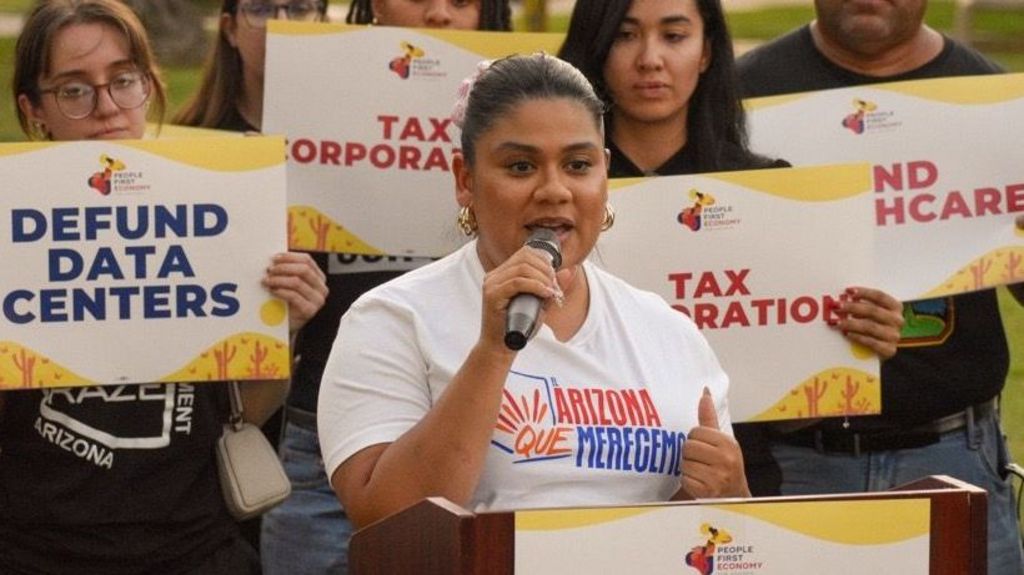
BBC reporters spoke to local organizers in five states — Indiana, Arizona, Michigan, Pennsylvania, and Oregon — all of whom have launched local campaigns to block new data center construction. Opponents raise a wide range of concerns, including noise pollution during construction and operation, harm to local air and water quality, strain on regional energy grids, and the lack of transparent public review before local authorities approve these massive projects.
Data from Data Center Watch, a research firm that collects data for AI industry stakeholders, shows that the number of community groups organizing against new data center projects more than doubled to 833 in the first half of this year, with new groups cropping up in nearly every U.S. state. Stephanie Maldonado, political director of Arizona-based community organizing group LUCHA, described the movement as a modern David and Goliath story that has been building for years. “People have been ready to put a stop to it,” Maldonado said. “Now, people are angry.”
New national polling confirms that AI regulation and data center expansion rank among the top issues for voters in this election cycle, trailing only the ongoing Iran conflict and broader economic concerns. Proponents of data center development, including big tech firms and many local economic development agencies, often argue that new facilities create high-paying local jobs. But recent non-partisan research from the Brookings Institution finds that the average new data center creates only 100 to 200 local jobs — far fewer than industry advocates claim — and has no measurable positive impact on local wages.
Even politicians who once supported aggressive data center expansion have reversed course under public pressure. Arizona Governor Katie Hobbs, once a proponent of the industry, signed an executive order in July putting a three-year pause on new tax breaks for data center projects. Arizona is far from alone in this policy shift: in Michigan, Democratic Senate candidate Abdul El Sayed made strict new data center regulations a core plank of his successful primary campaign. In the Georgia governor’s race, a Democratic candidate calling for a moratorium on new data centers is locked in a dead heat with a pro-development Republican incumbent.
In Ohio, where recent polling shows a majority of voters oppose new data centers, Republican incumbent Senator John Husted has been forced to soften his pro-development stance, now saying that local communities should have final say over whether new facilities are built. His Democratic challenger, Sherrod Brown, has centered his campaign on opposition to new data centers and currently leads Husted in recent polling. This shift has prompted the National Republican Senatorial Committee, the Senate’s top Republican fundraising body, to issue a private memo warning that GOP candidates must completely reframe their messaging on data centers to avoid upsetting voters. The memo called the issue a “sleeper issue for the entire election cycle.”
Texas offers one of the clearest examples of how backlash has transformed even the most pro-business political positions. Pew data shows Texas currently hosts nearly 300 operational data centers, with another 170 planned. Just a few months ago, Republican Governor Greg Abbott touted Texas as “the epicentre of AI development” thanks to its booming data center sector. Today, he has walked back that claim, citing public concerns over “safety and quality of life.”
This shift is already reshaping Texas’ upcoming Senate race. Democratic candidate James Talarico has centered his campaign on ending what he calls “sweetheart tax deals” for big tech, and he is now considered a frontrunner for a historically Republican Senate seat, facing off against Republican Attorney General Ken Paxton, who still insists that “there’s plenty of open space in Texas that we can put data centers.”
Most policy changes proposed so far are temporary, with many states enacting one-to-three-year moratoriums on new tax breaks or approvals. This leaves open the possibility that by the time these temporary measures expire, political pressure will have faded, allowing big tech and AI firms to resume their expansion plans. But for now, public anger runs deep, and even developers who design projects with modern sustainability features face overwhelming local opposition.
Balaji Tammabattula, CEO of Barupon, is developing a 700-acre data center and technology campus in Liberty, Texas, designed to capture rainwater for its water needs and operate on independent energy supplies — a design that has become increasingly common for large projects in response to environmental concerns. Even so, Tammabattula told the BBC that local opposition has been intractable. “There’s just such a high level of tension from the jump that you can’t really even break through with the facts,” he said. After one recent community event, he recalled attempting to speak one-on-one with a woman who was a vocal opponent of the project. “She just looked right at me and said, ‘Get the hell out of my state.’”