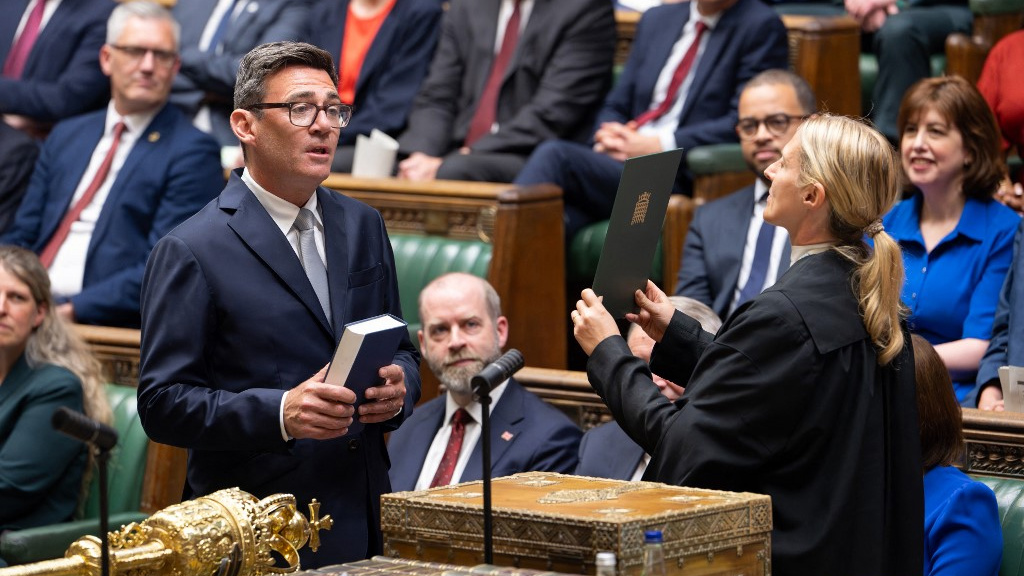
For weeks, Andy Burnham, the incoming UK prime minister set to take office as early as next month, has intentionally avoided public discussion of foreign policy. Multiple anonymous Labour party sources confirm that Burnham and his campaign team judged that weighing in on international issues would do little to boost his chances in the Makerfield by-election, a predominantly white working-class constituency he ultimately won to secure his seat in parliament.
During one of the few recent occasions he was pressed on the conflict in Gaza, Burnham refused to publicly label Israeli actions in the territory as genocide. “I can’t judge things of that enormity from where I am as mayor of Greater Manchester,” he stated at the time, though he added that he held deep concerns over the “disproportionate nature of what has happened in terms of the destruction” and called for a full international investigation and accountability for all parties.
The conflict has already claimed a devastating human toll since the October 7, 2023, Hamas attack that killed 1,200 people in southern Israel. Data confirms that Israeli military operations in Gaza and the West Bank have killed more than 73,000 Palestinians and wounded an additional 170,000 people to date.
Now that Burnham has secured his parliamentary seat and is on track to become prime minister unopposed in what is widely described as a political coronation, long-simmering pressure over his foreign policy stance is set to intensify. To win over the bulk of Labour’s membership, which overwhelmingly backs tougher critical action against Israel, and to win back disillusioned left-wing voters who have abandoned the party in droves over the issue, Burnham will be forced to confront the topic head-on.
Recent electoral data underscores just how costly the party’s current vague stance on Gaza has been. Polling from last month’s local elections shows that Labour lost more former voters to the left-wing Green Party than to the right-wing Reform UK. A subsequent study found that more than half of former Labour voters who plan to support another centre-left or left-wing party in the next general election cited Israel’s military campaign in Gaza as a key factor in their decision to abandon the party.
Labour MP Kim Johnson has urged Burnham to demonstrate the moral clarity that current leader Keir Starmer has repeatedly failed to show on the Gaza crisis. “If Andy wants to win back traditional Labour voters, especially those who feel abandoned on foreign policy, he has to show the moral clarity [Starmer] has too often lacked on Gaza,” Johnson told Middle East Eye. She added that Burnham must be willing to state openly what Starmer would not: that a genocide is ongoing in Gaza, and the party’s refusal to speak honestly and act decisively on the issue has come at a severe political cost.
“People wanted Labour to call it what it is, to stand up for international law and to listen to the Palestine solidarity movement,” Johnson explained. “Instead, that silence has alienated core voters and driven support away from the party. Take the May local elections for example – Palestine was on the ballot for millions of progressive voters. We lost 58 percent of the seats we were defending in England and lost almost four times as many voters to the Greens than to Reform UK. We cannot deny that Gaza is a major reason many have walked.”
Johnson emphasized that foreign policy is not a peripheral issue, saying: “Foreign policy isn’t a side issue. It’s about values, credibility and whose side you are on when it matters.”
Burnham’s history on Middle East policy is nuanced, leaving room for questions about what stance he will ultimately take. In 2015, he joined Labour Friends of Israel (LFI), a pro-Israel party grouping, a move that positioned him as a non-radical alternative to strongly pro-Palestinian figures like then-party leader Jeremy Corbyn. During his unsuccessful 2015 Labour leadership bid, Burnham even stated that his first overseas trip as prime minister would be to Israel.
But records also show Burnham has long been willing to criticize the Israeli government. Within days of Benjamin Netanyahu’s re-election as Israeli prime minister in 2015, Burnham wrote on X that the news was “depressing,” noting that Netanyahu had run on a pledge to expand illegal Israeli settlements and adding that “Palestine will need more international support.” That same year, he told the Palestine Solidarity Campaign that he backed full recognition of Palestinian statehood, calling it “not a gift to be given but a right to be recognised,” and acknowledged that Israeli settlements and their ongoing expansion remain a core barrier to lasting peace.
Burnham also has longstanding ties to the Council for Arab-British Understanding (Caabu), a leading UK policy group focused on the Middle East. He joined Caabu on a 2012 trip to the occupied West Bank, and in March 2025 praised the organization as a critical parliamentary partner, saying “in these times that we live now, Caabu is needed more than ever.”
Caabu director Chris Doyle argues that the next UK prime minister must implement a dramatic shift in the country’s Middle East policy. A meaningful course correction, Doyle says, would require ending the current climate of impunity Israel enjoys, holding parties that violate international law accountable through tangible consequences including backing International Criminal Court arrest warrants for Israeli officials, and guaranteeing full unimpeded access for UN and other humanitarian aid agencies to Gaza.
Doyle added that the UK must embrace a more humble role in global conflicts: “We need to accept that we are a middle-ranking power, that we don’t have the ability to go and determine conflicts abroad. But where we can make a difference is through creative, imaginative, determined diplomacy rooted in international law, rooted in basic core principles of how to resolve conflicts.”
In the immediate aftermath of the October 7 attack and Israel’s subsequent siege and bombardment of Gaza, Burnham broke with Starmer’s Labour leadership to join London mayor Sadiq Khan and Scottish Labour leader Anas Sarwar in calling for an immediate permanent ceasefire. In a column for The Independent, he warned Starmer against branding MPs who disagreed with the party line on the issue “as disloyal or as if they don’t care about innocent lives.”
Just last month, Labour party delegates voted overwhelmingly at the annual conference to officially recognize that Israel is committing genocide in Gaza and to back sanctions on Israel, a shock rebuke of the party’s current stance that underscores how deep support for a tougher line is among grassroots members.
Caabu and the British Palestine Project have already outlined five core Palestine policy pledges they are demanding the next Labour prime minister adopt: ban all UK trade with goods and services produced in illegal Israeli settlements, uphold and enforce international law, guarantee unrestricted access for UN agencies and humanitarian organizations to Gaza, open occupied Palestinian territories to independent journalists, politicians and international investigators, and work with global allies to end all unlawful regional occupations.
Doyle also notes that the next prime minister will need to resist intense pressure from the incoming second Trump administration to maintain the UK’s current uncritical support for Israel, rather than caving to unilateral American demands. Calls for a full ban on settlement goods are already growing among Labour backbenchers, and internal polling shows 87 percent of rank-and-file Labour members support such a ban, with just 6 percent opposing it. Privately, senior Foreign Office ministers have already acknowledged that a ban on settlement goods would align fully with the UK’s official stated position on the occupied Palestinian territories, sources confirm.
Rohan Talbot, director of advocacy and campaigns at Medical Aid for Palestinians, laid out clear expectations for whoever takes office at Downing Street: “Whoever walks into Downing Street next must do what Starmer would not to end these horrors: stop providing arms to Israel, stop trading with illegal settlements in the West Bank, guarantee unrestricted humanitarian access, and ensure that those responsible for crimes against humanity are held fully accountable. Respect for international law is measured by actions, not rhetoric. The next prime minister must not be an ally to atrocities.”