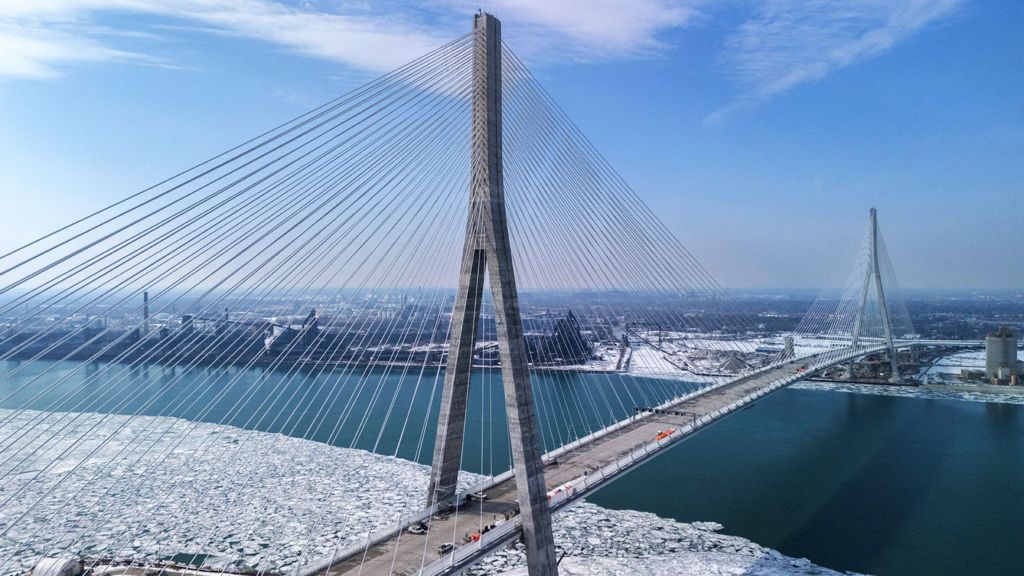
After eight years of construction and multiple unplanned delays, the Gordie Howe International Bridge – a C$6.4bn cross-border infrastructure project connecting the North American automotive hubs of Detroit, Michigan and Windsor, Ontario – was meant to stand as a powerful symbol of unity between long-time allies Canada and the United States. Named for the legendary Canadian ice hockey star who spent most of his Hall of Fame career with the Detroit Red Wings, the bridge was set to host a joint inauguration ceremony this week attended by senior dignitaries from both nations. Instead, Canadian organizers have disinvited their American counterparts and will proceed with a solo national celebration on Friday, a dramatic shift triggered by former President Donald Trump’s latest threat to impose new tariffs on Canadian goods.
The split inauguration is far more than a last-minute scheduling change: it lays bare the increasingly fraught trade relationship between the two neighboring countries, and amplifies mounting domestic political pressure on Canadian Prime Minister Mark Carney to navigate the ongoing standoff.
The project’s origins stretch back almost 15 years, when Canada agreed to cover the full cost of construction to cut through American political gridlock and move forward with the critical trade artery, which was designed to alleviate dangerous bottlenecks at the existing Windsor-Detroit crossing. Every day, more than C$1bn in goods moves through this border corridor, making the new bridge a high-stakes asset for manufacturers and businesses on both sides of the border. When Canada took on the construction cost, the original agreement stipulated that the bridge would be jointly owned by the Canadian federal government and the state of Michigan, with Michigan gaining access to a share of toll revenues only after Canada recouped its full construction costs.
That original framework started to unravel early this year, just weeks before a planned ribbon-cutting, when Trump announced he would block the bridge’s opening unless Canada agreed to cede shared authority and ownership to the US. “We should own, perhaps, at least one half of this asset,” Trump stated at the time. According to a New York Times report, the demand came just hours after billionaire Matthew Moroun – head of the Moroun family that owns the adjacent Ambassador Bridge, North America’s busiest privately owned commercial border crossing, and a top Trump donor – held a closed-door meeting with US Commerce Secretary Howard Lutnick.
By June, Carney had agreed to a US request to delay the bridge’s opening to allow for additional negotiations. In a move that has sparked fierce domestic backlash, Ottawa agreed to split half of all bridge revenues for the next 15 years with an economic development fund controlled exclusively by the US government, a concession designed to unlock the project’s opening. Trump quickly celebrated the deal on social media, calling it “MUCH BETTER” for the United States.
The latest rift over the inauguration comes as broader trade tensions between the two nations continue to escalate. During his election campaign, Carney vowed to tackle US trade disputes with an “elbows up” approach, a nod to the tough, physical playing style that made Gordie Howe a legend. But today, the prime minister faces growing criticism from political opponents who argue he has conceded too much to a US administration that a large share of Canadians view as acting in bad faith toward their country.
Colin Robertson, a former Canadian diplomat and senior fellow at the Canadian Global Affairs Institute, told the BBC that working with the current US administration is unlike any previous experience for Canadian negotiators. “They renege on deals. They don’t follow agreements. It’s like dealing with pirates,” Robertson said.
Beyond the bridge revenue dispute, the Carney government has already made a series of concessions the prime minister’s critics label as unnecessary, including dropping a planned digital services tax opposed by large US tech firms and rolling back some retaliatory tariffs imposed in response to earlier US trade measures. Conservative Member of Parliament Shuvaloy Majumdar argues the entire ordeal proves Canada has negotiated from a position of weakness as it pursues a broader comprehensive trade deal with the Trump administration. “Canadians are sick and tired of being made into a punching bag by President Trump and have the self-respect to fight for their existence and their country,” Majumdar said at a recent press conference. “They deserve a government that is willing to do the same thing.”
Carney has also faced scrutiny over a lack of public transparency around the terms of the new bridge deal, particularly around how revenue sharing will be structured. During a press availability Thursday, he clarified that the original agreement with the state of Michigan to recoup construction costs remains in place, and the new US-focused revenue sharing arrangement runs “in parallel” to that original framework.
Not all Canadian political leaders have criticized the deal. Ontario Premier Doug Ford praised Carney for “an excellent job of getting this deal done,” though he has also called Trump a “bully” and urged Ottawa to use Canada’s energy and critical mineral exports as leverage in ongoing trade talks. Robertson acknowledges that the revenue agreement is a clear concession, but argues it was a necessary compromise to protect cross-border commerce. “This new state-of-the-art bridge was done at a great expense, and yes we paid, but it is necessary to keep supply chains intact,” he said, noting that business communities on both sides of the border have pushed for years to get the bridge open.
The split over how to approach US trade talks has already exposed deep cracks in Canada’s provincial consensus: while Ford pushes for a harder line, Alberta Premier Danielle Smith and Saskatchewan Premier Scott Moe have called for restraint. For Carney, the path forward remains uncertain. Robertson notes that while Gordie Howe played with “elbows up”, his ultimate goal was always to put the puck in the net – a metaphor for getting the critical infrastructure open. Even so, Robertson added, Canada has already reached the limit of what it should concede. “Any further concessions would be problematic and probably not in our interest, given the behaviour of the Trump administration up to now,” he said.