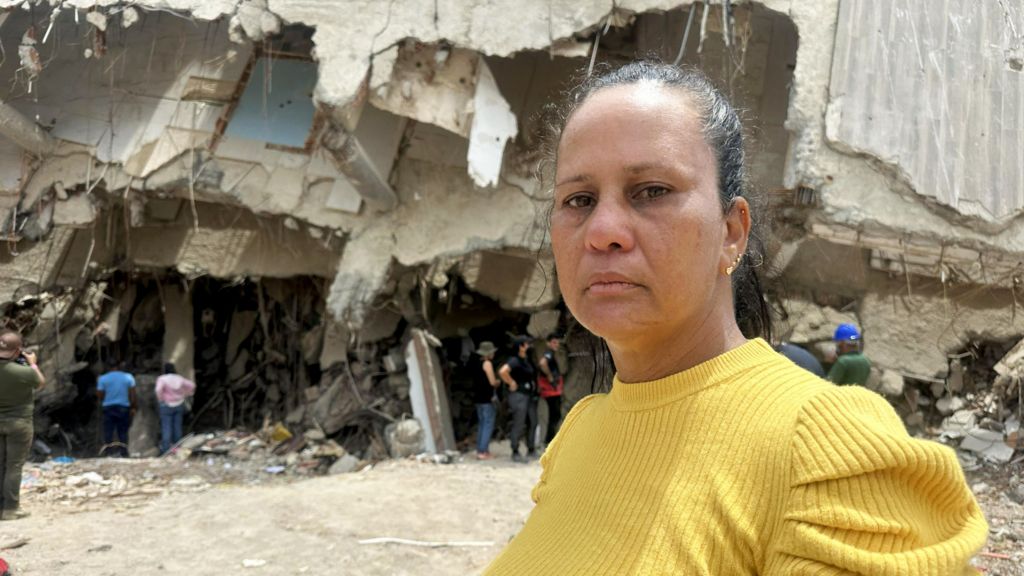
Thirty days have passed since powerful twin earthquakes tore through Venezuela’s northern coastline, and for countless grieving families, the agonizing search for the remains of missing loved ones continues, unfolding against a backdrop of unprocessed grief, mounting anger at official authorities, and deep uncertainty over the long road to recovery.
For 49-year-old fisherman Victor Calderón, the tragedy struck while he was 18 days out at sea. When word arrived via radio that his family’s apartment building had collapsed, he rushed back to shore only to learn that 26 members of his extended family—ranging in age from a 2-year-old toddler to elders in their late 70s, including his sisters, stepfather, and nine cousins—were gone. “It’s a terrible, terrible thing,” he says, his voice tight with unwept emotion. “I haven’t cried for them yet, not until I find the last ones who are missing.” Today, Calderón and his two surviving family members live in a cramped tent on a local golf course, in what was Caraballeda’s OPPE 26 public housing complex, widely recognized as the epicenter of the disaster.
Calderón’s story is far from unique. Official government data, updated daily, puts the confirmed death toll at more than 5,300, with over 16,500 people injured. While authorities have not released an official count of those still unaccounted for, independent estimates place the number of missing in the tens of thousands. As daylight faded at the OPPE 26 site recently, recovery teams pulled three more bodies from the twisted rebar and crumbled concrete, including that of an 11-year-old girl. As her small body was carefully wrapped in black sheeting, rescue workers paused their work to offer a silent prayer, while the father’s guttural howls of grief cut through the rumble of nearby earthmoving equipment. “This is soul-destroying,” said Magin Hernández, a member of a volunteer search team, wiping quiet tears. “For the rescuers, the families, the friends; just soul destroying.”
Weeks after the disaster, nearly all of the international rescue teams that deployed to assist have departed, leaving families to sift through unstable rubble on their own. This abandonment has fueled widespread, palpable resentment toward the national government, with survivors questioning how 10 out of 12 residential buildings at the OPPE 26 complex completely collapsed. Many are demanding answers about whether flawed construction designs, cost-cutting shortcuts, or substandard building materials contributed to the disaster, and whether official negligence played a role.
During a press tour of the affected area, Public Works Minister Juan José Ramírez pushed back against these claims, insisting the buildings were structurally sound. He argued that no country could have withstood the force of two nearly simultaneous earthquakes, moving in opposing directions, that leveled both public and private structures alike. “The earthquake didn’t discriminate between the two,” he said.
A short distance away in the coastal town of Catia La Mar, Laura Barrios continues to dig through the remains of a collapsed private apartment building, searching for the body of her brother-in-law, still trapped in the building’s underground parking garage. It was in that same garage that security guard Hernán Gil was pulled alive eight days after the quakes, a rare miracle that briefly lifted the nation’s collective mood. But the international teams that assisted in that dramatic rescue have long since left, and even the heavy machinery assigned to clear unstable debris has been reassigned to another site—just one day after Barrios’ family recovered the bodies of her sister-in-law and the couple’s two young children, 10 and 3, found huddled together in their bedroom. “The other day was the Day of the Child in Venezuela,” Barrios said through sobs. “But we have no children to celebrate. Ours are gone.” Furious over the slow, inadequate government response, she says the removal of the heavy equipment she still desperately needs has drained her will to keep fighting. “What more can we say that this rubble doesn’t already tell us?” she asked, gesturing to the scattered remains of lives destroyed in just 39 seconds of shaking: lost children’s toys, unused cutlery, broken crockery, abandoned T-shirts, entire lifetimes erased.
Amid the grief and anger, small acts of human solidarity persist. At meal queues run by US-based humanitarian group World Central Kitchen, survivors still share quiet jokes and warm hugs, holding onto their characteristic resilience in the face of unthinkable loss. But for most, the end of each day brings a return to flimsy nylon tents pitched along curbsides, their temporary homes for the foreseeable future. The acting government led by Delcy Rodríguez—who took office in January following the removal of former leader Nicolás Maduro by US forces—recently donated 200 temporary homes to displaced families, but aid groups estimate total need is more than 100 times that number.
The scale of reconstruction is staggering: the World Bank estimates the twin quakes caused $19.6 billion in damage, a cost Venezuela is ill-equipped to cover. With US authorities currently controlling the country’s oil industry, its primary source of national revenue, the timeline and scope of long-term recovery remain deeply unclear. Thousands of families still wait for closure, their stories of loss adding up to a national trauma that has left an indelible scar on a country already grappling with political and economic upheaval.