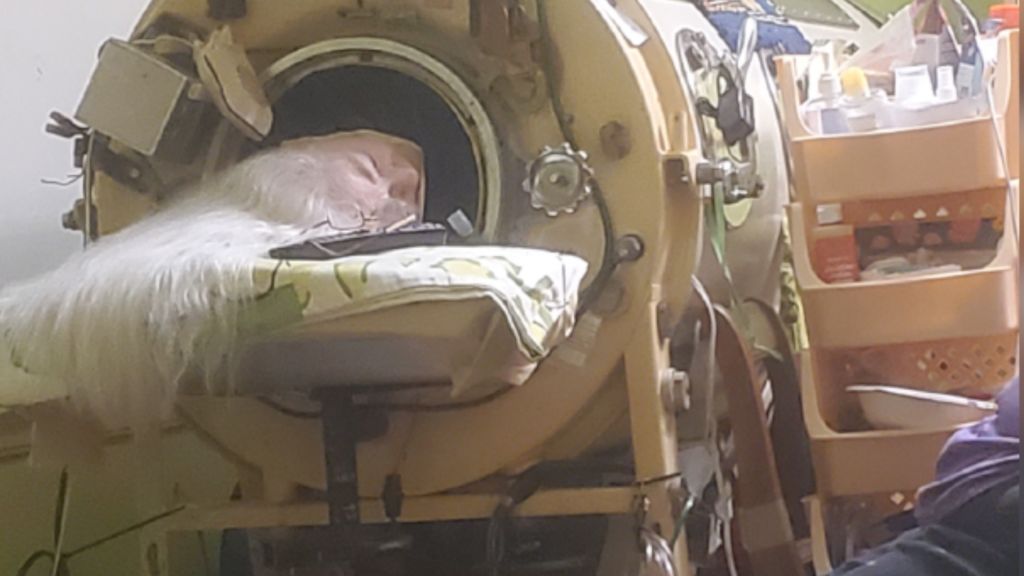
Martha Lillard, the United States’ last remaining person who relied on an iron lung to breathe after contracting polio, died at her home in Oklahoma at the age of 78 on June 26. For nearly three-quarters of her life, the large metal breathing device defined her daily routine — but it never defined her spirit, her family says.
Lillard was just 5 years old when she was diagnosed with paralytic polio in the mid-1950s, one year before the first widespread polio vaccine rolled out across the U.S. Waking up one morning unable to lift her head from her pillow, she already understood what her symptoms meant: widespread public fear of the incurable disease dominated conversations at the time, and the young girl immediately recognized the signs of the infection that had already left so many children dead or disabled.
After her diagnosis, Lillard spent decades dependent on the iron lung, a negative-pressure respiratory device that works by adjusting air pressure inside a sealed metal cylinder to force the lungs to expand and contract, doing the work of weakened respiratory muscles automatically. While many children who relied on the machine feared it, Lillard never shared that anxiety, according to her younger sister Cindy McVey. Instead, the device felt like a recharge, leaving her feeling refreshed after daily sessions inside it.
Against all odds, Lillard and her family refused to let her condition limit the life she built. Determined to let her live as independently as possible, her uncle and grandfather engineered a custom modification to the iron lung that let Lillard open and close the device on her own, granting her the ability to live alone that most other iron lung users never had. Loved ones also retrofitted a car to match her limited mobility: the steering wheel was repositioned to rest in her lap, and turn signals were moved to the floor, letting Lillard drive herself wherever she wanted to go.
Over her decades of life, Lillard cultivated a rich set of passions. She became a skilled painter, creating detailed landscape works, and was an avid learner who constantly asked questions of her smart speaker to expand her knowledge. She also shared more than 20 years with her partner Baha Salh, who moved to the U.S. from Egypt after securing a visa earlier this year. The pair married in February, just four months before Lillard’s death.
While her official cause of death is listed as post-polio syndrome and chronic pulmonary failure, McVey says long COVID-19 ultimately contributed to her sister’s passing. Even so, McVey says her sister remained resilient and resourceful throughout her entire life: “She was resilient, she would find a way, or make do.”
Lillard’s story comes amid a renewed reckoning over polio and vaccine access in the U.S. After the polio vaccine was introduced in 1955, a nationwide mass vaccination campaign eliminated endemic polio in the U.S. by 1979, a major public health victory that ended the regular outbreaks that killed and paralyzed thousands of children annually. According to the World Health Organization, roughly 1 in 200 polio infections result in permanent paralysis, and 5 to 10 percent of paralyzed patients die when their breathing muscles become immobilized.
Today, however, growing vaccine hesitancy across the U.S. has put that progress at risk. Earlier this year, Kirk Milhoan, chair of the Centers for Disease Control and Prevention’s Advisory Committee on Immunization Practices, drew controversy after suggesting that polio vaccination should be made optional, arguing that improved sanitation and lower current risk mean the tradeoff between vaccine risk and disease risk has shifted.
That rhetoric and the trend of declining childhood vaccination leave McVey deeply worried. Speaking through tears, she warned that fading cultural memory of polio’s devastation has led generations to underestimate the danger of the disease. “Polio is terrible. The disease disfigures, disables and leaves people trapped. We had it under control here and now we have all these people who aren’t vaccinating their children,” she said. “They may think there’s problems with the vaccine, but there’s a whole lot more problems if they don’t vaccinate.”
McVey also noted just how narrow the gap was between her sister’s fate and a polio-free life: Lillard was infected the year before the vaccine became widely available, and McVey had friends who participated in the vaccine trials that same year. “It was that close,” she said.