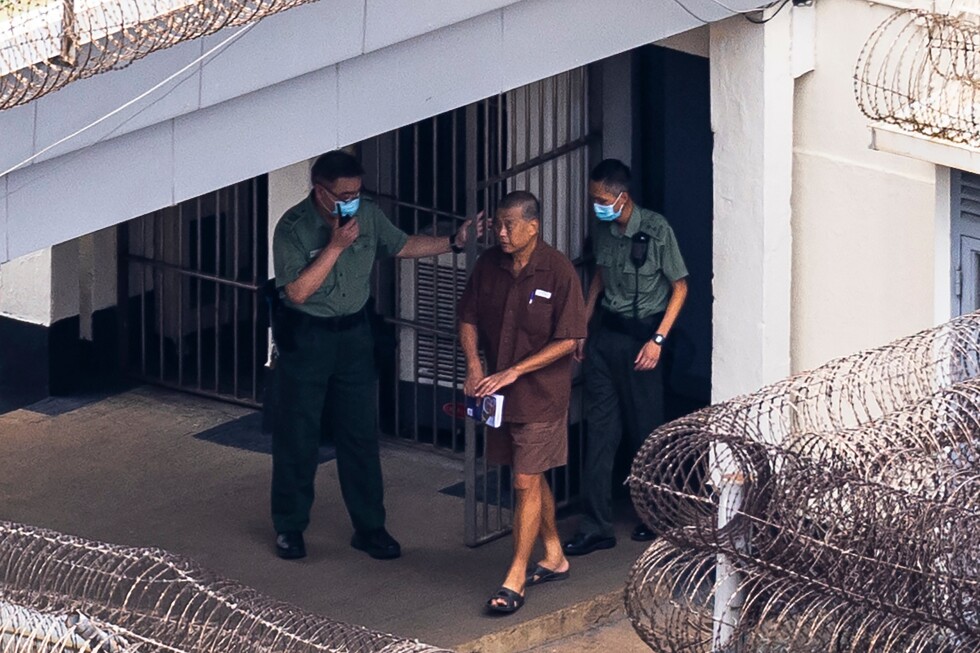
Court documents obtained by the Associated Press on Tuesday have revealed new details of a major asset forfeiture action launched by the Hong Kong Special Administrative Region government against jailed former media entrepreneur Jimmy Lai. Authorities are moving to seize more than 127 million Hong Kong dollars, equal to roughly 16 million U.S. dollars, in cash held in personal and corporate bank accounts, corporate shares, and other funds linked to what officials describe as national security crimes tied to Lai. While the government first announced its plan to pursue asset forfeiture in early April, it had not publicly disclosed the full value of the assets in question until the release of the court filing, which also does not detail the specific connection between the targeted properties and Lai’s convicted offenses.
Jimmy Lai, founder of the now-shuttered pro-democracy newspaper Apple Daily and a long-standing vocal critic of China’s ruling Communist Party, was found guilty in December last year on two counts under the Beijing-imposed Hong Kong National Security Law: conspiracy to collude with foreign forces and conspiracy to publish seditious content. In February, he was handed a 20-year prison sentence, the harshest penalty issued to date under the 2020 national security legislation.
The court filing outlines the full scope of assets Hong Kong’s Department of Justice is seeking to have forfeited to the government. The list includes 15 personal bank accounts held under Lai’s name, funds held in accounts tied to multiple companies he is associated with, and corporate shares controlled by Lai and other connected parties. Among the targeted shares are Lai’s stake in Next Digital, the parent holding company of Apple Daily, and holdings in Dico Consultants, a firm tied to an earlier fraud conviction against Lai that was ultimately quashed by the courts. The requested seizure also includes 2 million Hong Kong dollar (US$255,440) fine from Lai’s 2022 fraud conviction, which was set to be refunded to him after that conviction was overturned in February, as well as bail funds deposited with the Hong Kong judiciary.
In its April 2 statement announcing the forfeiture application, the Hong Kong government cited provisions of the national security law, which allow for the confiscation of any assets used, or intended for use, in committing a national security offense, as well as any proceeds generated through those offenses. Officials argue that the forfeiture order is a necessary step to protect national security, preventing Lai, his allies, and his representatives from using crime-connected assets to carry out further activities that threaten the stability and security of Hong Kong and China. A court hearing on the government’s application is scheduled to be held in July.
The case has sparked ongoing international and domestic debate over the scope of the national security law and its impact on civil liberties in Hong Kong, which returned to Chinese rule in 1997 after more than 150 years of British colonial administration. Critics of Lai’s conviction argue that it represents a dramatic erosion of press freedom and other core civil liberties that were guaranteed to Hong Kong under the 1997 handover framework. Conversely, the Hong Kong government has repeatedly emphasized that the prosecution is not an attack on free press, maintaining that Lai and other co-defendants used journalistic activity as a cover to carry out acts that undermined national security over a period of years.