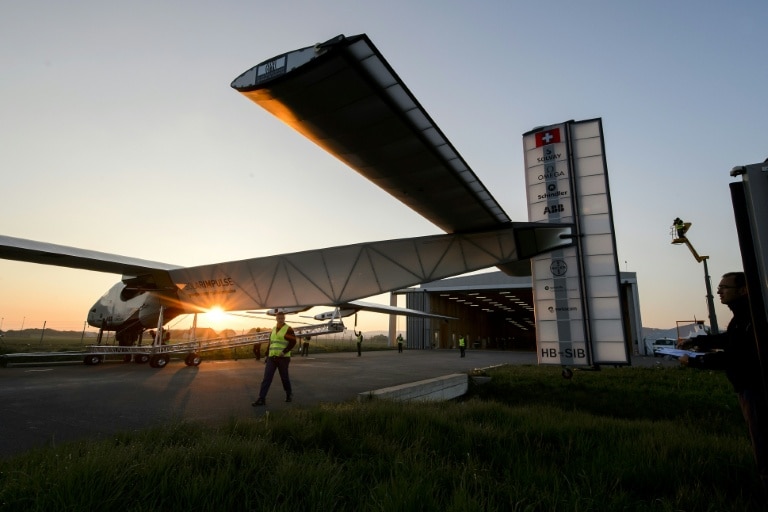
One of aviation’s most groundbreaking sustainable technology experiments has met an unexpected end. Solar Impulse 2, the Swiss-engineered solar-powered aircraft that made global history in 2016 by completing the first ever fuel-free circumnavigation of the globe, has crashed into the Gulf of Mexico during a post-conversion test flight, its former owner confirmed recently.
When it completed its landmark journey seven years ago, Solar Impulse 2 redefined what renewable energy-powered flight could achieve. Piloted alternately by Swiss explorers Bertrand Piccard and Andre Borschberg, the aircraft completed its round-the-world trip across 17 separate legs of travel. Over a total cumulative flight time of 23 days, it covered 43,000 kilometers (26,700 miles), crossing four continents, two oceans and three seas without relying on a single drop of traditional jet fuel.
The aircraft changed hands three years after its record-setting voyage, when it was acquired by U.S.-based aerospace firm Skydweller Aero. The company had launched an initiative to convert the legendary manned plane into an autonomous long-endurance drone, designed to support a range of operations including military and scientific missions. According to an official statement released by the firm this Tuesday, the doomed flight was part of a planned controlled ditching exercise tied to a U.S. Navy test program.
Skydweller Aero confirmed that the aircraft departed from Stennis, Mississippi on April 26 for the test flight, but crashed into the Gulf of Mexico on May 4. Despite the crash, the company noted that the test campaign had already achieved a major milestone: an 8-day and 14-minute continuous flight that proved the feasibility of perpetual solar-powered flight for military operations in real-world conditions.
The U.S. National Transportation Safety Board has launched an official investigation into the accident to determine the root cause of the crash. Industry observers note that while the loss of the iconic aircraft is unexpected, the technological breakthroughs it enabled during its historic career will continue to inform the development of sustainable and long-endurance solar aviation for years to come.