Last week, British Prime Minister Andy Burnham formally ruled out any potential coalition partnership with the UK Green Party, citing the party’s recent membership vote that passed a motion labelling Zionism as a form of racism, which Burnham framed as an antisemitic position. The passed motion frames Zionism, the ideological foundation for the establishment of the state of Israel, as rooted in colonialist practice and the assertion of Jewish ethnic supremacy over Palestinian communities, positioning the Green Party in explicit opposition to the ideology. Notably, Green Party leader Zack Polanski, who identifies as an anti-Zionist Jew, abstained from the vote because a set of proposed amendments he supported failed to secure passage. In a sharp public rebuke posted to social media platform X, Polanski accused Burnham of being “a Prime Minister who arms a genocide and locks pensioners up for opposing it,” and charged him with engaging in “the dangerous & irresponsible blurring of challenging Israel & Antisemitism.”
The discourse around Zionism and Jewish identity is far more layered than mainstream narratives often present. For much of modern Jewish history, Zionism existed as a marginal, fringe ideology, only gaining widespread mainstream acceptance across Jewish communities and institutional bodies over the last 75 years. Critics point out that many staunch defenders of the state of Israel regularly conflate Jewish religious and cultural identity with Zionist political ideology, smearing all critics of Israeli state policy as antisemitic. This conflation, observers note, erases the legitimate Jewish identity of anti-Zionist figures such as Polanski, while also perpetuating the harmful antisemitic myth that all Jewish people hold a uniform, monolithic set of political priorities that are inherently aligned with supporting the state of Israel.
Demographic shifts are reshaping these perspectives rapidly. While the majority of British Jewish residents still identify as Zionists, younger generations are increasingly distancing themselves from that label. This trend is even more pronounced among Jewish communities in the United States, where recent surveys show only one in three American Jews identify as Zionist, with adults aged 18 to 34 representing the demographic most likely to describe themselves as either anti-Zionist or non-Zionist. A growing number of these younger Jewish people are rediscovering a long-forgotten legacy of Jewish anti-Zionist organising, reviving marginalised Jewish identities that many believe could once again emerge as a dominant force in global Jewish communal life.
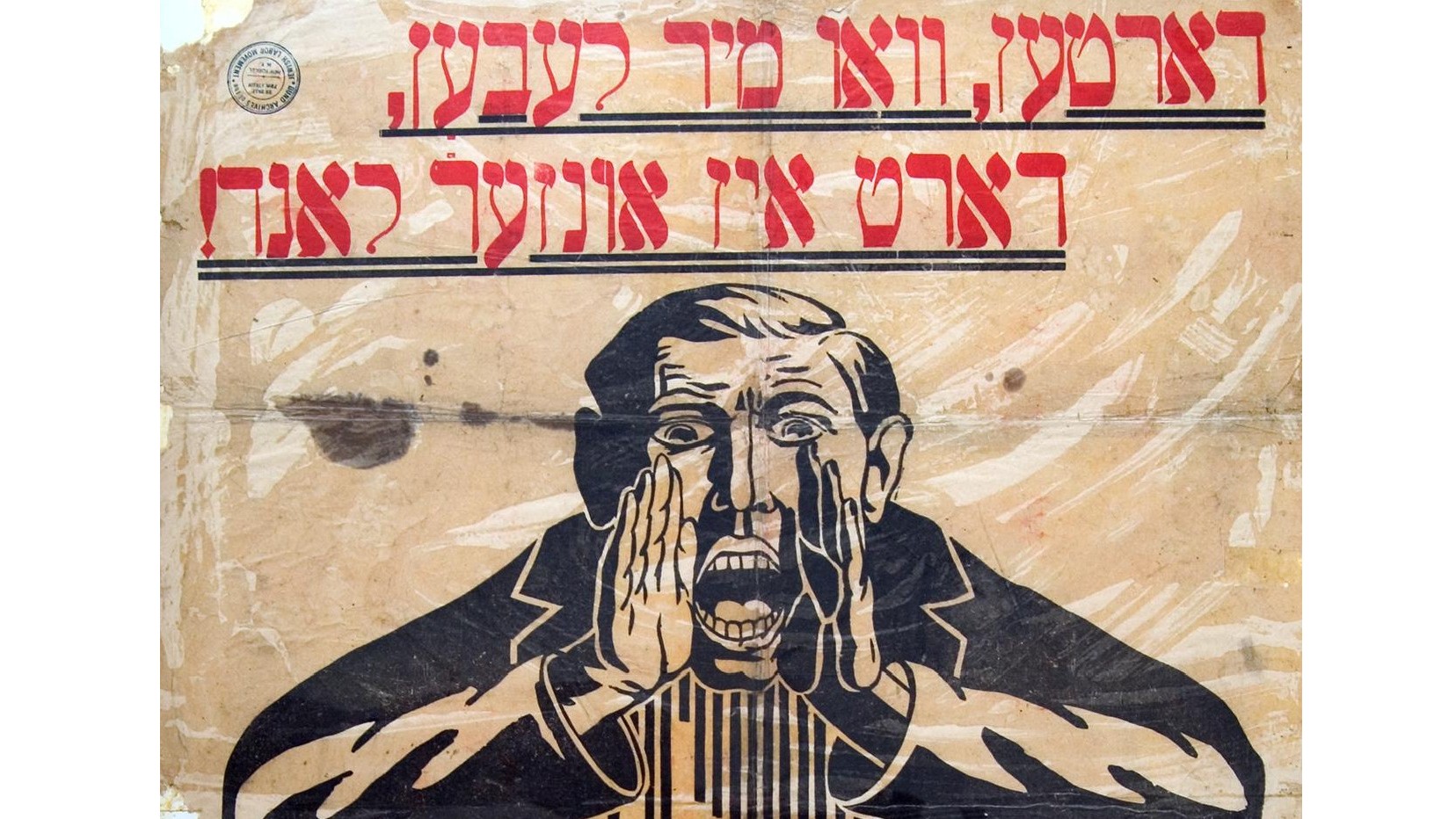
When Zionism first emerged as a formal political movement in the 1880s and 1890s, it faced widespread, organised opposition from large swathes of European Jewish society, most notably from the Bundists. Founded in Eastern Europe in the final years of the 19th century, the Jewish Labour Bund was a socialist workers’ movement dedicated to upholding distinct Jewish cultural identity, defined as Diaspora Nationalism, while participating in broader internationalist class struggle to liberate all working people from capitalist exploitation. By the start of the 20th century, it had grown into the largest, most well-structured Jewish political party in Eastern Europe, boasting 34,000 registered members spread across 274 local branches.
Independent artist and author Molly Crabapple’s newly released book *Here Where We Live Is Our Country* traces her own family’s multigenerational Bundist history, earning widespread critical acclaim from Jewish and non-Jewish audiences eager to engage with this largely erased chapter of Jewish political life. “As American Jews turn away from Zionism, they are seeking these … liberatory, solidaristic and universalist histories which are so present in our story,” Crabapple shared in an interview with Middle East Eye. A core philosophical tenet of Bundism, particularly in the aftermath of the Holocaust, was the concept of “hereness” — or doikayt in its original Yiddish — which directly rejects the central Zionist claim that Jewish collective safety can only be guaranteed through the construction of an ethnostate thousands of miles away in historic Palestine. “Zionism has always been a movement that gave into antisemitic European logic,” Crabapple continued, noting that it capitulated to the “European ethnonationalist idea that Jews are foreigners who belong elsewhere.” Her book documents previously underreported historical records showing that Zionist leaders actively collaborated with Poland’s antisemitic ruling government in the late 1930s, with Polish state authorities arming, training and funding Zionist militias operating in Palestine, while also supplying weapons to youth militias on Polish soil that targeted and murdered Jewish civilians.
Even the 1917 Balfour Declaration, the historic British government document that laid the groundwork for establishing a “Jewish national home” in Palestine, was rooted in this exclusionary framing. Arthur Balfour, the British foreign secretary for whom the declaration is named, openly described Zionism as a “serious effort to mitigate the age-old miseries created for western civilisation by the presence in its midst of a body [Jewish people] which is too long regarded as alien and even hostile, but which it was equally unable to expel or absorb.” At the time the declaration was drafted, Edwin Montagu, the only Jewish member of the 1917 British Cabinet, was the sole official to vote against it, warning presciently that the document would “prove a rallying ground for antisemites in every country in the world.”
“For non-Zionist Eastern European Jews facing antisemitism in the 20th century, doikayt articulated a commitment to worldmaking in the places where Jews lived, called home, [and] belonged for centuries,” explained Miriam Chorley-Schulz, a University of Oregon Holocaust studies scholar. “Against Zionism’s settler-colonial solution to the ‘Jewish Question’, this commitment opposed Jewish ‘normalisation’ within racial capitalist structures through ethnostate-building in Palestine, insisting on fighting the material and ideological conditions of oppression here and now instead.” Eyshe Beirich, a translator currently working on an upcoming collection of Yiddish Bundist writings titled *We, Traitors*, added, “Opposition to Zionism was as obvious to the Bund as opposing fascism and any other nationalist violence: Jewish nationalism was just as ugly, just as contemptuous as any other.”
As committed socialists, Bundist organisers built cross-communal Jewish trade unions and coordinated mass demonstrations that drew tens of thousands of Jewish workers and students. In Russia, Bund members played a pivotal role in the early 20th century revolutions, and organised coordinated Jewish self-defence units to protect communities during the violent 1903 to 1906 pogroms. Bernard Goldstein, who led the Bund’s militia operations in interwar Poland, advocated for armed resistance against Nazi persecution and helped smuggle critical weapons supplies to Jewish fighters ahead of the 1943 Warsaw Ghetto uprising. Bundist organisations also established the first formal secular Yiddish school system, alongside a network of institutions that delivered “education, mutual aid, and organisational support to Jewish workers all over Poland,” according to Beirich, building a thriving cultural ecosystem that leading Jewish studies scholar Jack Jacobs termed a “Bundist counterculture.” Yiddish, the everyday European Jewish vernacular spoken by the vast majority of Jewish people at the time, was celebrated by the Bund as a secular Jewish language that preserved shared communal cultural heritage. For Bundist leaders, Beirich explained, “Yiddish carried the idioms and revolutionary spirit … of the Jewish working class, and it was incumbent on the Bund to support its development.” While a small number of Zionist figures supported Yiddish language education in interwar Poland, most mainstream Zionist political parties actively opposed the Bundist school system, and even collaborated with the antisemitic Polish state government to forcibly shut them down. Chorley-Schulz noted that “the Zionist movement eventually opted for an aggressive Hebrew revivalism – a nationalist monolingual project that deliberately suppressed languages spoken by diasporic Jews … as both a tool of negating the diaspora and nation-building in the settler colony.”
Both the Yiddish language and the Bundist movement itself were nearly eradicated during the Holocaust or lost to widespread cultural assimilation in the post-WWII era, with the language surviving only in isolated Orthodox and ultra-Orthodox Jewish communities. Today, however, a growing movement of activists and scholars is working to revive both the Bundist political tradition and the Yiddish language. Many Jewish refugees who fled Eastern Europe in the early 20th century settled in the United States, bringing their Bundist ideological commitments with them and helping to build the infrastructure of American Jewish socialism during the peak of the country’s labour organising movements in the 1880s. They joined forces with other immigrant communities to launch mutual aid organisations and create spaces to celebrate their distinct Jewish cultural heritage. Benjamin Balthauser’s book *Citizens of the Whole World* revisits this largely overlooked history of the American Jewish left. Balthauser notes that among American Jewish communities, there remains a “long memory of a Jewish fight against fascism, nationalism, racism.” “That was a Bundist idea: that we are proud of our Jewish heritage, of our Jewish identity, but also want to be in solidarity with the working class, with anti-colonial struggles around the world” — including the Palestinian anti-colonial movement. “This memory is coming back … a memory that is buried, but it’s a very shallow grave,” Balthauser observed, as growing numbers of American Jews are “remembering this older language, and also realising that this language is not that old.”
In his new book *Anti-Zionism: A Jewish History*, author Benjamin Moser documents the lives and work of Jewish anti-Zionist figures across centuries and continents who have been systematically sidelined and erased by mainstream efforts to conflate Judaism and Zionism. Moser argues that Jewish communities have historically occupied the social role that philosopher Hannah Arendt famously termed the “conscious pariah,” a status that made them frequent targets of European ruling elites during periods of social and economic crisis. Moser told MEE that the unifying thread connecting these disparate Jewish anti-Zionists across different eras and geographies is that “they are all pariahs, all resistors” who “don’t want to go along with the rationale of power and violence.” Arendt, one of the key figures profiled in Moser’s work, wrote extensively that Zionism functioned as a mechanism of “getting Jews to disengage from their own societies,” rather than encouraging them to see themselves as interconnected with other marginalised groups and the broader global working class. Reflecting on Theodor Herzl’s foundational Zionist text *The Jewish State*, Arendt wrote in 1946: “Only when we come to see ourselves as part and parcel of a world in which we, like everybody else, are engaged in a struggle against great and sometimes overwhelming odds, and yet with a chance of victory, however small, and with allies, however few… only then will we be able to rid the world of its nightmarish quality.” For contemporary anti-Zionist Jewish thinkers including Moser, the social role of the “conscious pariah” Arendt described is more urgently relevant today than at any point in recent history.