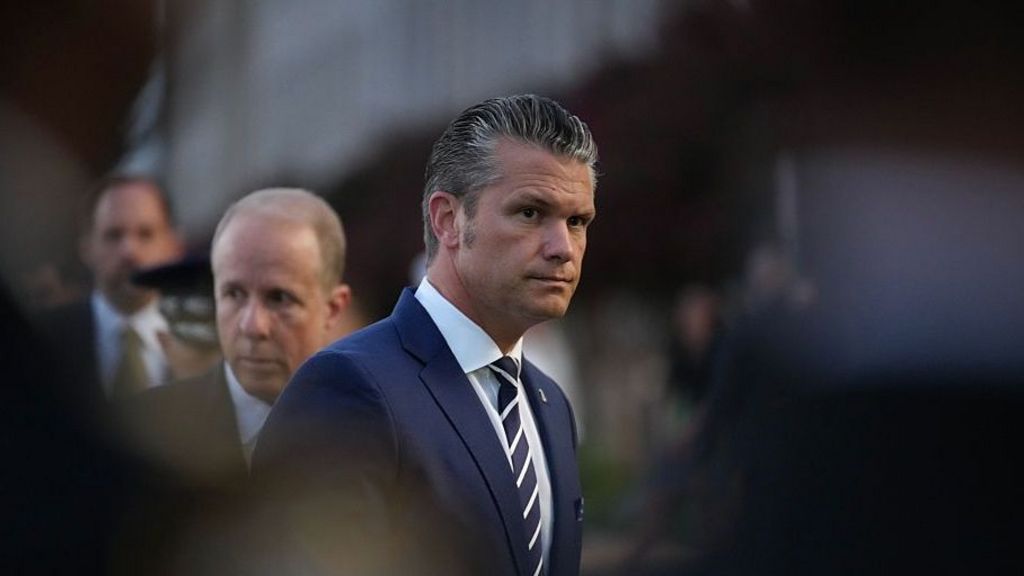
The United States military currently finds itself entangled in two overlapping, high-stakes conflicts that are raising urgent questions about its operational readiness, global positioning, and long-term institutional stability during Donald Trump’s second presidential term. One front unfolds abroad: a years-long stalemate with Iran over control of the critical Strait of Hormuz, which has forced a massive global redistribution of U.S. military assets that is now rippling through alliance networks from Europe to the Indo-Pacific. The second front is a domestic institutional upheaval, led by Defense Secretary Pete Hegseth, whose aggressive shake-up of Pentagon leadership has triggered bitter partisan and internal recriminations, capped last week by the resignation of the U.S. Army’s top civilian leader, Secretary Dan Driscoll.
Driscoll, a relatively low-profile figure outside defense policy circles, oversaw a critical modernization push for the U.S. Army before stepping down last Monday. For months, he had clashed repeatedly with Hegseth over the scope and pace of proposed reforms, particularly his push to integrate cheap, mass-produced drones into standard infantry formations, a shift he argued was essential to adapting 21st-century battlefields after lessons drawn from the war in Ukraine. Driscoll warned that the U.S. military’s bloated bureaucracy and glacial, costly procurement processes left it ill-prepared to counter evolving modern threats, according to senior administration sources. Though Hegseth initially backed the broader modernization agenda, he ultimately pushed back against rapid expansion, and Driscoll accused him of blocking the plan by removing senior generals tasked with leading its implementation. Driscoll’s departure is just the latest in a string of high-profile exits of top civilian and uniformed leaders aligned with the modernization effort.
The growing chaos has prompted sharp criticism from across the political and national security spectrum. Republican Senator Thom Tillis, a consistent critic of Trump, has publicly called for Hegseth’s ouster, saying he has never witnessed more incompetent management of U.S. service members. Former first-term Trump National Security Adviser H.R. McMaster called Driscoll’s departure troubling for the U.S. Army, noting Driscoll had been pushing a critical modernization agenda to bring the service up to speed against near-peer competitors. Retired Navy Captain Jon Duffy, a former White House defense policy official during the Obama administration, argued that Driscoll’s exit has “hollowed out” senior military leadership at a critical moment, creating crippling uncertainty that disrupts progress on modernization and ripples down through the ranks to impact frontline readiness.
Hegseth, a former Army National Guardsman and conservative Fox News pundit who campaigned on transforming the Pentagon’s cultural identity, has framed his overhaul as a necessary correction to decades of what he calls ideological overreach and institutional stagnation. He has repeatedly vowed to eliminate what he labels “woke” diversity initiatives, loosen restrictive rules of engagement he claims limit warfighter lethality, and purge the Pentagon of what he calls out-of-touch, complacent senior leaders. To date, he has removed or sidelined the top uniformed leaders of the Army, Navy, and Air Force, along with more than two dozen senior generals, admirals, and civilian defense officials—many of them among the military’s most decorated officers—often without public explanation.
Critics have drawn unflinching comparisons to large-scale political purges of foreign military establishments. Michael Schiffer, a former senior Pentagon official for East Asia during the Obama administration and now a senior fellow at the Center for American Progress, argued that the mass leadership shake-up amounts to a U.S. military purge that has created serious command gaps and readiness deficiencies that mirror those seen after China’s political purges of its People’s Liberation Army. “The way [Hegseth] is shaking them up… is bringing on board an awful lot of risk without any apparent way to address or ameliorate it,” Schiffer told the BBC.
But Hegseth retains staunch support from the White House and top Trump administration officials. Vice President JD Vance defended the Pentagon overhaul last week, saying he strongly agreed with the need for cultural change after four decades of what he called lost wars and military misadventures. “What Pete came in wanting to do was revive the warrior spirit in the United States of America,” Vance said. The White House confirmed that Trump retains full confidence in Hegseth, pointing to what it calls a record of success in recent military operations against Iran. Trump has repeatedly stood by Hegseth through prior controversies, including the Signalgate scandal, calling him “one of my best” picks in a recent interview with NBC News. Ezra Cohen, a former Under Secretary of Defense during Trump’s first term, described Hegseth’s reforms as a breath of fresh air, bringing new ideas and a more proactive approach to defense strategy.
Beyond the domestic upheaval, the ongoing stalemate with Iran in the Gulf is stretching U.S. military capabilities thin and straining long-standing alliances across the globe. After Trump ordered major strikes on Iran last February, the U.S. has drawn down critical weapons stockpiles and troop deployments from both Europe and the Pacific to reinforce the Gulf, replenishing munitions and moving large ground and naval assets to the region. The shift has already created significant strategic blowback in Europe, according to Liana Fix, a Germany-based expert at the Council on Foreign Relations.
Fix explained that the Trump administration failed to consult NATO and European allies ahead of the Iran strikes, and the subsequent resource drawdown has accelerated a pre-planned shift of U.S. forces out of the continent, a move aligned with Trump’s longstanding criticism that European allies fail to carry their own defense weight. The perceived disunity and weakening of U.S. commitment to European security has created an opening for Russian President Vladimir Putin to escalate hybrid attacks, including armed drone strikes and sabotage operations across NATO countries like Germany, Fix said. “What [Putin] is seeing is not a united stance from the United States and the Europeans to further increase pressure on Russia… he sees that they are weakening, that there are windows and openings of vulnerabilities in Europe,” she noted. Recent unusual diplomatic moves reflect the growing tension: CIA Director John Ratcliffe made a rare high-profile visit to Moscow last month to warn the Kremlin against testing NATO’s resolve, while a top Hegseth aide was in Europe pushing allied governments to increase their own defense spending. The U.S. has already cut 5,000 troops from its 40,000-strong deployment in Germany, and scrapped a Biden-era plan to station a battalion armed with long-range Tomahawk missiles in the country.
While the drawdown in Europe aligns with the Trump administration’s long-stated goal of refocusing U.S. strategy on great power competition with China in the Pacific, the Iran conflict has actually stretched U.S. capabilities in the Indo-Pacific too. Key naval assets, including the USS Abraham Lincoln and the Japan-based USS George Washington carrier strike groups, were diverted from the Pacific to the Gulf to support operations against Iran, leaving the region understaffed at a critical moment of rising tensions with Beijing. The prolonged deployment has already taken a visible toll: recent photos of the USS Abraham Lincoln docking in Thailand with a rusted hull after nine months straight at sea were seized on by Iranian state media to portray the U.S. as overextended and exhausted. Hegseth has forcefully denied claims of poor conditions aboard the vessel, but the image has become a symbol of the strain of the prolonged conflict.
Most notably, the Iran conflict has gutted critical U.S. munitions stockpiles, according to analysis from the Center for Strategic and International Studies (CSIS), a Washington-based think tank. The U.S. has fired roughly one-third of its entire national stockpile of 3,000 Tomahawk cruise missiles, and nearly 1,500 Patriot air defense interceptors—roughly two-thirds of the country’s total stockpile of 2,300—have been expended to counter Iranian drones and missiles. The White House has pushed back against these concerns, with Principal Deputy Press Secretary Anna Kelly insisting that U.S. military power is stronger than ever, and that the military retains enough stockpiles to meet all of the president’s strategic goals. Pro-administration analysts, including former Trump defense official Ezra Cohen, now at the conservative Hudson Institute, argue that the strikes have severely degraded Iran’s conventional military capabilities and weakened its proxy networks across the Middle East, leaving the U.S. with greater flexibility to target Iranian nuclear facilities if needed.
Still, the ongoing conflict shows no sign of ending: 82nd Airborne Division troops deployed to the Middle East more than six months ago are now expected to remain in the region through 2027 with no clear exit strategy. For Trump and Hegseth, the dual challenge of overhauling the Pentagon’s culture and leadership while waging a costly, protracted conflict in the Gulf has created an unprecedented test of U.S. military stability, one that could shape the legacy of Trump’s second term and the future of U.S. global power for decades to come.