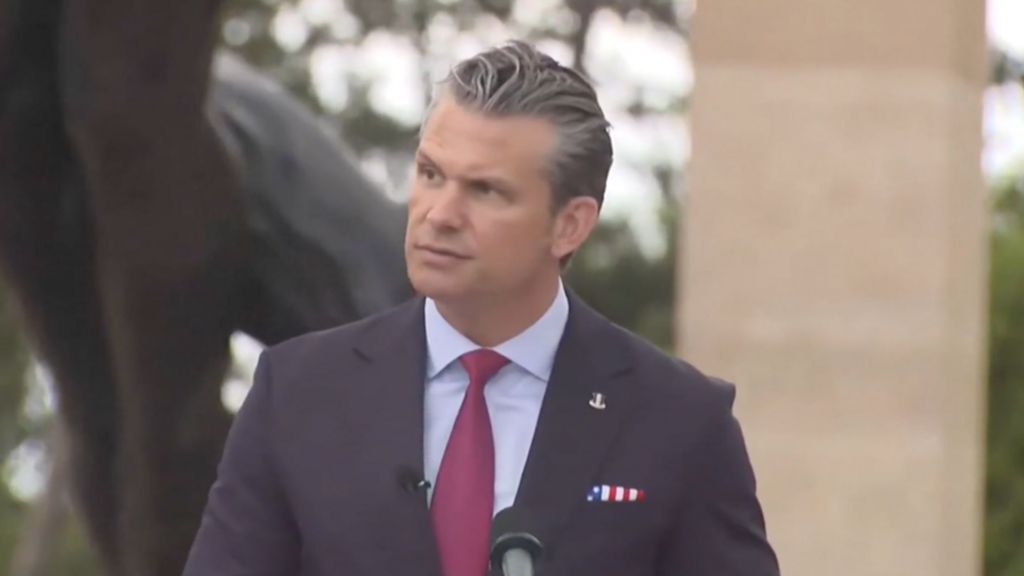
Eighty-two years after the largest seaborne invasion in modern history, U.S. Defense Secretary Pete Hegseth used the anniversary of the 1944 D-Day landings in Normandy, France, to launch a sharp public rebuke of European nations’ handling of irregular migration, drawing widespread pushback for tying the historic military operation to contemporary immigration debates.
Hegseth’s address, delivered on the very beaches where Allied troops from the U.S., United Kingdom, and Canada gave their lives to liberate Northwestern Europe from Nazi occupation, claimed that modern European coastlines are now facing a different kind of incursion. “Sadly, today, different European beaches are stormed by different dangerous ideologies,” he told the assembled crowd. “Beaches in Spain, in Italy, in Greece and Bulgaria. Boats and men arrive. When will European capitals do something about that invasion?”
The U.S. defense secretary also argued that post-WWII European leaders have grown complacent in protecting the hard-won freedom secured by D-Day casualties. “The men who fought and died here restored freedom to Europe,” Hegseth said. “That freedom must be maintained by this generation of leaders and war fighters or what they fought for was merely temporary. Freedom is not free.”
Irregular migration across the Mediterranean and English Channel has been one of the most polarizing political issues across Europe for more than a decade. Sea arrivals of asylum seekers and migrants to mainland Europe hit a peak in 2015, when United Nations figures recorded more than one million crossings of the Mediterranean. More recently, between April 2025 and March 2026, a total of 169,341 irregular sea arrivals were recorded across the UK, Greece, Italy, Spain and Cyprus, with approximately 23% of those arrivals crossing to the UK. For the first five months of 2026, 9,142 people crossed the English Channel from France to the UK in small boats, marking a 38% drop from the same period in 2025.
Hegseth’s comments are not an isolated incident: they reflect a coordinated pattern of criticism of European migration policy from senior officials in the second Trump administration. Just days before the D-Day anniversary, U.S. Vice President JD Vance linked the 2025 fatal stabbing of 18-year-old British student Henry Nowak in Southampton to what he called a “mass invasion of migrants”, calling for “righteous anger” in response. Downing Street pushed back forcefully against Vance’s remarks, condemning outside interference in British domestic politics, and noting that the Nowak family had explicitly requested their son’s death not be exploited to sow political division.
President Donald Trump himself has repeatedly attacked European immigration approaches, telling the United Nations General Assembly last year that European countries were “going to hell” due to what he labeled “uncontrolled migration”. UK Prime Minister Keir Starmer rejected Trump’s claims as “not right”, though he has acknowledged that irregular small boat crossings remain a pressing policy challenge his government is working to address.
In December 2025, the Trump administration released its updated National Security Strategy, which went even further, warning that if current migration trends continue, Europe would be “unrecognisable in 20 years or less”, claiming that the continent’s longstanding economic challenges are “eclipsed by the real and more stark prospect of civilisational erasure”.
At home, the Trump administration has centered restrictive anti-immigration policy as a core pillar of its domestic agenda. Since taking office in January 2025, U.S. Immigration and Customs Enforcement agents have carried out thousands of arrest operations targeting undocumented migrants living in the country, advancing the administration’s promise of sweeping immigration enforcement.